Moro Kazuki, Ichikawa Hiroshi, Koyama Yu, Abe Shun, Uchida Haruka, Naruse Kana, Obata Yasuo, Tsuchida Junko, Toshikawa Chie, Ikarashi Mayuko, Muneoka Yusuke, Miura Kohei, Tajima Yosuke, Shimada Yoshifumi, Kobayashi Takashi, Sakata Jun, Takabe Kazuaki, Wakai Toshifumi
Division of Digestive and General Surgery, Graduate School of Medical and Dental Sciences, Niigata University, Niigata, Japan.
Department of Nursing, Graduate School of Health Sciences, Niigata University, Niigata, Japan.
World J Oncol. 2023 Oct;14(5):430-437. doi: 10.14740/wjon1656. Epub 2023 Sep 20.
Ceramide and sphingosine-1-phosphate (S1P) play opposing roles in cell death and survival, and maintain a dynamic balance called the sphingolipid rheostat. Glucosylceramide is a substrate to generate ceramide but its effect on breast cancer by oral administration was never tested. The purpose of this study was to reveal the anticancer activity of glucosylceramide and its potential as a new therapeutic agent in breast cancer.
E0771 cells were inoculated into the breast tissue of female C57BL/6NJcl mice. Glucosylceramide was administered orally to the mice for nine consecutive days. The concentrations of sphingolipid mediators including ceramide, glucosylceramide, and S1P in tumor tissues and serum were determined by mass spectrometry.
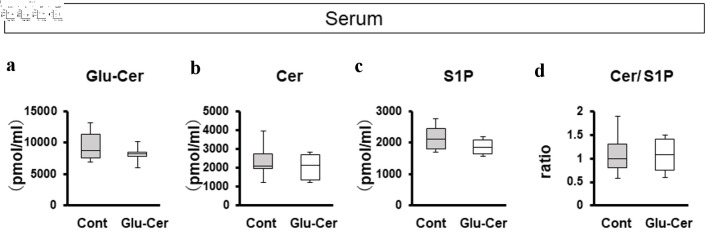
Oral administration of glucosylceramide significantly suppressed E0771 tumor growth compared with the control group (P = 0.006). There were no significant differences in the serum concentrations of sphingolipid mediators including ceramide and S1P between the mice treated with glucosylceramide and control-treated mice. The ceramide concentration was significantly lower in tumor tissues (P = 0.026), and the S1P concentration was significantly higher than that in paired non-tumor tissues (P = 0.009). The S1P concentration in tumor tissues was significantly lower in mice treated with glucosylceramide than in control-treated mice (P = 0.001). The ceramide-to-S1P concentration ratio in tumor tissues was significantly higher in mice treated with glucosylceramide than in control-treated mice (P = 0.034).
Breast tumors could enhance their survival by increasing S1P conversion from ceramide. Oral administration of glucosylceramide suppressed tumor growth by affecting the ceramide/S1P balance. Oral administration of glucosylceramide is a promising basis for a new therapeutic approach.
神经酰胺和1-磷酸鞘氨醇(S1P)在细胞死亡和存活中发挥相反作用,并维持一种称为鞘脂变阻器的动态平衡。葡萄糖神经酰胺是生成神经酰胺的底物,但其口服给药对乳腺癌的影响从未得到测试。本研究的目的是揭示葡萄糖神经酰胺的抗癌活性及其作为乳腺癌新治疗药物的潜力。
将E0771细胞接种到雌性C57BL/6NJcl小鼠的乳腺组织中。连续九天给小鼠口服葡萄糖神经酰胺。通过质谱法测定肿瘤组织和血清中包括神经酰胺、葡萄糖神经酰胺和S1P在内的鞘脂介质浓度。
与对照组相比,口服葡萄糖神经酰胺显著抑制了E0771肿瘤生长(P = 0.006)。在接受葡萄糖神经酰胺治疗的小鼠和接受对照治疗的小鼠之间,包括神经酰胺和S1P在内的鞘脂介质血清浓度没有显著差异。肿瘤组织中的神经酰胺浓度显著较低(P = 0.026),S1P浓度显著高于配对的非肿瘤组织(P = 0.009)。接受葡萄糖神经酰胺治疗的小鼠肿瘤组织中的S1P浓度显著低于接受对照治疗的小鼠(P = 0.001)。接受葡萄糖神经酰胺治疗的小鼠肿瘤组织中的神经酰胺与S1P浓度比显著高于接受对照治疗的小鼠(P = 0.034)。
乳腺肿瘤可通过增加神经酰胺向S1P的转化来提高其存活率。口服葡萄糖神经酰胺通过影响神经酰胺/S1P平衡抑制肿瘤生长。口服葡萄糖神经酰胺是一种有前景的新治疗方法的基础。