Department of Molecular Biology and Human Genetics, Tzu-Chi University, Hualien 97004, Taiwan.
Institute of Medical Sciences, Tzu-Chi University, Hualien 97004, Taiwan.
Int J Mol Sci. 2023 Jul 1;24(13):10995. doi: 10.3390/ijms241310995.
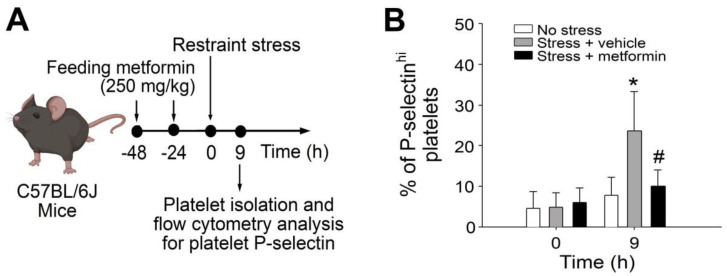
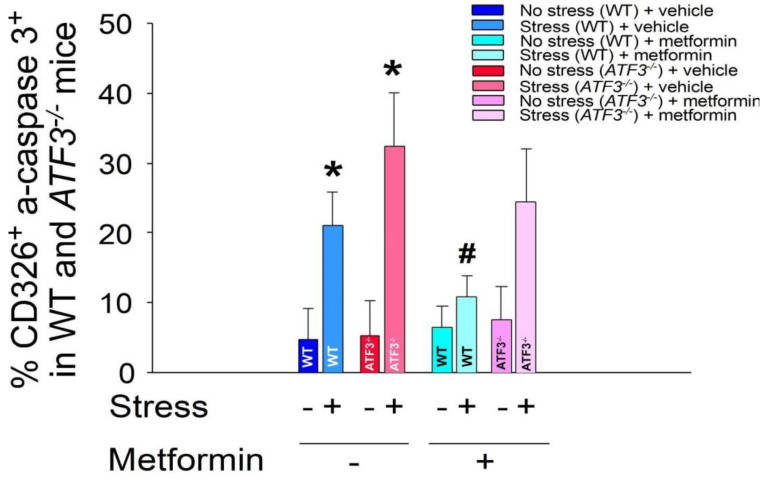
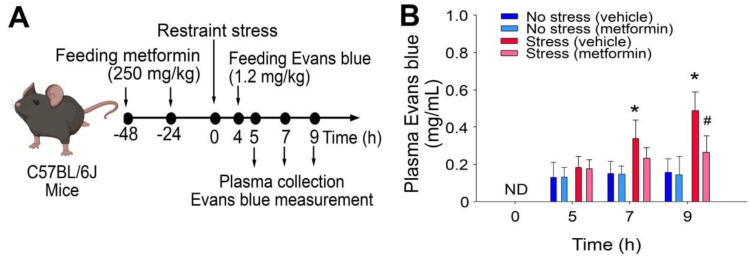
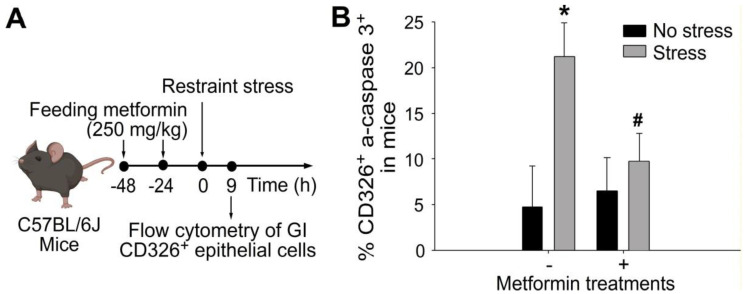
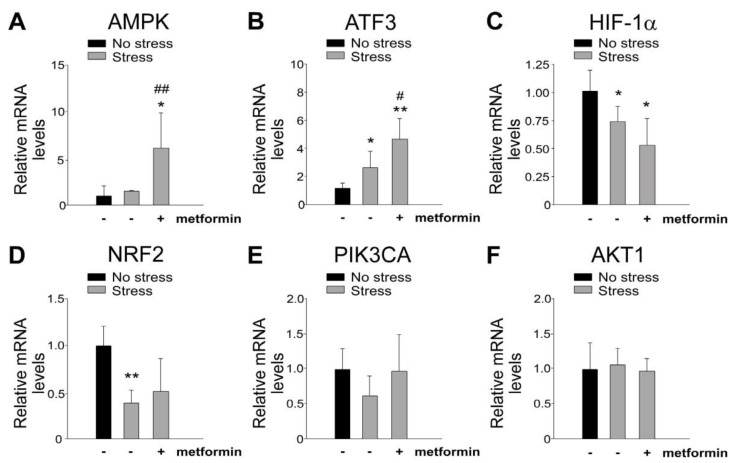
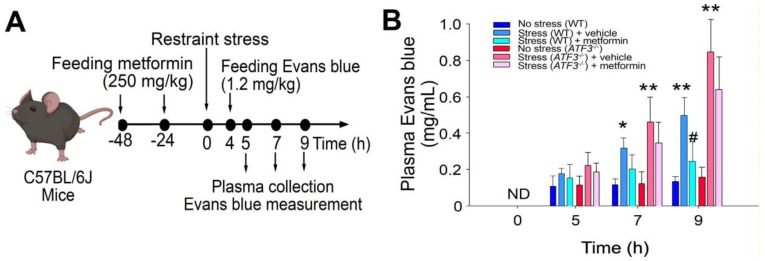
Metformin is one of the most commonly used drugs for type 2 diabetes mellitus. In addition to its anti-diabetic property, evidence suggests more potential applications for metformin, such as antiaging, cellular protection, and anti-inflammation. Studies have reported that metformin activates pathways with anti-inflammatory effects, enhances the integrity of gut epithelial tight junctions, and promotes a healthy gut microbiome. These actions contribute to the protective effect of metformin against gastrointestinal (GI) tract injury. However, whether metformin plays a protective role in psychological-stress-associated GI tract injury remains elusive. We aim to elucidate the potential protective effect of metformin on the GI system and develop an effective intervention strategy to counteract GI injury induced by acute psychological stress. By monitoring the levels of GI-nonabsorbable Evans blue dye in the bloodstream, we assessed the progression of GI injury in live mice. Our findings demonstrate that the administration of metformin effectively mitigated GI leakage caused by psychological stress. The GI protective effect of metformin is more potent when used on wild-type mice than on activating-transcription-factor 3 (ATF3)-deficient () mice. As such, metformin-mediated rescue was conducted in an ATF3-dependent manner. In addition, metformin-mediated protection is associated with the induction of stress-induced GI mRNA expressions of the stress-induced genes ATF3 and AMP-activated protein kinase. Furthermore, metformin treatment-mediated protection of CD326 GI epithelial cells against stress-induced apoptotic cell death was observed in wild-type but not in mice. These results suggest that metformin plays a protective role in stress-induced GI injury and that ATF3 is an essential regulator for metformin-mediated rescue of stress-induced GI tract injury.
二甲双胍是治疗 2 型糖尿病最常用的药物之一。除了其抗糖尿病作用外,有证据表明二甲双胍可能具有更多的潜在应用,如抗衰老、细胞保护和抗炎作用。研究报告称,二甲双胍激活具有抗炎作用的途径,增强肠道上皮紧密连接的完整性,并促进健康的肠道微生物组。这些作用有助于二甲双胍对胃肠道(GI)损伤的保护作用。然而,二甲双胍是否在心理应激相关的胃肠道损伤中发挥保护作用仍不清楚。我们旨在阐明二甲双胍对胃肠道系统的潜在保护作用,并开发一种有效的干预策略来对抗急性心理应激引起的胃肠道损伤。通过监测血流中胃肠道不可吸收的 Evans 蓝染料水平,我们评估了活鼠胃肠道损伤的进展。我们的研究结果表明,二甲双胍的给药有效减轻了心理应激引起的胃肠道渗漏。与 ATF3 缺陷型()小鼠相比,二甲双胍在野生型小鼠中对胃肠道的保护作用更强。因此,二甲双胍介导的拯救是通过 ATF3 依赖的方式进行的。此外,与应激诱导的基因 ATF3 和 AMP 激活蛋白激酶的应激诱导的胃肠道 mRNA 表达相关,二甲双胍介导的保护作用。此外,在野生型但不是在 小鼠中观察到二甲双胍治疗对 CD326 胃肠道上皮细胞应激诱导的凋亡细胞死亡的保护作用。这些结果表明,二甲双胍在应激诱导的胃肠道损伤中发挥保护作用,ATF3 是二甲双胍介导的应激诱导的胃肠道损伤恢复的重要调节剂。