AlzeCure Pharma AB, Hälsovägen 7, 141 57 Huddinge, Sweden.
Division of Neuroscience, Care and Society, Department of Neurogeriatrics, Karolinska Institutet, 171 77 Solna, Sweden.
Int J Mol Sci. 2023 Jul 6;24(13):11159. doi: 10.3390/ijms241311159.
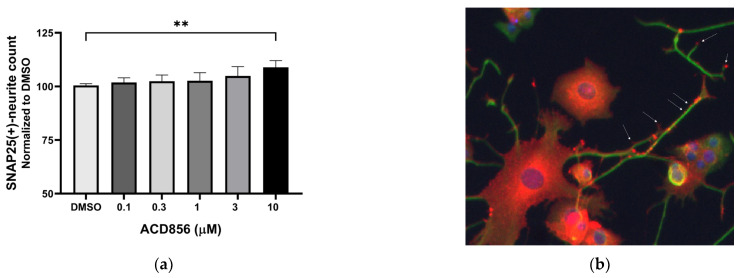
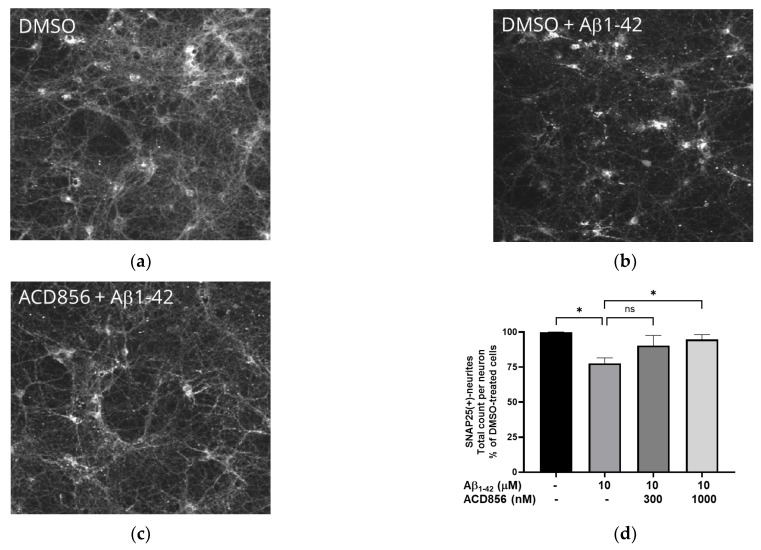
The introduction of anti-amyloid monoclonal antibodies against Alzheimer's disease (AD) is of high importance. However, even though treated patients show very little amyloid pathology, there is only a modest effect on the rate of cognitive decline. Although this effect can possibly increase over time, there is still a need for alternative treatments that will improve cognitive function in patients with AD. Therefore, the purpose of this study was to characterize the triazinetrione ACD856, a novel pan-Trk positive allosteric modulator, in multiple models to address its neuroprotective and potential disease-modifying effects. The pharmacological effect of ACD856 was tested in recombinant cell lines, primary cortical neurons, or animals. We demonstrate that ACD856 enhanced NGF-induced neurite outgrowth, increased the levels of the pre-synaptic protein SNAP25 in PC12 cells, and increased the degree of phosphorylated TrkB in SH-SY5Y cells. In primary cortical neurons, ACD856 led to increased levels of phospho-ERK1/2, showed a neuroprotective effect against amyloid-beta or energy-deprivation-induced neurotoxicity, and increased the levels of brain-derived neurotrophic factor (BDNF). Consequently, administration of ACD856 resulted in a significant increase in BDNF in the brains of 21 months old mice. Furthermore, repeated administration of ACD856 resulted in a sustained anti-depressant effect, which lasted up to seven days, suggesting effects that go beyond merely symptomatic effects. In conclusion, the results confirm ACD856 as a cognitive enhancer, but more importantly, they provide substantial in vitro and in vivo evidence of neuroprotective and long-term effects that contribute to neurotrophic support and increased neuroplasticity. Presumably, the described effects of ACD856 may improve cognition, increase resilience, and promote neurorestorative processes, thereby leading to a healthier brain in patients with AD.
抗淀粉样蛋白单克隆抗体治疗阿尔茨海默病(AD)具有重要意义。然而,尽管接受治疗的患者淀粉样蛋白病理变化很小,但认知能力下降的速度只有适度的改善。虽然这种效果可能会随着时间的推移而增加,但仍需要其他治疗方法来改善 AD 患者的认知功能。因此,本研究的目的是表征新型泛 Trk 正变构调节剂三嗪酮 ACD856,以确定其在多种模型中的神经保护和潜在的疾病修饰作用。在重组细胞系、原代皮质神经元或动物中测试了 ACD856 的药理作用。我们证明 ACD856 增强了 NGF 诱导的神经突生长,增加了 PC12 细胞中突触前蛋白 SNAP25 的水平,并增加了 SH-SY5Y 细胞中磷酸化 TrkB 的程度。在原代皮质神经元中,ACD856 导致磷酸化 ERK1/2 水平升高,对淀粉样β或能量剥夺诱导的神经毒性具有神经保护作用,并增加脑源性神经营养因子(BDNF)的水平。因此,ACD856 的给药导致 21 个月大的小鼠大脑中的 BDNF 水平显著增加。此外,重复给予 ACD856 导致持续的抗抑郁作用,持续时间长达七天,表明其作用不仅限于症状缓解。总之,这些结果证实了 ACD856 作为认知增强剂的作用,但更重要的是,它们提供了大量的体外和体内证据,证明了其具有神经保护和长期作用,有助于神经营养支持和增加神经可塑性。据推测,ACD856 的描述作用可能改善认知、提高韧性并促进神经修复过程,从而使 AD 患者的大脑更健康。