Tuo Dengfeng, Lu Qi, Wu Bo, Li Qiang, Yao Bin, Cheng Leilei, Zhu Jinlei
Institute of Ecological Conservation and Restoration, Chinese Academy of Forestry, Beijing 100091, China.
Institute of Desertification Studies, Chinese Academy of Forestry, Beijing 100091, China.
Plants (Basel). 2023 Jul 6;12(13):2568. doi: 10.3390/plants12132568.
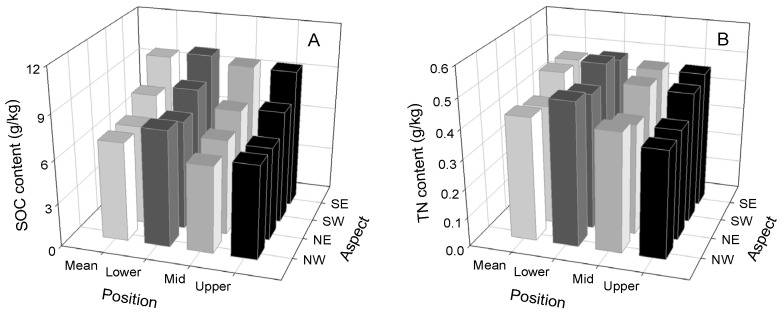
Wind and water erosion processes can lead to soil degradation. Topographic factors also affect the variation of soil properties. The effect of topographic factors on soil properties in regions where wind and water erosion simultaneously occur remains complicated. To address this effect, we conducted this study to determine the relationships between the changes in wind-water erosion and soil properties in different topographic contexts. We collected soil samples from conical landforms with different slope characteristics and positions in the wind-water erosion crisscross region of China. We examined the soil Cs inventory, soil organic carbon (SOC), total nitrogen (TN), soil particles, soil water content (SWC), and biomass. Cs was applied to estimate soil erosion. The results show that the soil erosion rate followed the order of northwest slope > southwest slope > northeast slope > southeast slope. The soil erosion rate on the northwest slope was about 12.06-58.47% higher than on the other. Along the slopes, the soil erosion rate decreased from the upper to the lower regions, and was 65.65% higher at the upper slope than at the lower one. The change in soil erosion rate was closely related to soil properties. The contents of SOC, TN, clay, silt, SWC, and biomass on the northern slopes (northwest and northeast slopes) were lower than those on the southern slopes (southeast and southwest slopes), and they were lower at the upper slope than at the lower one. Redundancy analysis showed that the variation in soil properties was primarily affected by the slope aspect, and less affected by soil erosion, accounting for 56.1% and 30.9%, respectively. The results demonstrate that wind-water erosion accelerates the impact of topographic factors on soil properties under slope conditions. Our research improves our understanding of the mechanisms of soil degradation in gully regions where wind and water erosion simultaneously occur.
风和水的侵蚀过程会导致土壤退化。地形因素也会影响土壤性质的变化。在风和水侵蚀同时发生的地区,地形因素对土壤性质的影响仍然很复杂。为了研究这种影响,我们开展了本研究,以确定在不同地形背景下,风水侵蚀变化与土壤性质之间的关系。我们在中国风水侵蚀交错区,从具有不同坡度特征和位置的锥形地貌上采集了土壤样本。我们检测了土壤铯储量、土壤有机碳(SOC)、总氮(TN)、土壤颗粒、土壤含水量(SWC)和生物量。铯被用于估算土壤侵蚀。结果表明,土壤侵蚀速率的顺序为西北坡>西南坡>东北坡>东南坡。西北坡的土壤侵蚀速率比其他坡大约高12.06 - 58.47%。沿坡面,土壤侵蚀速率从上部到下部区域降低,上坡的侵蚀速率比下坡高65.65%。土壤侵蚀速率的变化与土壤性质密切相关。北坡(西北坡和东北坡)的SOC、TN、黏土、粉砂、SWC和生物量含量低于南坡(东南坡和西南坡),且上坡低于下坡。冗余分析表明,土壤性质的变化主要受坡向影响,受土壤侵蚀的影响较小,分别占56.1%和30.9%。结果表明,在坡面条件下,风水侵蚀加速了地形因素对土壤性质的影响。我们的研究增进了我们对风和水侵蚀同时发生的沟壑区土壤退化机制的理解。