Department of Laboratory Medicine and Pathology, Faculty of Health Sciences, Walter Sisulu University, Mthatha 5100, Eastern Cape, South Africa.
College of Graduate Studies, University of South Africa, Pretoria 0001, Gauteng, South Africa.
Nutrients. 2023 Jul 2;15(13):3017. doi: 10.3390/nu15133017.
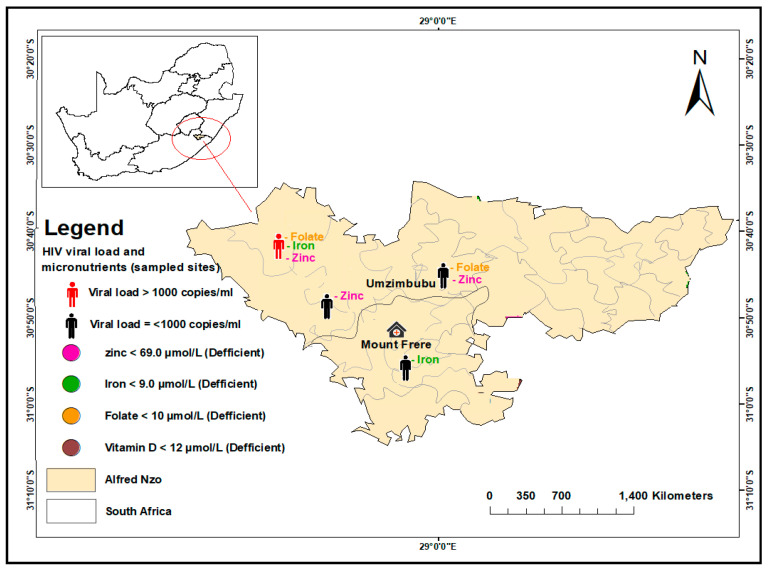
Human immunodeficiency virus (HIV)/acquired immune deficiency syndrome (AIDS) leads to immune suppression, and micronutrients play vital roles in human immune responses. Hence, this study aimed to evaluate the effects of viral load suppression in adult HIV-infected patients receiving antiretroviral therapy (ART) on micronutrient deficiency and its prevalence in selected rural districts in the Eastern Cape Province of South Africa. This cross-sectional study was conducted from February 2019 to February 2021 among 50 consenting HIV-infected patients attending community health centers within the three selected districts. The data were analysed with ArcGIS v.10.8 to create geospatial maps; the Global Positioning System (GPS) for analysis and presentation; and SPSS version 25 for inferential statistics involving the -test and Fisher's exact test, with the level of significance set at < 0.05. Of the 50 participants, a significant difference of = 0.003 was observed in mean age among viral load-suppressed (42.9 ± 8.89 years) and unsuppressed (32 ± 6.3 years). In addition, significant differences in the mean viral load and CD4 counts ( < 0.05) were seen. Only iron micronutrient showed a statistically significant difference ( < 0.001) between the viral load-suppressed group (mean 14.8, SD 6.1) and the unsuppressed group (mean 8.1, SD 1.6). Of the 38 individuals from the OR Tambo district, overall micronutrient deficiency was 60.5% (13 (34.2%) deficient for zinc, 9 (23.7%) deficient for iron, 5 (13.2%) for folate, and 1 (2.63%) for vitamin D). In all three study districts, deficiencies in zinc, iron, and folate micronutrients exceeded 25%, particularly in those with an unsuppressed viral load. To address these micronutrient deficiencies, people living with HIV (PLHIV) require robust nutritional supplementation programs.
人类免疫缺陷病毒 (HIV)/获得性免疫缺陷综合征 (AIDS) 可导致免疫抑制,而微量营养素在人体免疫反应中起着至关重要的作用。因此,本研究旨在评估接受抗逆转录病毒疗法 (ART) 的成年 HIV 感染患者病毒载量抑制对南非东开普省选定农村地区微量营养素缺乏及其流行率的影响。这项横断面研究于 2019 年 2 月至 2021 年 2 月期间在三个选定地区的社区卫生中心就诊的 50 名同意参与的 HIV 感染患者中进行。数据使用 ArcGIS v.10.8 进行分析以创建地理空间地图;全球定位系统 (GPS) 用于分析和呈现;以及 SPSS 版本 25 进行推断统计,包括检验和 Fisher 精确检验,显著性水平设为 < 0.05。在 50 名参与者中,病毒载量抑制组(42.9 ± 8.89 岁)和未抑制组(32 ± 6.3 岁)的平均年龄差异有统计学意义(= 0.003)。此外,病毒载量和 CD4 计数的平均值也存在显著差异(< 0.05)。只有铁微量营养素在病毒载量抑制组(平均 14.8,SD 6.1)和未抑制组(平均 8.1,SD 1.6)之间存在统计学显著差异(< 0.001)。在奥坦博地区的 38 名个体中,总体微量营养素缺乏率为 60.5%(13 人(34.2%)缺锌,9 人(23.7%)缺铁,5 人(13.2%)缺叶酸,1 人(2.63%)缺维生素 D)。在所有三个研究地区,锌、铁和叶酸微量营养素的缺乏率均超过 25%,尤其是在病毒载量未得到抑制的人群中。为了解决这些微量营养素缺乏问题,艾滋病毒感染者需要强有力的营养补充计划。