College of Health Science, Debre Markos University, Debre Markos, Ethiopia.
School of Public Health, Faculty of Health, University of Technology Sydney, Ultimo, New South Wales, Australia.
PLoS One. 2022 Mar 7;17(3):e0264843. doi: 10.1371/journal.pone.0264843. eCollection 2022.
Opportunistic infections (OIs) are the leading causes of hospitalization, morbidity, and mortality (accounting for 94.1% of all deaths) in people living with human immunodeficiency virus (PLHIV). Despite evidence suggested that undernutrition significantly increases the risk of OIs in PLHIV, to our knowledge, no study has examined the actual effects of undernutrition on OIs in this population, particularly in low-income countries. Thus, this study examined the effects of undernutrition on OIs in adults living with HIV receiving antiretroviral therapy (ART).
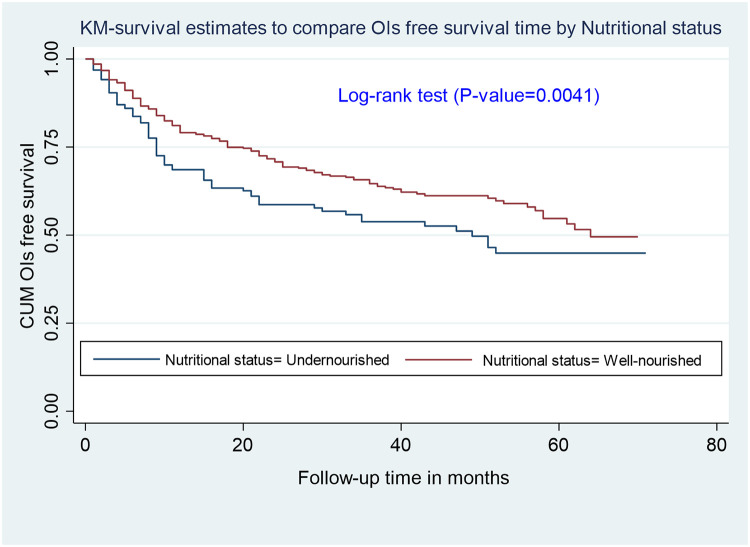
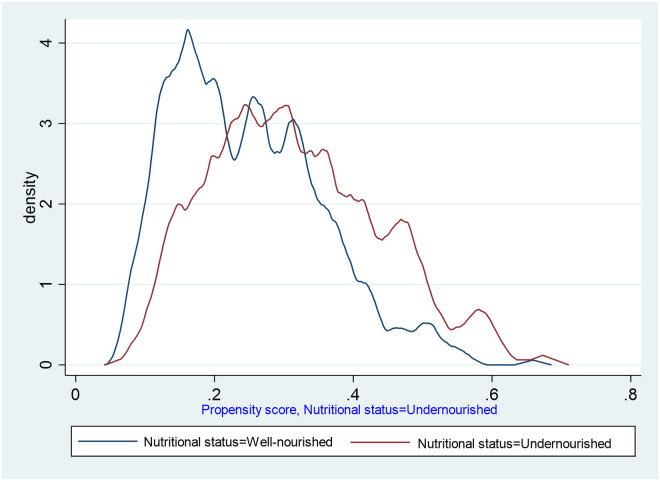
We conducted a retrospective cohort study among 841adults living with HIV receiving ART between June 2014 and June 2020 at Debre Markos Comprehensive Specialized Hospital, Northwest Ethiopia. Study participants were selected using a simple random sampling technique. Data from participants' medical records were extracted using a project-specific data extraction checklist. The Kaplan Meier survival curve estimated the OIs free survival time. The effects of undernutrition on time to develop OIs was estimated using inverse-probability weighting. Finally, regression coefficients with 95% confidence intervals (95% CIs) were reported, with a statistical significance of p < 0.05.
Of 841 study participants, 262 (31.2%) developed OIs, and the overall incidence rate was 16.7 (95% CI: 14.8, 18.8) per 100 person-years. The incWidence of OIs in undernourished participants (21/100 person-years, 95% CI: 17.8, 27.4) was higher than well-nourished participants (15.0/100 person-years, 95% CI: 12.9, 17.4). When everyone in the population of interest is well-nourished, average time to develop OIs is estimated as 26.5 (coefficient: 26.5, 95% CI: 20.6, 32.4, p < 0.001) months. When everyone in the population of interest is undernourished, average time to develop OIs is estimated as 17.7 (95% CI: 12.8, 22.6) months. However, when everyone is undernourished, average time to develop OIs decreases by 8.8 (coefficient: -8.8, 95% CI: -16.6, -1.0, p = 0.026) months. Lastly, exposure to undernourishment (intervention) (ratio of average treatment effects to well-nourished potential outcome means in this study was a 32.5% reduction in OIs among adults living with HIV on ART.
We found that undernutrition significantly shortened time to develop OIs in adults living with HIV. This implies that the occurrence of OIs in this vulnerable population can be improved through different cost-effective nutritional interventions, such as routine nutritional assessments and education.
机会性感染(OIs)是导致感染人类免疫缺陷病毒(PLHIV)的人住院、发病和死亡的主要原因(占所有死亡人数的 94.1%)。尽管有证据表明营养不良显著增加了 PLHIV 发生 OIs 的风险,但据我们所知,尚无研究在这一人群中,特别是在低收入国家,实际研究营养不良对 OIs 的影响。因此,本研究旨在探讨营养不良对接受抗逆转录病毒治疗(ART)的 HIV 感染者 OIs 的影响。
我们在 2014 年 6 月至 2020 年 6 月期间,在埃塞俄比亚西北部德布雷马克罗斯综合专科医院对 841 名接受 ART 的 HIV 感染者进行了回顾性队列研究。采用简单随机抽样技术选择研究参与者。使用特定于项目的数据提取清单从参与者的病历中提取数据。Kaplan-Meier 生存曲线估计了 OIs 无事件生存时间。采用逆概率加权法估计营养不良对发生 OIs 时间的影响。最后,报告了具有 95%置信区间(95%CI)的回归系数,统计学意义为 p < 0.05。
在 841 名研究参与者中,有 262 名(31.2%)发生了 OIs,总发生率为 16.7(95%CI:14.8,18.8)/100 人年。营养不良参与者的 OIs 发生率(21/100 人年,95%CI:17.8,27.4)高于营养良好参与者(15.0/100 人年,95%CI:12.9,17.4)。当感兴趣的人群中的每个人都营养良好时,估计发生 OIs 的平均时间为 26.5 个月(系数:26.5,95%CI:20.6,32.4,p < 0.001)。当感兴趣的人群中的每个人都营养不良时,估计发生 OIs 的平均时间为 17.7 个月(95%CI:12.8,22.6)。然而,当每个人都营养不良时,发生 OIs 的平均时间减少了 8.8 个月(系数:-8.8,95%CI:-16.6,-1.0,p = 0.026)。最后,营养不良的暴露(干预)(本研究中平均治疗效果与营养良好的潜在结果平均值的比值为 32.5%,这意味着接受 ART 的 HIV 感染者的 OIs 发生风险降低了 32.5%。
我们发现营养不良显著缩短了 HIV 感染者发生 OIs 的时间。这意味着,通过不同的具有成本效益的营养干预措施,如常规营养评估和教育,可以改善这一脆弱人群中 OIs 的发生。