Department of Electrical, Computer and Biomedical Engineering, Toronto Metropolitan University, Toronto, ON M5B 2K3, Canada.
Department of Computer Science and Engineering, American University of Ras Al Khaimah, Ras al Khaimah P.O. Box 10021, United Arab Emirates.
Sensors (Basel). 2023 Jul 2;23(13):6095. doi: 10.3390/s23136095.
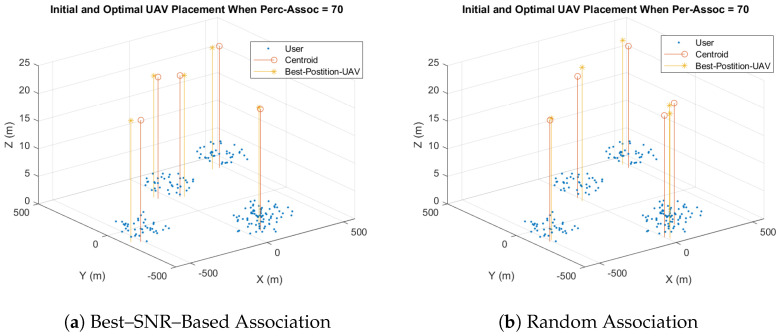
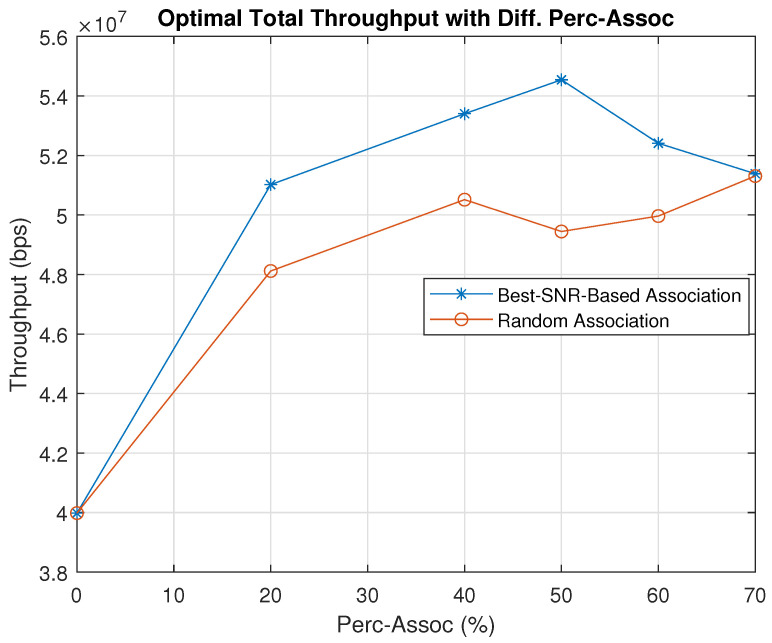
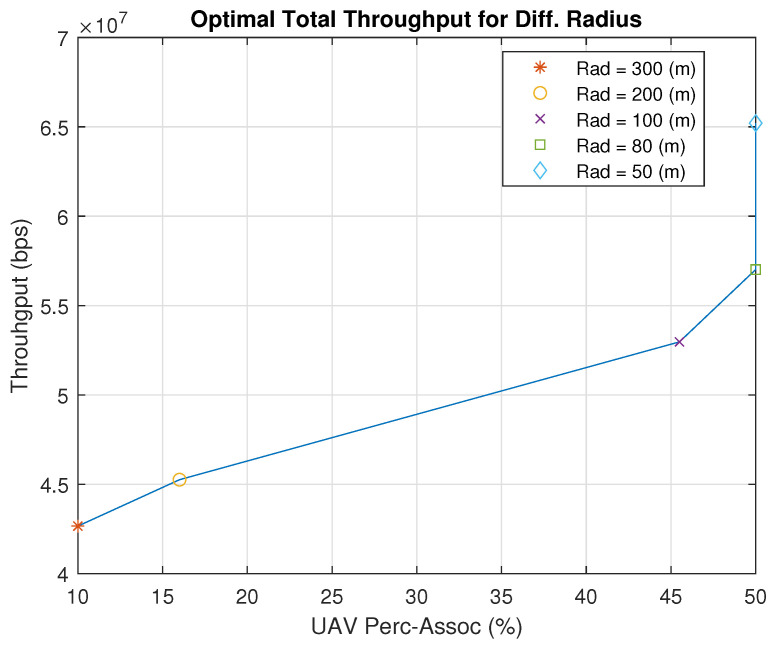
In this paper, a collaboration scheme between a high-altitude platform (HAP) and several unmanned aerial vehicles (UAVs) for wireless communication networks is investigated. The main objective of this study is to maximize the total downlink throughput of the ground users by optimizing the UAVs' three-dimensional (3D) placements and user associations. An optimization problem is formulated and a separate genetic-algorithm-based approach is proposed to solve the problem. The K-means algorithm is also utilized to find the initial UAV placement to reduce the convergence time of the proposed genetic-algorithm-based allocation. The performance of the proposed algorithm is analyzed in terms of convergence time, complexity, and fairness. Finally, the simulation results show that the proposed HAP-UAV integrated network achieves a higher total throughput through joint user association and UAV placement schemes compared to a scheme with a single HAP serving all users.
在本文中,研究了高空平台 (HAP) 和多个无人机 (UAV) 之间用于无线通信网络的协作方案。本研究的主要目的是通过优化 UAV 的三维 (3D) 位置和用户关联来最大化地面用户的总下行链路吞吐量。本文提出了一个优化问题,并提出了一种基于遗传算法的单独方法来解决该问题。K-means 算法也被用来找到初始的 UAV 位置,以减少基于遗传算法的分配的收敛时间。所提出算法的性能在收敛时间、复杂度和公平性方面进行了分析。最后,仿真结果表明,与单个 HAP 为所有用户服务的方案相比,所提出的 HAP-UAV 集成网络通过联合用户关联和 UAV 放置方案实现了更高的总吞吐量。