Centrum Wiskunde & Informatica, Science Park 123, 1098 XG Amsterdam, The Netherlands.
Mathematical Institute, Utrecht University, 3584 CS Utrecht, The Netherlands.
Sensors (Basel). 2023 Jul 5;23(13):6179. doi: 10.3390/s23136179.
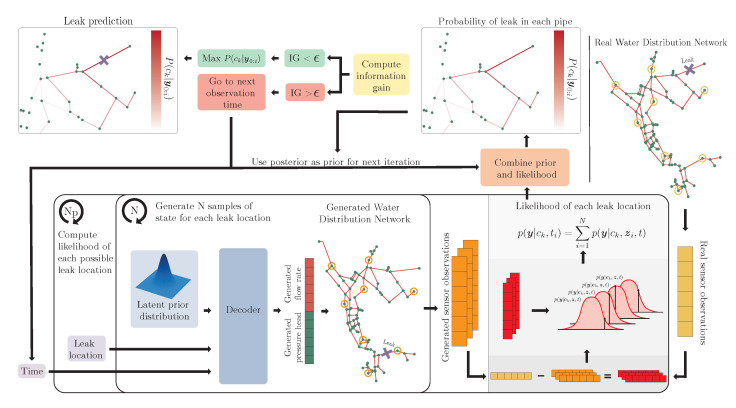
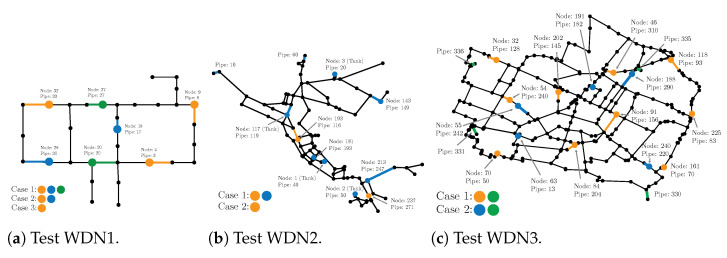
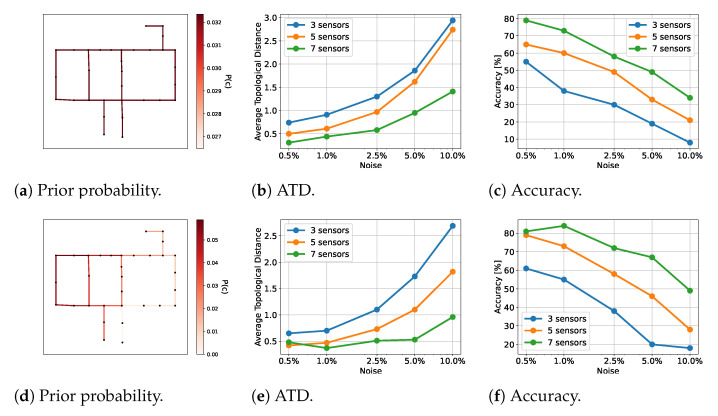
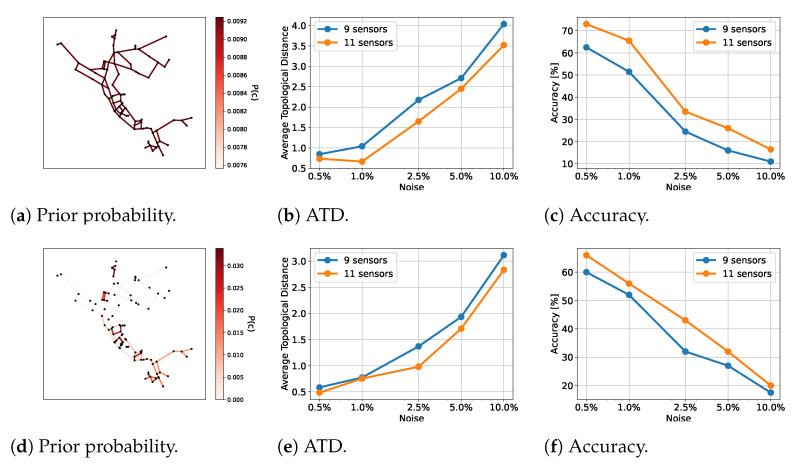
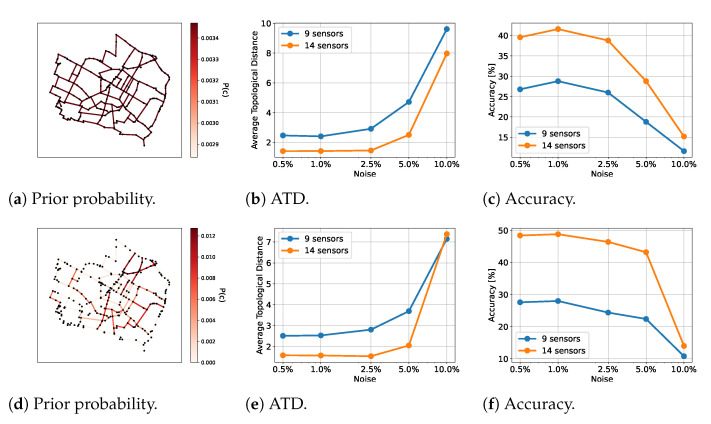
Localizing leakages in large water distribution systems is an important and ever-present problem. Due to the complexity originating from water pipeline networks, too few sensors, and noisy measurements, this is a highly challenging problem to solve. In this work, we present a methodology based on generative deep learning and Bayesian inference for leak localization with uncertainty quantification. A generative model, utilizing deep neural networks, serves as a probabilistic surrogate model that replaces the full equations, while at the same time also incorporating the uncertainty inherent in such models. By embedding this surrogate model into a Bayesian inference scheme, leaks are located by combining sensor observations with a model output approximating the true posterior distribution for possible leak locations. We show that our methodology enables producing fast, accurate, and trustworthy results. It showed a convincing performance on three problems with increasing complexity. For a simple test case, the Hanoi network, the average topological distance (ATD) between the predicted and true leak location ranged from 0.3 to 3 with a varying number of sensors and level of measurement noise. For two more complex test cases, the ATD ranged from 0.75 to 4 and from 1.5 to 10, respectively. Furthermore, accuracies upwards of 83%, 72%, and 42% were achieved for the three test cases, respectively. The computation times ranged from 0.1 to 13 s, depending on the size of the neural network employed. This work serves as an example of a digital twin for a sophisticated application of advanced mathematical and deep learning techniques in the area of leak detection.
本地化大型供水管网的泄漏是一个重要且普遍存在的问题。由于源自供水管网的复杂性、传感器太少以及测量噪声大,这是一个极具挑战性的问题。在这项工作中,我们提出了一种基于生成式深度学习和贝叶斯推断的方法,用于进行具有不确定性量化的泄漏定位。生成式模型利用深度神经网络作为概率替代模型来替代完整的方程,同时也包含了这些模型固有的不确定性。通过将这个替代模型嵌入到贝叶斯推断方案中,我们通过将传感器观测值与模型输出相结合来定位泄漏,模型输出近似于可能泄漏位置的真实后验分布。我们表明,我们的方法能够产生快速、准确和可靠的结果。它在三个具有递增复杂性的问题上表现出令人信服的性能。对于一个简单的测试案例,即河内网络,预测和真实泄漏位置之间的平均拓扑距离(ATD)在不同数量的传感器和测量噪声水平下从 0.3 到 3 不等。对于另外两个更复杂的测试案例,ATD 分别从 0.75 到 4 和从 1.5 到 10 不等。此外,三个测试案例的准确率分别高达 83%、72%和 42%。计算时间取决于所使用的神经网络的大小,范围从 0.1 到 13 秒不等。这项工作是一个数字孪生的示例,用于在泄漏检测领域中复杂应用高级数学和深度学习技术。