Michaux Lionel, Perrier Alexandre, Mehlman Camille, Alshehhi Hussa, Dubois Antonin, Lacave Roger, Coulet Florence, Cadranel Jacques, Fallet Vincent
Department of Pulmonology and Thoracic Oncology, Assistance Publique Hôpitaux de Paris, Hôpital Tenon and Groupe de Recherche Clinique 4 (GRC 4), Theranoscan, Sorbonne Université, Paris, France.
Genetics Department, Assistance Publique Hôpitaux de Paris, Hôpital de la Pitié-Salpêtrière and Sorbonne Université, Paris, France.
Front Oncol. 2023 Jun 28;13:1182558. doi: 10.3389/fonc.2023.1182558. eCollection 2023.
ALK tyrosine kinase inhibitors (ALK TKIs) have improved prognosis in -rearranged ( ) non-small-cell lung cancer (NSCLC). However, drug resistance mechanisms occur inevitably during the course of treatment leading to disease progression. Activation of epidermal growth factor receptor (EGFR) bypass signaling pathway is an uncommon cause of acquired resistance to ALK TKIs.
We present two patients with rearranged NSCLC, developing an acquired resistance mutation after receiving multiple lines of ALK TKIs.
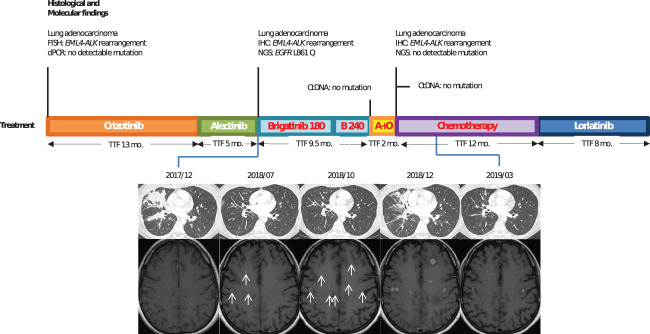
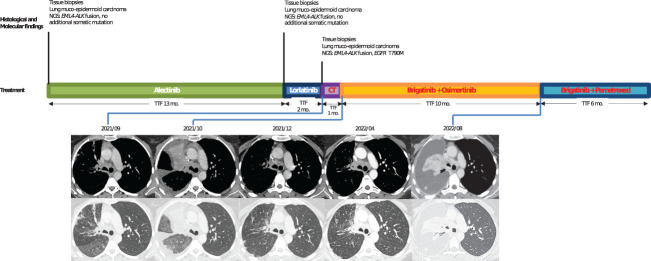
While preclinical models have showed encouraging data, there is a critical need for clinical studies on treatment strategies to overcome this drug resistance. Three real-life therapeutic approaches were used in this report: i) using brigatinib, an inhibitor targeting both ALK and EGFR tyrosine kinases; ii) combining two ALK TKIs together; and iii) delivering doublet platinum chemotherapy. In case 1, time to treatment failure (TTF) was 9.5 months with brigatinib; in case 2, TTF was 10 months with combined TKIs (osimertinib and brigatinib), whereas TTF with chemotherapy was only 2 months. Tolerability profile TKIs combotherapy was acceptable.
These case reports underline the therapeutic complexity of -acquired resistance mutation in NSCLC and offers some leads to solve this real-life clinical challenge.
间变性淋巴瘤激酶(ALK)酪氨酸激酶抑制剂(ALK TKIs)改善了ALK重排(ALK+)非小细胞肺癌(NSCLC)的预后。然而,治疗过程中不可避免地会出现耐药机制,导致疾病进展。表皮生长因子受体(EGFR)旁路信号通路的激活是ALK TKIs获得性耐药的罕见原因。
我们报告了2例ALK重排NSCLC患者,在接受多线ALK TKIs治疗后出现获得性ALK耐药突变。
虽然临床前模型已显示出令人鼓舞的数据,但迫切需要开展关于克服这种耐药性的治疗策略的临床研究。本报告采用了三种实际治疗方法:i)使用布加替尼,一种同时靶向ALK和EGFR酪氨酸激酶的抑制剂;ii)将两种ALK TKIs联合使用;iii)给予双联铂类化疗。病例1中,使用布加替尼的治疗失败时间(TTF)为9.5个月;病例2中,联合使用TKIs(奥希替尼和布加替尼)的TTF为10个月,而化疗的TTF仅为2个月。联合使用TKIs的耐受性良好。
这些病例报告强调了ALK+ NSCLC中获得性ALK耐药突变的治疗复杂性,并为解决这一实际临床挑战提供了一些线索。