Patel Evan A, Poulson Trevor A, Shah Manushi, Jagasia Ashok A
Department of Otolaryngology-Head and Neck Surgery Rush University Medical Center Chicago Illinois USA.
OTO Open. 2023 Jul 12;7(3):e63. doi: 10.1002/oto2.63. eCollection 2023 Jul-Sep.
The objective of this study was to quantify the wait times that patients may encounter for common clinical diagnoses when seeking otolaryngology care, while determining whether a wait time disparity exists based on geographic location within Illinois.
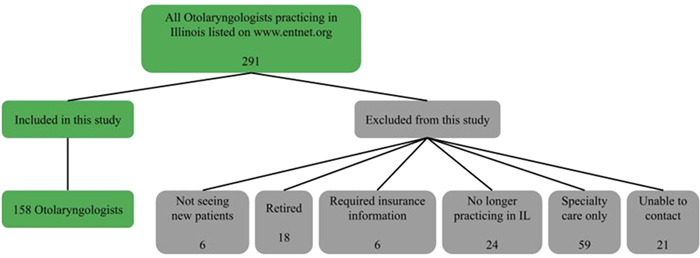
In November 2022, a list of Illinois otolaryngologists was obtained from www.entnet.org. Using a uniform script, each of the 291 otolaryngologists were contacted. The caller posed as a new patient with either sudden sensorineural hearing loss, a neck mass, or chronic sinusitis. Each clinic was called 3 times and wait times were recorded. One hundred fifty-eight otolaryngologists were included in the analysis.
The average statewide wait time for a new patient presenting with sudden unilateral hearing loss, a neck mass, and chronic sinusitis was 18.0, 22.6, and 25.5 days, respectively. There was no statistically significant difference between urban and rural wait times.
Although wait time differences were noted, the lack of urban versus rural value significance may be attributed to the small sample size ( = 11) of rural otolaryngologists in Illinois. However, the overall wait times in this study were longer compared to those reported in other studies, suggesting that the current number of otolaryngologists in Illinois is inadequate to meet the public need.
We have demonstrated that the current demand for otolaryngology care is outstripping the existing supply in Illinois. This suggests that an emphasis should be placed on training more otolaryngologists, or increasing the use of physician extenders, while incentivizing otolaryngologists to practice in rural areas.
本研究的目的是量化患者在寻求耳鼻喉科护理时,对于常见临床诊断可能遇到的等待时间,同时确定伊利诺伊州内是否存在基于地理位置的等待时间差异。
全州范围内,新患者出现突发性单侧听力损失、颈部肿块和慢性鼻窦炎的平均等待时间分别为18.0天、22.6天和25.5天。城乡等待时间之间没有统计学上的显著差异。
尽管注意到了等待时间的差异,但城乡差异缺乏统计学意义可能归因于伊利诺伊州农村耳鼻喉科医生的样本量较小(n = 11)。然而,与其他研究报告的等待时间相比,本研究中的总体等待时间更长,这表明伊利诺伊州目前的耳鼻喉科医生数量不足以满足公众需求。
我们已经证明,伊利诺伊州目前对耳鼻喉科护理的需求超过了现有供应。这表明应强调培训更多的耳鼻喉科医生,或增加使用医师助理,同时激励耳鼻喉科医生在农村地区执业。
5级。