de Oliveira Lucian Batista, de Figueiredo Martins Siqueira Mariana Andrade, de Macedo Gadêlha Rafael Buarque, Barreto Beatriz Pontes, Correia Alice Rodrigues Pimentel, Leão Vinicius Belfort, Garcia Jessica, Bandeira Francisco
Division of Endocrinology and Diabetes, Agamenon Magalhães Hospital, University of Pernambuco (UPE), Faculty of Medical Sciences, Recife, Brazil.
Division of Cardiology, Agamenon Magalhães Hospital, University of Pernambuco (UPE), Faculty of Medical Sciences, Recife, Brazil.
J Bone Metab. 2023 May;30(2):167-177. doi: 10.11005/jbm.2023.30.2.167. Epub 2023 May 31.
This study aimed to evaluate the bone mineral density (BMD), trabecular bone score (TBS), and fracture history of middle-aged patients hospitalized for heart failure (HF), as well as analyze the association of these factors with cardiometabolic parameters and muscle strength.
A cross-sectional study with patients aged 40 to 64 years hospitalized for HF was performed. Dual energy X-ray absorptiometry was performed to obtain BMD and TBS. Fracture history, handgrip strength (HGS), and clinical and laboratory cardiometabolic parameters of the patients were evaluated.
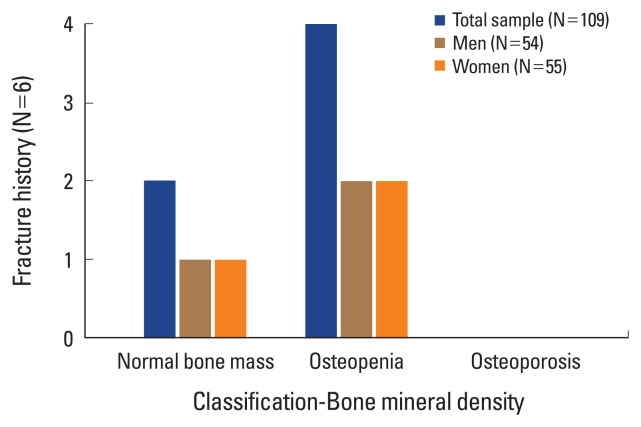
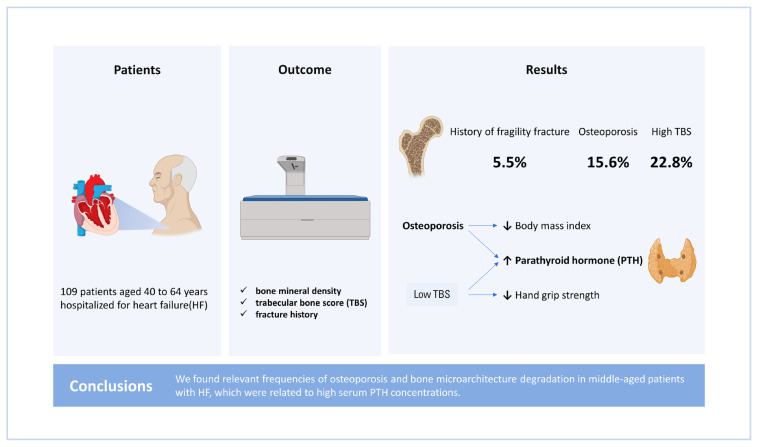
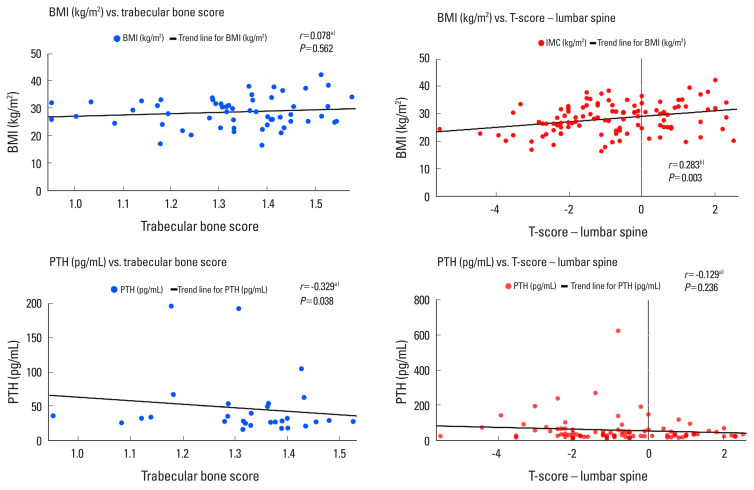
Altogether, 109 patients were evaluated (female 50.5%). Medians and interquartile ranges for age and length of hospital stay were 58.0 (53.0-61.0) years and 20.0 (11.0-32.0) days, respectively. Osteoporosis was observed in 15.6% of the patients, low TBS was observed in 22.8%, and 6 patients had a history of fragile fracture. No differences between the sexes regarding BMD (p=0.335) or TBS (p=0.736) classifications were observed. No association was observed between low BMD and HF classification (p>0.05) regarding the ejection fraction, ischemic etiology, or New York Heart Association Functional Classification. However, there was a significant association between high serum parathyroid hormone (PTH) and the presence of osteoporosis (62.5 [37.2-119.0] pg/mL vs. 34.2 [25.0-54.1] pg/mL; p=0.016). There was a negative correlation between serum PTH and TBS (r=-0.329, p=0.038) and a higher frequency of reduced HGS in patients with low TBS (92.3% vs. 50.0%; p=0.009).
We found relevant frequencies of osteoporosis and bone microarchitecture degradation in middle-aged patients with HF, which were related to high serum PTH concentrations.
本研究旨在评估因心力衰竭(HF)住院的中年患者的骨矿物质密度(BMD)、小梁骨评分(TBS)和骨折史,并分析这些因素与心脏代谢参数和肌肉力量之间的关联。
对年龄在40至64岁因HF住院的患者进行了一项横断面研究。采用双能X线吸收法获取BMD和TBS。评估了患者的骨折史、握力(HGS)以及临床和实验室心脏代谢参数。
共评估了109例患者(女性占50.5%)。年龄和住院时间的中位数及四分位间距分别为58.0(53.0 - 61.0)岁和20.0(11.0 - 32.0)天。15.6%的患者存在骨质疏松,22.8%的患者TBS较低,6例患者有脆性骨折史。在BMD(p = 0.335)或TBS(p = 0.736)分类方面,未观察到性别差异。在射血分数、缺血病因或纽约心脏协会功能分级方面,低BMD与HF分类之间未观察到关联(p>0.05)。然而,高血清甲状旁腺激素(PTH)与骨质疏松的存在之间存在显著关联(62.5 [37.2 - 119.0] pg/mL对34.2 [25.0 - 54.1] pg/mL;p = 0.016)。血清PTH与TBS之间存在负相关(r = -0.329,p = 0.038),TBS低的患者中HGS降低的频率更高(92.3%对50.0%;p = 0.009)。
我们发现中年HF患者中骨质疏松和骨微结构退化的发生率较高,这与高血清PTH浓度有关。