Gimhae Airport National Quarantine Station, Gyeongnam Regional Disease Response Center, Korea Disease Control and Prevention Agency, Busan, Korea.
Busan National Quarantine Station, Gyeongnam Regional Disease Response Center, Korea Disease Control and Prevention Agency, Busan, Korea.
PLoS One. 2023 Jul 14;18(7):e0288064. doi: 10.1371/journal.pone.0288064. eCollection 2023.
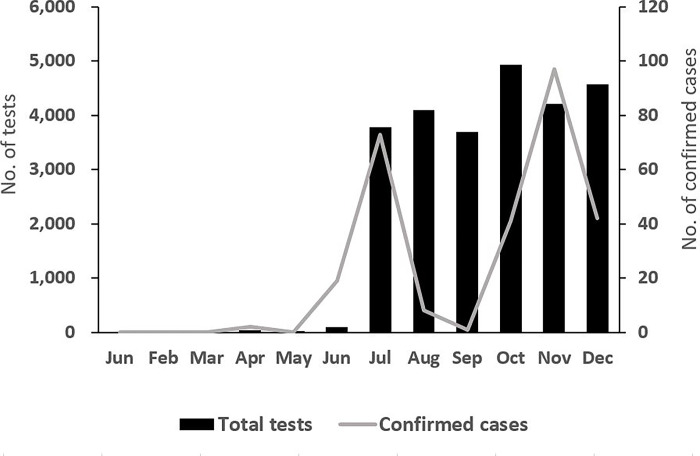
Quarantine played an important role in preventing the spread of infectious diseases between countries in the early stages of the COVID-19 outbreak. In particular, in ports, infection during transit can cause a large number of patients on board ships and can flow into the community. In this study investigated cause of the cause of transmission in ships and suggested the way of preventing secondary transmission by analyzing clinical and epidemiological characteristics of COVID-19 patients identified at Busan Port (South Korea) in 2020. During the study period, out of 19,396 ships that arrived at Busan Port, 50 ships had COVID-19 confirmed cases. Among the 50 ships, type of deep-sea fishing vessels (24 ships, 48.0%), ships weighing less than 5,000 tons (31 ships, 62.0%), and ships from Russia (41 ships, 82.0%) had the highest positivity rates. Total 283 of the 25,450 arrivals tested positive for COVID-19 (a positivity rate of 1.1%), and 270 (95.4%) were asymptomatic. Moreover, the number of COVID-19 patients increased with the duration of the waiting period between arrival and sample collection (12.7% to 37.4%), and the positivity rate was significantly higher for those working as stewards (64.3%). These results indicate secondary transmission was active on board ships and that infection among stewards importantly contributed to group outbreaks. In addition, onboard residence time after arrival significantly elevated to COVID-19 positivity rates, indicating that rapid isolation, as determined using various screening techniques, might be effective at preventing onboard transmission and subsequent community outbreaks.
检疫在 COVID-19 疫情早期对防止国家间传染病传播发挥了重要作用。特别是在港口,转运过程中的感染可导致船上大量患者,并可能流入社区。本研究通过分析 2020 年在韩国釜山港发现的 COVID-19 患者的临床和流行病学特征,调查了船舶传播的原因,并提出了防止二次传播的方法。在研究期间,在抵达釜山港的 19396 艘船舶中,有 50 艘船舶确诊 COVID-19。在这 50 艘船舶中,深海渔船(24 艘,48.0%)、载重 5000 吨以下船舶(31 艘,62.0%)和俄罗斯船舶(41 艘,82.0%)的阳性率最高。在 25450 名抵达者中,共有 283 人检测出 COVID-19 阳性(阳性率为 1.1%),其中 270 人(95.4%)无症状。此外,COVID-19 患者的数量随着抵达和样本采集之间的等待时间的延长而增加(12.7%至 37.4%),且船上服务员的阳性率(64.3%)显著更高。这些结果表明船舶上存在二次传播,且服务员感染对群体暴发有重要贡献。此外,抵达后的船上居留时间显著提高了 COVID-19 的阳性率,表明使用各种筛查技术进行快速隔离可能有效防止船上传播和随后的社区暴发。