Pieszko Konrad, Hiczkiewicz Jarosław, Łojewska Katarzyna, Uziębło-Życzkowska Beata, Krzesiński Paweł, Gawałko Monika, Budnik Monika, Starzyk Katarzyna, Wożakowska-Kapłon Beata, Daniłowicz-Szymanowicz Ludmiła, Kaufmann Damian, Wójcik Maciej, Błaszczyk Robert, Mizia-Stec Katarzyna, Wybraniec Maciej, Kosmalska Katarzyna, Fijałkowski Marcin, Szymańska Anna, Dłużniewski Mirosław, Kucio Michał, Haberka Maciej, Kupczyńska Karolina, Michalski Błażej, Tomaszuk-Kazberuk Anna, Wilk-Śledziewska Katarzyna, Wachnicka-Truty Renata, Koziński Marek, Kwieciński Jacek, Wolny Rafał, Kowalik Ewa, Kolasa Iga, Jurek Agnieszka, Budzianowski Jan, Burchardt Paweł, Kapłon-Cieślicka Agnieszka, Slomka Piotr J
'Club 30', Polish Cardiac Society, Poland.
Department of Interventional Cardiology and Cardiac Surgery, University of Zielona Gora, Collegium Medicum, Zielona Gora, Poland.
Eur Heart J. 2024 Jan 1;45(1):32-41. doi: 10.1093/eurheartj/ehad431.
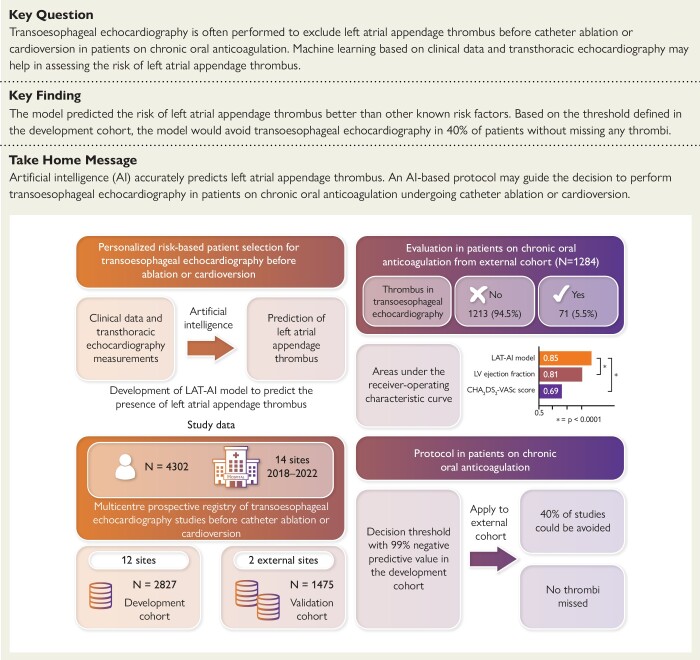
Transoesophageal echocardiography (TOE) is often performed before catheter ablation or cardioversion to rule out the presence of left atrial appendage thrombus (LAT) in patients on chronic oral anticoagulation (OAC), despite associated discomfort. A machine learning model [LAT-artificial intelligence (AI)] was developed to predict the presence of LAT based on clinical and transthoracic echocardiography (TTE) features.
Data from a 13-site prospective registry of patients who underwent TOE before cardioversion or catheter ablation were used. LAT-AI was trained to predict LAT using data from 12 sites (n = 2827) and tested externally in patients on chronic OAC from two sites (n = 1284). Areas under the receiver operating characteristic curve (AUC) of LAT-AI were compared with that of left ventricular ejection fraction (LVEF) and CHA2DS2-VASc score. A decision threshold allowing for a 99% negative predictive value was defined in the development cohort. A protocol where TOE in patients on chronic OAC is performed depending on the LAT-AI score was validated in the external cohort. In the external testing cohort, LAT was found in 5.5% of patients. LAT-AI achieved an AUC of 0.85 [95% confidence interval (CI): 0.82-0.89], outperforming LVEF (0.81, 95% CI 0.76-0.86, P < .0001) and CHA2DS2-VASc score (0.69, 95% CI: 0.63-0.7, P < .0001) in the entire external cohort. Based on the proposed protocol, 40% of patients on chronic OAC from the external cohort would safely avoid TOE.
LAT-AI allows accurate prediction of LAT. A LAT-AI-based protocol could be used to guide the decision to perform TOE despite chronic OAC.
尽管经食管超声心动图(TOE)会给患者带来不适,但在慢性口服抗凝药(OAC)治疗的患者进行导管消融或心律转复前,常进行该检查以排除左心耳血栓(LAT)的存在。开发了一种机器学习模型[LAT-人工智能(AI)],以根据临床和经胸超声心动图(TTE)特征预测LAT的存在。
使用了来自13个地点的前瞻性登记数据,这些患者在心律转复或导管消融前接受了TOE检查。LAT-AI使用来自12个地点(n = 2827)的数据进行训练以预测LAT,并在来自两个地点的慢性OAC患者(n = 1284)中进行外部测试。将LAT-AI的受试者工作特征曲线(AUC)下面积与左心室射血分数(LVEF)和CHA2DS2-VASc评分的AUC进行比较。在开发队列中定义了一个允许99%阴性预测值的决策阈值。在外部队列中验证了一种根据LAT-AI评分对慢性OAC患者进行TOE检查的方案。在外部测试队列中,5.5%的患者发现有LAT。LAT-AI的AUC为0.85[95%置信区间(CI):0.82-0.89],在整个外部队列中优于LVEF(0.81,95%CI 0.76-0.86,P <.0001)和CHA2DS2-VASc评分(0.69,95%CI:0.63-0.7,P <.0001)。根据提议的方案,外部队列中40%的慢性OAC患者可以安全地避免进行TOE检查。
LAT-AI能够准确预测LAT。基于LAT-AI的方案可用于指导在慢性OAC情况下进行TOE检查的决策。