Department of Health Policy and Management, Graduate School, Korea University, Seoul, Korea.
BK21FOUR R&E Center for Learning Health Systems, Korea University, Seoul, Korea.
Sci Rep. 2023 Jul 16;13(1):11473. doi: 10.1038/s41598-023-38742-1.
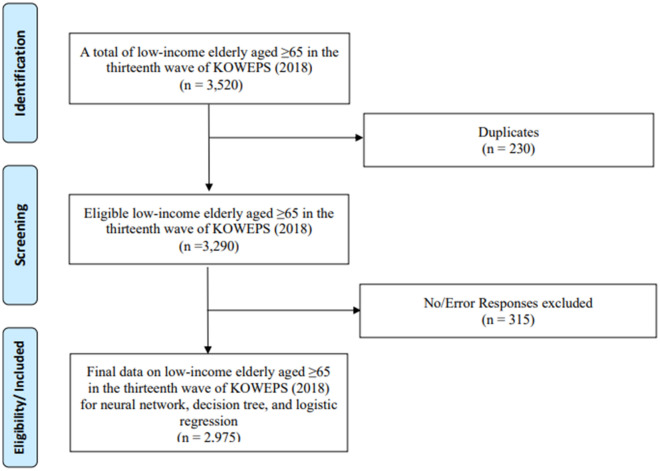
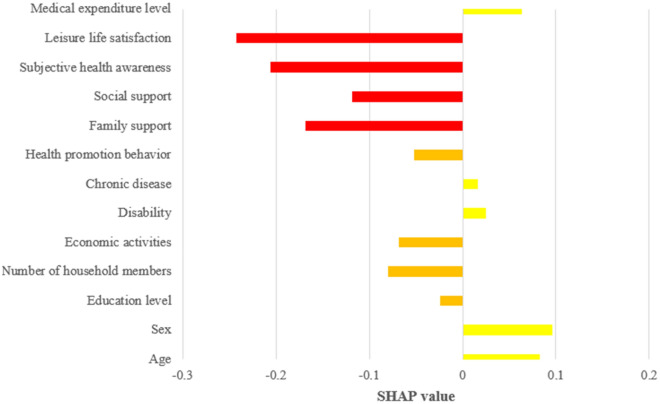
Korea is showing the fastest trend in the world in population aging; there is a high interest in the elderly population nationwide. Among the common chronic diseases, the elderly tends to have a high incidence of depression. That said, it has been vital to focus on preventing depression in the elderly in advance. Hence, this study aims to select the factors related to depression in low-income seniors identified in previous studies and to develop a prediction model. In this study, 2975 elderly people from low-income families were extracted using the 13th-year data of the Korea Welfare Panel Study (2018). Decision trees, logistic regression, neural networks, and random forest were applied to develop a predictive model among the numerous data mining techniques. In addition, the wrapper's stepwise backward elimination, which finds the optimal model by removing the least relevant factors, was applied. The evaluation of the model was confirmed via accuracy. It was verified that the final prediction model, in the case of a decision tree, showed the highest predictive power with an accuracy of 97.3%. Second, psychological factors, leisure life satisfaction, social support, subjective health awareness, and family support ranked higher than demographic factors influencing depression. Based on the results, an approach focused on psychological support is much needed to manage depression in low-income seniors. As predicting depression in the elderly varies on numerous influencing factors, using a decision tree may be beneficial to establish a firm prediction model to identify vital factors causing depression in the elderly population.
韩国是全球人口老龄化趋势最快的国家;全国范围内对老年人口都有着高度关注。在常见的慢性病中,老年人往往更容易出现抑郁症状。因此,提前关注老年人的抑郁预防至关重要。因此,本研究旨在选择之前研究中确定的与低收入老年人抑郁相关的因素,并建立一个预测模型。在这项研究中,使用韩国福利面板研究(2018 年)的第 13 年数据,提取了 2975 名来自低收入家庭的老年人。在众多数据挖掘技术中,应用决策树、逻辑回归、神经网络和随机森林来开发预测模型。此外,还应用了包裹式逐步向后消除法(wrapper's stepwise backward elimination),通过去除最不相关的因素来找到最优模型。通过准确性来验证模型的评估。验证结果表明,最终的预测模型(决策树)具有最高的预测能力,准确率为 97.3%。其次,心理因素、休闲生活满意度、社会支持、主观健康意识和家庭支持对抑郁的影响高于人口统计学因素。基于这些结果,需要关注心理支持,以管理低收入老年人的抑郁问题。由于预测老年人的抑郁情况受到众多因素的影响,因此使用决策树可能有助于建立一个可靠的预测模型,以确定导致老年人群体抑郁的关键因素。