Department of Physical and Analytical Chemistry, University of Oviedo, Avenida Julian Clavería 8, 33006, Oviedo, Asturias, Spain.
Health Research Institute of Asturias, ISPA, Avenida Hospital Universitario, s/n 33011, Oviedo, Asturias, Spain.
Mikrochim Acta. 2023 Jul 17;190(8):292. doi: 10.1007/s00604-023-05868-y.
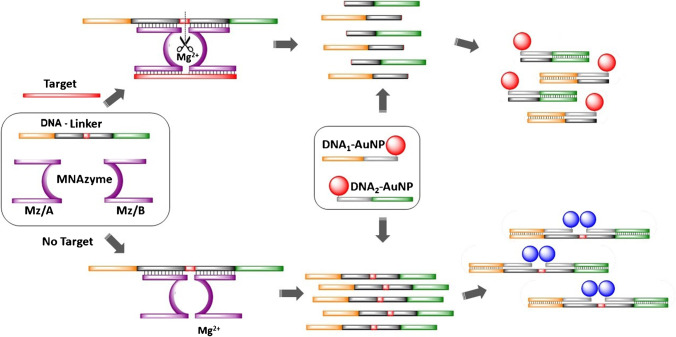
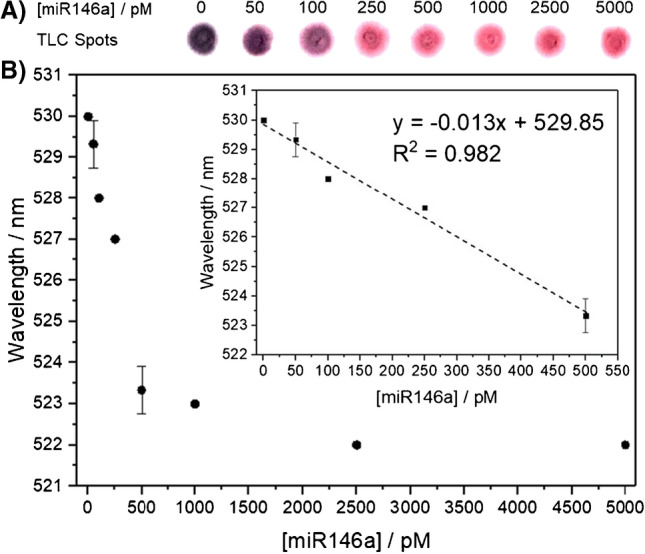
MicroRNAs (miRNAs) represent a class of small noncoding RNAs that are considered a novel emerging class of disease biomarkers in a variety of afflictions. Sensitive detection of miRNA is typically achieved using hybridization-based methods coupled with genetic amplification techniques. Although their sensitivity has improved, amplification techniques often present erroneous results due to their complexity. In addition, the use of these techniques is usually linked to the application of protein enzymes, the activity of which is dependent on the temperature and pH of the medium. To address these drawbacks, an alternative genetic enzyme for the highly sensitive detection of miRNAs is proposed in this work. Multicomponent nucleic acid enzymes (MNAzymes), coupled with the use of DNA-functionalized gold nanoparticles (AuNPs), were used in this study to develop an isothermal signal amplification strategy for visual genetic detection. miR146a, a biomarker of bovine mastitis present in milk, was selected as a model analyte. The developed methodology is easily carried out in 80 min at 50 °C, generating a low visual limit of detection of 250 pM based on the observation of a color change. The methodology was successfully applied to the detection of miR146a in raw cow milk samples.
微小 RNA(miRNA)是一类小的非编码 RNA,被认为是多种疾病中新型的新兴疾病生物标志物。miRNA 的敏感检测通常采用基于杂交的方法与遗传扩增技术相结合来实现。尽管它们的灵敏度有所提高,但由于其复杂性,扩增技术常常会产生错误的结果。此外,这些技术的应用通常与蛋白质酶的使用相关联,其活性取决于介质的温度和 pH 值。为了解决这些缺点,本工作提出了一种用于高度敏感检测 miRNA 的替代遗传酶。本研究中使用了多组分核酸酶(MNAzymes),并结合使用了 DNA 功能化的金纳米粒子(AuNPs),开发了一种用于可视化遗传检测的等温信号扩增策略。miR146a 是牛奶中存在的牛乳腺炎的生物标志物,被选为模型分析物。所开发的方法在 50°C 下 80 分钟内很容易进行,基于颜色变化的观察,得到了低至 250 pM 的低视觉检测限。该方法成功应用于原始牛奶样品中 miR146a 的检测。