Vanderbilt Memory & Alzheimer's Center, Vanderbilt University Medical Center, Nashville, Tennessee.
Vanderbilt Genetics Institute, Vanderbilt University Medical Center, Nashville, Tennessee.
JAMA Neurol. 2023 Sep 1;80(9):929-939. doi: 10.1001/jamaneurol.2023.2169.
Sex differences are established in associations between apolipoprotein E (APOE) ε4 and cognitive impairment in Alzheimer disease (AD). However, it is unclear whether sex-specific cognitive consequences of APOE are consistent across races and extend to the APOE ε2 allele.
To investigate whether sex and race modify APOE ε4 and ε2 associations with cognition.
DESIGN, SETTING, AND PARTICIPANTS: This genetic association study included longitudinal cognitive data from 4 AD and cognitive aging cohorts. Participants were older than 60 years and self-identified as non-Hispanic White or non-Hispanic Black (hereafter, White and Black). Data were previously collected across multiple US locations from 1994 to 2018. Secondary analyses began December 2021 and ended September 2022.
Harmonized composite scores for memory, executive function, and language were generated using psychometric approaches. Linear regression assessed interactions between APOE ε4 or APOE ε2 and sex on baseline cognitive scores, while linear mixed-effect models assessed interactions on cognitive trajectories. The intersectional effect of race was modeled using an APOE × sex × race interaction term, assessing whether APOE × sex interactions differed by race. Models were adjusted for age at baseline and corrected for multiple comparisons.
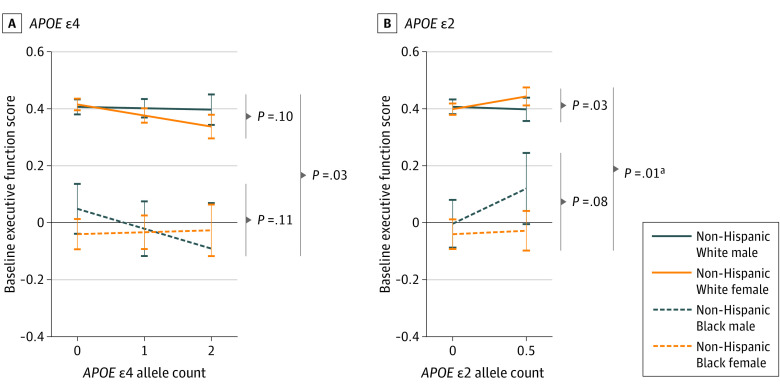
Of 32 427 participants who met inclusion criteria, there were 19 007 females (59%), 4453 Black individuals (14%), and 27 974 White individuals (86%); the mean (SD) age at baseline was 74 years (7.9). At baseline, 6048 individuals (19%) had AD, 4398 (14%) were APOE ε2 carriers, and 12 538 (38%) were APOE ε4 carriers. Participants missing APOE status were excluded (n = 9266). For APOE ε4, a robust sex interaction was observed on baseline memory (β = -0.071, SE = 0.014; P = 9.6 × 10⁻⁷), whereby the APOE ε4 negative effect was stronger in females compared with males and did not significantly differ among races. Contrastingly, despite the large sample size, no APOE ε2 × sex interactions on cognition were observed among all participants. When testing for intersectional effects of sex, APOE ε2, and race, an interaction was revealed on baseline executive function among individuals who were cognitively unimpaired (β = -0.165, SE = 0.066; P = .01), whereby the APOE ε2 protective effect was female-specific among White individuals but male-specific among Black individuals.
In this study, while race did not modify sex differences in APOE ε4, the APOE ε2 protective effect could vary by race and sex. Although female sex enhanced ε4-associated risk, there was no comparable sex difference in ε2, suggesting biological pathways underlying ε4-associated risk are distinct from ε2 and likely intersect with age-related changes in sex biology.
在载脂蛋白 E (APOE) ε4 与阿尔茨海默病 (AD) 认知障碍之间的关联中,性别差异已经确立。然而,APOE 的性别特异性认知后果是否在不同种族之间一致,以及是否扩展到 APOE ε2 等位基因,目前还不清楚。
研究性别和种族是否改变了 APOE ε4 和 ε2 与认知的关联。
设计、地点和参与者:这项遗传关联研究包括来自 4 个 AD 和认知老化队列的纵向认知数据。参与者年龄大于 60 岁,自认为是非西班牙裔白人或非西班牙裔黑人(以下简称白人和黑人)。数据之前是在 1994 年至 2018 年期间从美国多个地点收集的。二次分析于 2021 年 12 月开始,2022 年 9 月结束。
使用心理测量方法生成记忆、执行功能和语言的综合评分。线性回归评估了 APOE ε4 或 APOE ε2 与性别对基线认知评分的交互作用,而线性混合效应模型则评估了认知轨迹的交互作用。种族的交叉效应通过 APOE × 性别 × 种族的交互作用项来建模,评估 APOE × 性别交互作用是否因种族而异。模型根据基线时的年龄进行调整,并进行了多次比较的校正。
在符合纳入标准的 32427 名参与者中,有 19007 名女性(59%)、4453 名黑人(14%)和 27974 名白人(86%);基线时的平均(SD)年龄为 74 岁(7.9)。基线时,6048 人(19%)患有 AD,4398 人(14%)为 APOE ε2 携带者,12938 人(38%)为 APOE ε4 携带者。参与者缺失 APOE 状态被排除(n=9266)。对于 APOE ε4,在基线记忆方面观察到了一个强有力的性别交互作用(β=-0.071,SE=0.014;P=9.6×10⁻⁷),这表明与男性相比,女性的 APOE ε4 负效应更强,而且在不同种族之间没有显著差异。相反,尽管样本量很大,但在所有参与者中都没有观察到 APOE ε2×性别对认知的交互作用。当检测性别、APOE ε2 和种族的交叉影响时,在认知未受损的个体中发现了基线执行功能的交互作用(β=-0.165,SE=0.066;P=0.01),这表明 APOE ε2 的保护作用在白人女性中是特异性的,但在黑人男性中是特异性的。
在这项研究中,尽管种族没有改变 APOE ε4 的性别差异,但 APOE ε2 的保护作用可能因种族和性别而异。虽然女性性别增强了 ε4 相关风险,但在 ε2 中没有类似的性别差异,这表明 ε4 相关风险的生物学途径与 ε2 不同,可能与年龄相关的性别生物学变化相交。