Department of Sports Studies, Faculty of Educational Studies, Universiti Putra Malaysia, Selangor, Malaysia.
College of Physical Education, Chongqing University, Chongqing, China.
PLoS One. 2023 Jul 17;18(7):e0288340. doi: 10.1371/journal.pone.0288340. eCollection 2023.
The literature has proven that plyometric training (PT) improves various physical performance outcomes in sports. Even though PT is one of the most often employed strength training methods, a thorough analysis of PT and how it affects technical skill performance in sports needs to be improved.
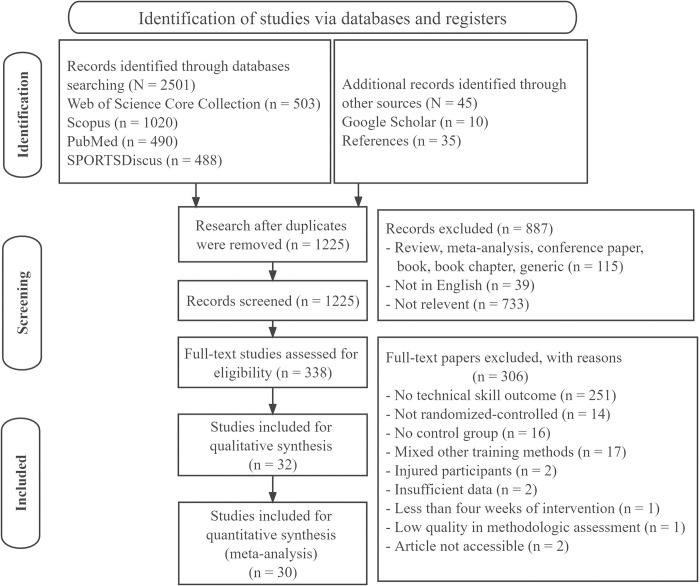
This study aimed to compile and synthesize the existing studies on the effects of PT on healthy athletes' technical skill performance. A comprehensive search of SCOPUS, PubMed, Web of Science Core Collection, and SPORTDiscus databases was performed on 3rd May 2023. PICOS was employed to establish the inclusion criteria: 1) healthy athletes; 2) a PT program; 3) compared a plyometric intervention to an active control group; 4) tested at least one measure of athletes' technical skill performance; and 5) randomized control designs. The methodological quality of each individual study was evaluated using the PEDro scale. The random-effects model was used to compute the meta-analyses. Subgroup analyses were performed (participant age, gender, PT length, session duration, frequency, and number of sessions). Certainty or confidence in the body of evidence was assessed using the Grading of Recommendations Assessment, Development, and Evaluation (GRADE).
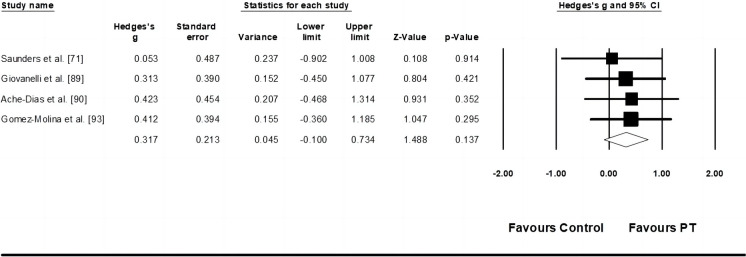
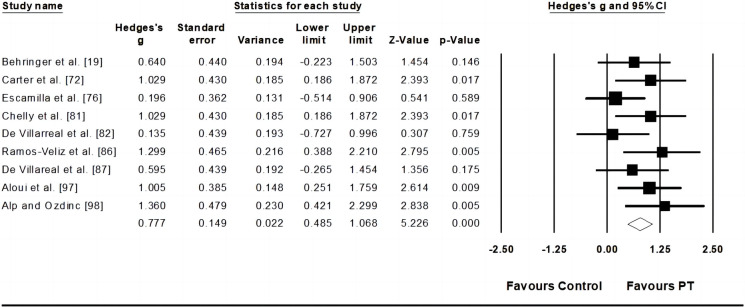
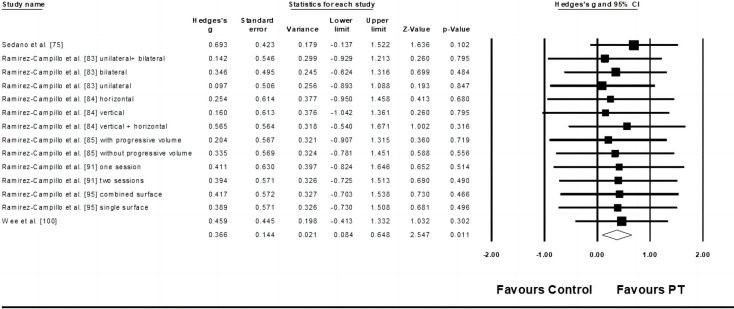
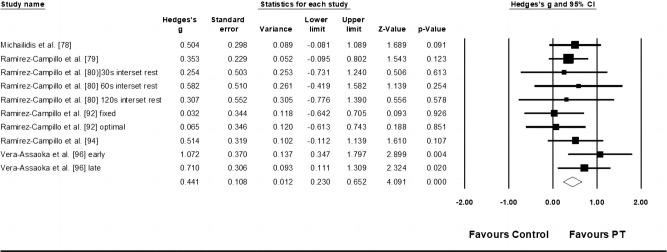
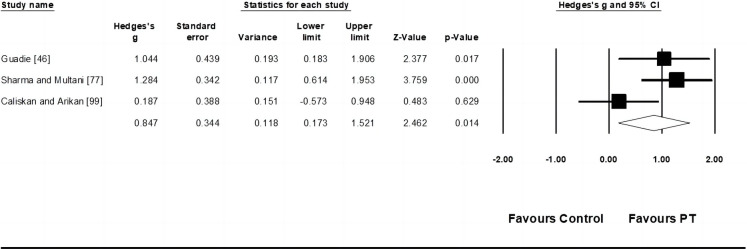
Thirty-two moderate-high-quality studies involving 1078 athletes aged 10-40 years met the inclusion criteria. The PT intervention lasted for 4 to 16 weeks, with one to three exercise sessions per week. Small-to-moderate effect sizes were found for performance of throwing velocity (i.e., handball, baseball, water polo) (ES = 0.78; p < 0.001), kicking velocity and distance (i.e., soccer) (ES = 0.37-0.44; all p < 0.005), and speed dribbling (i.e., handball, basketball, soccer) (ES = 0.85; p = 0.014), while no significant effects on stride rate (i.e., running) were noted (ES = 0.32; p = 0.137). Sub-analyses of moderator factors included 16 data sets. Only training length significantly modulated PT effects on throwing velocity (> 7 weeks, ES = 1.05; ≤ 7 weeks, ES = 0.29; p = 0.011). The level of certainty of the evidence for the meta-analyzed outcomes ranged from low to moderate.
Our findings have shown that PT can be effective in enhancing technical skills measures in youth and adult athletes. Sub-group analyses suggest that PT longer (> 7 weeks) lengths appear to be more effective for improving throwing velocity. However, to fully determine the effectiveness of PT in improving sport-specific technical skill outcomes and ultimately enhancing competition performance, further high-quality research covering a wider range of sports is required.
文献证明,增强式训练(PT)可提高运动中的各种身体表现结果。尽管 PT 是最常使用的力量训练方法之一,但仍需要对 PT 及其如何影响运动中的技术技能表现进行更全面的分析。
本研究旨在综合现有关于 PT 对健康运动员技术技能表现影响的研究。于 2023 年 5 月 3 日,在 SCOPUS、PubMed、Web of Science Core Collection 和 SPORTDiscus 数据库中进行了全面检索。采用 PICOS 建立纳入标准:1)健康运动员;2)PT 方案;3)将增强式干预与积极对照组进行比较;4)至少测试一项运动员技术技能表现指标;5)随机对照设计。使用 PEDro 量表评估每个单独研究的方法学质量。使用随机效应模型进行荟萃分析。进行了亚组分析(参与者年龄、性别、PT 长度、课程持续时间、频率和课程次数)。使用推荐评估、制定和评估(GRADE)的 Grading of Recommendations Assessment 评估证据体的确定性或信心。
符合纳入标准的有 32 项高质量研究,涉及 1078 名年龄在 10-40 岁的运动员。PT 干预持续 4 至 16 周,每周进行一到三次运动课程。在投掷速度(即手球、棒球、水球)(ES = 0.78;p < 0.001)、踢球速度和距离(即足球)(ES = 0.37-0.44;均 p < 0.005)和速度运球(即手球、篮球、足球)(ES = 0.85;p = 0.014)方面,发现了小到中等大小的效果,而在步幅率(即跑步)方面没有发现显著影响(ES = 0.32;p = 0.137)。对调节因素的亚组分析包括 16 个数据集。只有训练长度显著调节了 PT 对投掷速度的影响(>7 周,ES = 1.05;≤7 周,ES = 0.29;p = 0.011)。对荟萃分析结果的证据确定性水平从低到中等不等。
我们的研究结果表明,PT 可以有效提高青少年和成年运动员的技术技能测量指标。亚组分析表明,PT 时间较长(>7 周)似乎更能有效提高投掷速度。然而,为了全面确定 PT 在提高特定运动技术技能表现结果并最终提高比赛表现方面的有效性,还需要进行更多涵盖更广泛运动的高质量研究。