National Center for Chronic and Non-Communicable Disease Control and Prevention, Chinese Center for Disease Control and Prevention, No.27 Nanwei Road, Xicheng District, Beijing, 100050, People's Republic of China.
Department of Biostatistics and Epidemiology, School of Public Health, China Medical University, No.77 Puhe Road, Shenyang, Liaoning Province, 110122, People's Republic of China.
Int J Behav Nutr Phys Act. 2023 Jul 17;20(1):87. doi: 10.1186/s12966-023-01470-w.
The global prevalence of insufficient physical activity (PA) was reported to be 27.5% in 2016, and there were stable levels of insufficient PA worldwide between 2001 and 2016. The global target of a 10% reduction in insufficient PA by 2025 will not be met if the trends remain. The relevant data for trends in China were still scarce. This study aimed to determine nationwide temporal trends in insufficient PA among adults in China from 2010 to 2018.
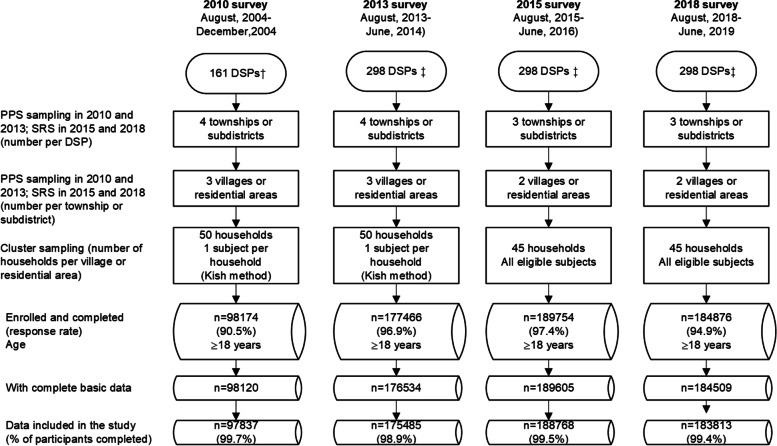
645 903 adults aged 18 years or older were randomly selected from four nationally representative cross-sectional surveys of the China Chronic Disease and Risk Factor Surveillance conducted in 2010, 2013, 2015, and 2018. PA was measured using the Global Physical Activity Questionnaire. Temporal changes in insufficient PA prevalence and participation of domain-specific moderate- to vigorous-intensity PA (MVPA) were analyzed using logistic regression.
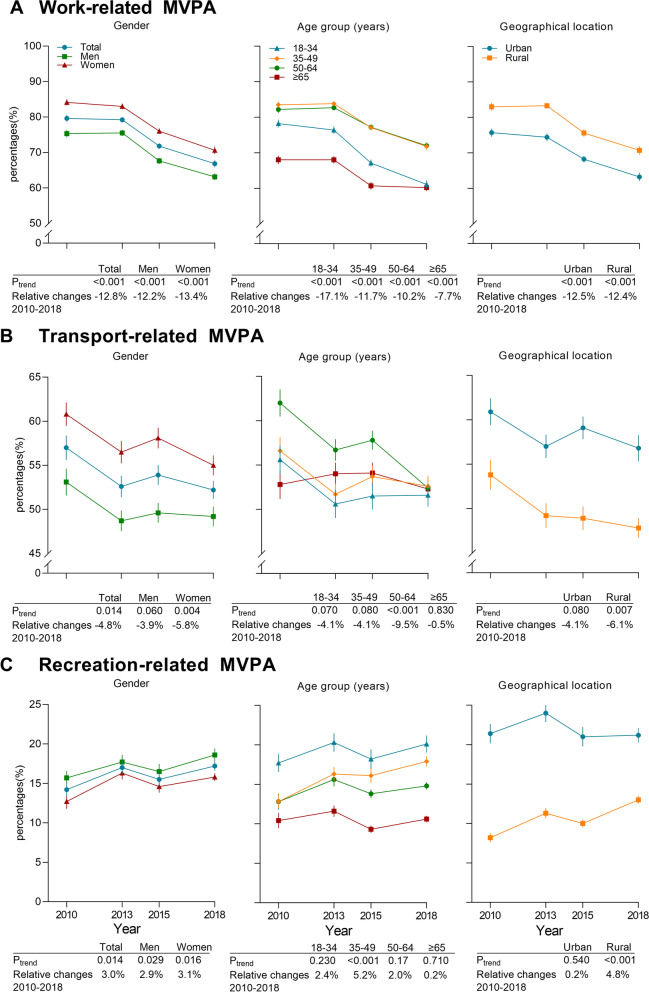
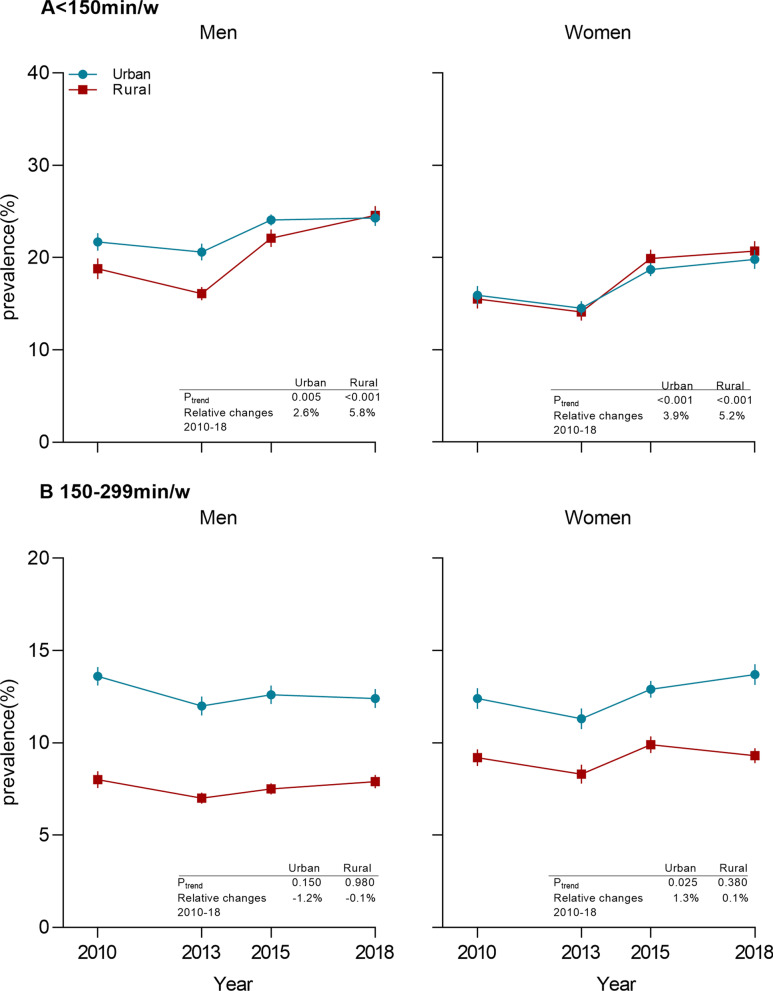
From 2010 to 2018, the age-adjusted prevalence of insufficient PA in China increased from 17.9% (95% confidence interval 16.3% to 19.5%) in 2010 to 22.3% (20.9% to 23.8%) in 2018 (P for trend < 0.001). By age group, with a significant increase in insufficient PA in adults aged 18-34 years (P for trend < 0.001), which rose more rapidly than in adults aged ≥ 35 years (P for interaction < 0.001). Insufficient PA has increased significantly among adults engaged in agriculture-related work, non-manual work, and other manual work (all P for trend < 0.05). And among the occupational groups, those engaged in agriculture-related work had the fastest increase (P for interaction = 0.01). The percentage of adults participating in work-related MVPA decreased from 79.6% (77.8% to 81.5%) to 66.8% (64.9% to 68.7%) along with a decrease in time spent on work-related MVPA, while percentages of adults participating in recreation-related MVPA increased from 14.2% (12.5% to 15.9%) to 17.2% (16.0% to 18.4%) (all P for trend < 0.05).
Among Chinese adults, an increasing trend was found in insufficient PA from 2010 to 2018, with more than one-fifth of adults failing to achieve the recommendation of adequate PA. More targeted PA promotion strategies should be developed to improve population health.
全球范围内,2016 年缺乏身体活动(PA)的比例为 27.5%,2001 年至 2016 年期间,全球缺乏 PA 的比例保持稳定。如果这种趋势持续下去,到 2025 年,全球减少 10%的缺乏 PA 的目标将无法实现。中国相关趋势的数据仍然很少。本研究旨在确定 2010 年至 2018 年期间中国成年人缺乏 PA 的全国性时间趋势。
从 2010 年、2013 年、2015 年和 2018 年进行的中国慢性病与危险因素监测的四个全国代表性横断面调查中,随机选择了 645903 名年龄在 18 岁及以上的成年人。使用全球体力活动问卷测量 PA。采用 logistic 回归分析不同年份和不同亚组中缺乏 PA 的流行率和特定领域中度至剧烈强度体力活动(MVPA)的参与情况。
2010 年至 2018 年,中国年龄调整后的缺乏 PA 的流行率从 2010 年的 17.9%(95%置信区间为 16.3%至 19.5%)上升至 2018 年的 22.3%(20.9%至 23.8%)(P趋势<0.001)。按年龄组分析,18-34 岁成年人的缺乏 PA 显著增加(P趋势<0.001),这一增长率高于≥35 岁成年人(P交互<0.001)。从事农业相关工作、非体力劳动和其他体力劳动的成年人中,缺乏 PA 的比例显著增加(所有 P趋势<0.05)。在职业群体中,从事农业相关工作的成年人的增长速度最快(P交互=0.01)。与工作相关的 MVPA 的时间减少,而从事农业相关工作的成年人的比例从 79.6%(77.8%至 81.5%)下降至 66.8%(64.9%至 68.7%),与此同时,与娱乐相关的 MVPA 的成年人比例从 14.2%(12.5%至 15.9%)增加至 17.2%(16.0%至 18.4%)(所有 P趋势<0.05)。
2010 年至 2018 年期间,中国成年人缺乏 PA 的趋势呈上升趋势,超过五分之一的成年人未能达到足够 PA 的推荐标准。应制定更有针对性的 PA 促进策略,以改善人口健康。