Institute of Sports and Sports Science, Karlsruhe Institute of Technology, 76131 Karlsruhe, Germany.
Int J Environ Res Public Health. 2022 Feb 16;19(4):2250. doi: 10.3390/ijerph19042250.
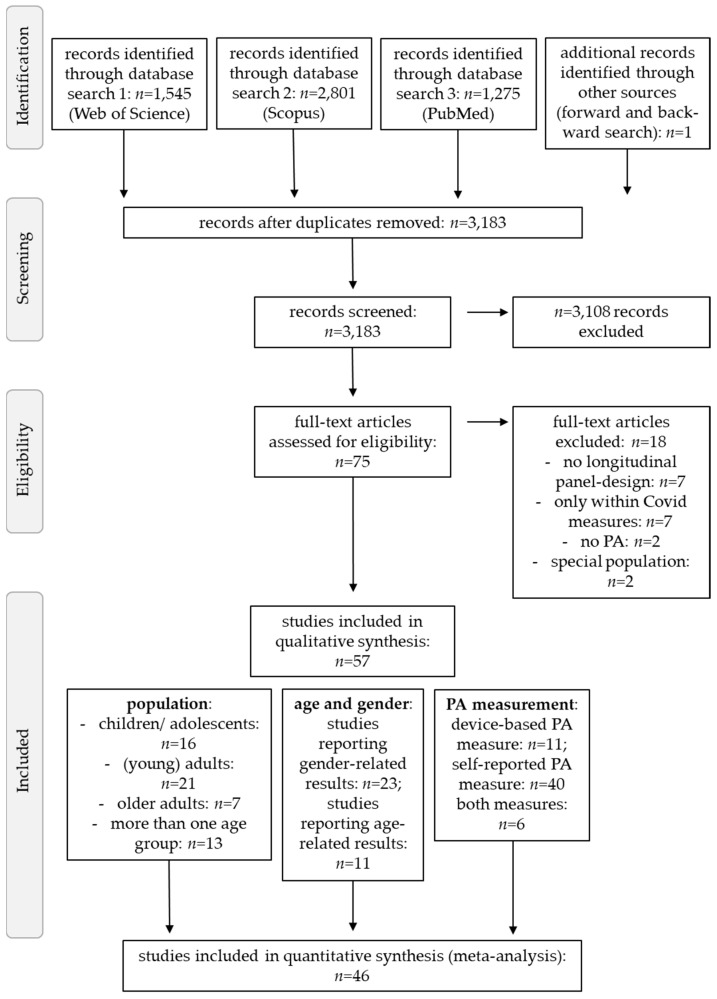
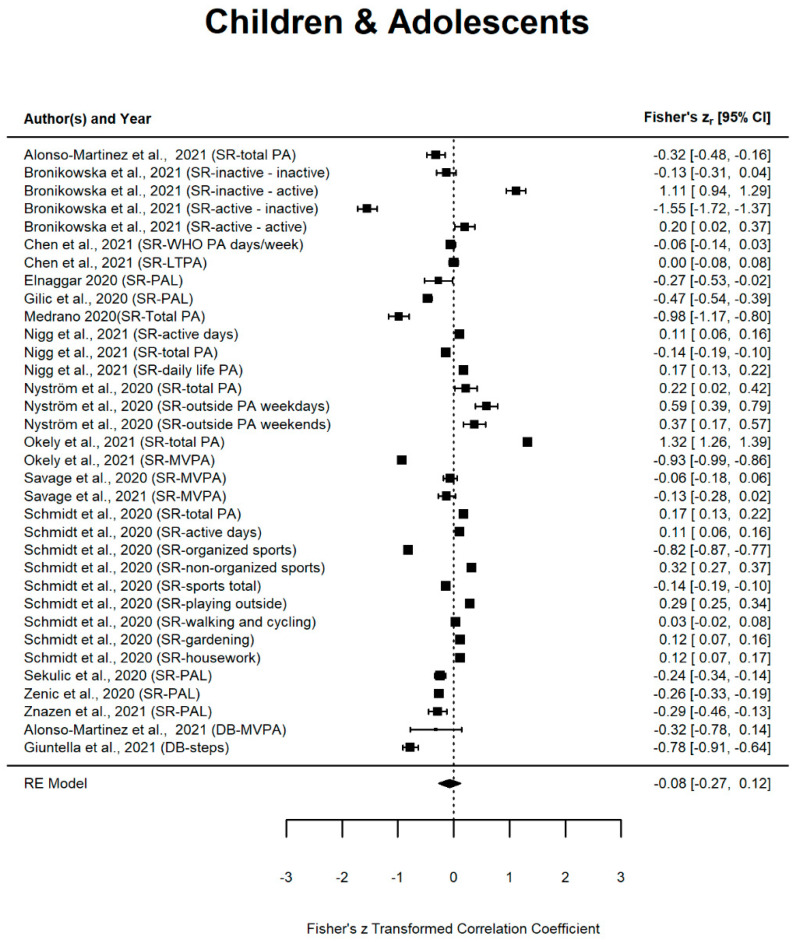
With the outbreak of the Corona Virus Disease 19 (Covid-19) in late 2019, governments increasingly imposed containment strategies, including social distancing as well as restricted population movement, potentially having negative impacts on mental and physical health. A growing number of studies have examined the impact of the pandemic on different facets of physical activity (PA); an overview combining these (mixed) results, however, is missing. Thus, the objective of this systematic review and meta-analysis was to investigate whether and to which extent PA changed from before to during the Covid-19 pandemic, taking age, gender, and measurement method into account. The literature search was conducted using PubMed, Web of Science, and Scopus. Results of the main characteristics were descriptively synthesized and analyzed in a meta-analysis quantifying effects of the pandemic on PA divided by age groups, with additional subgroup analyses of the characteristics age, gender, and measurement method being narratively synthesized. Overall, 57 studies with a total sample size of 119,094 participants (N between 10 and 60,560 subjects) from 14 countries worldwide with participants aged between four and 93 years were included. Thirty-two studies revealed a significant decline in PA, whereas only five studies found a significant increase in PA during the Covid-19 pandemic. Fourteen studies revealed mixed results. PA decreased in all age groups, independent of gender. Most self-reported and all device-based measurement methods showed a reduction in PA. However, effects were not found to be significant in all age groups. Nevertheless, the declining trend should be noted and governments should strive to enable PA within periods of pandemic restrictions, or promote alternatives such as digital training to avoid negative health consequences within the population.
自 2019 年末新冠病毒病(COVID-19)爆发以来,各国政府越来越多地采取遏制策略,包括社交距离以及限制人口流动,这可能对身心健康产生负面影响。越来越多的研究探讨了大流行对不同方面的身体活动(PA)的影响;然而,缺乏综合这些(混合)结果的概述。因此,本系统评价和荟萃分析的目的是调查 PA 是否以及在多大程度上从 COVID-19 大流行之前到期间发生了变化,并考虑了年龄、性别和测量方法。使用 PubMed、Web of Science 和 Scopus 进行了文献检索。主要特征的结果进行了描述性综合,并在荟萃分析中对 PA 的影响进行了量化,按年龄组划分了大流行的影响,对年龄、性别和测量方法的特征进行了额外的亚组分析,进行了叙述性综合。总体而言,从全球 14 个国家共纳入了 57 项研究,共有 119094 名参与者(N between 10 and 60,560),年龄从 4 岁到 93 岁。32 项研究表明 PA 显著下降,而只有 5 项研究表明 PA 在 COVID-19 大流行期间显著增加。14 项研究结果混杂。PA 在所有年龄组中都下降了,与性别无关。大多数自我报告和所有基于设备的测量方法都显示 PA 减少。然而,并非在所有年龄组中都发现效果显著。尽管如此,应该注意到下降趋势,政府应努力在大流行限制期间促进 PA,并推广数字培训等替代方案,以避免人群中的负面健康后果。