Moore Sharlen, Wang Zyan, Zhu Ziyi, Sun Ruolan, Lee Angel, Charles Adam, Kuchibhotla Kishore V
Department of Psychological and Brain Sciences, Krieger School of Arts and Sciences, Johns Hopkins University, Baltimore, MD, USA.
The Solomon H. Snyder Department of Neuroscience, Johns Hopkins School of Medicine, Baltimore, Maryland, USA.
bioRxiv. 2023 Jul 7:2023.07.05.547783. doi: 10.1101/2023.07.05.547783.
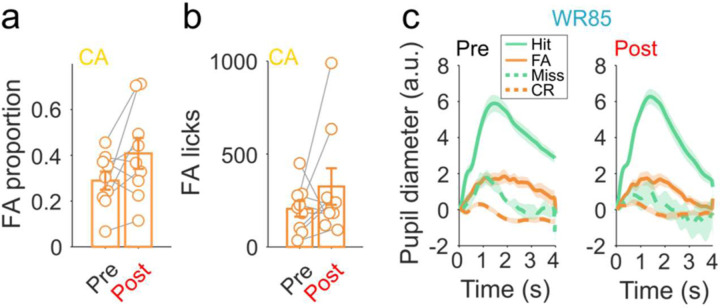
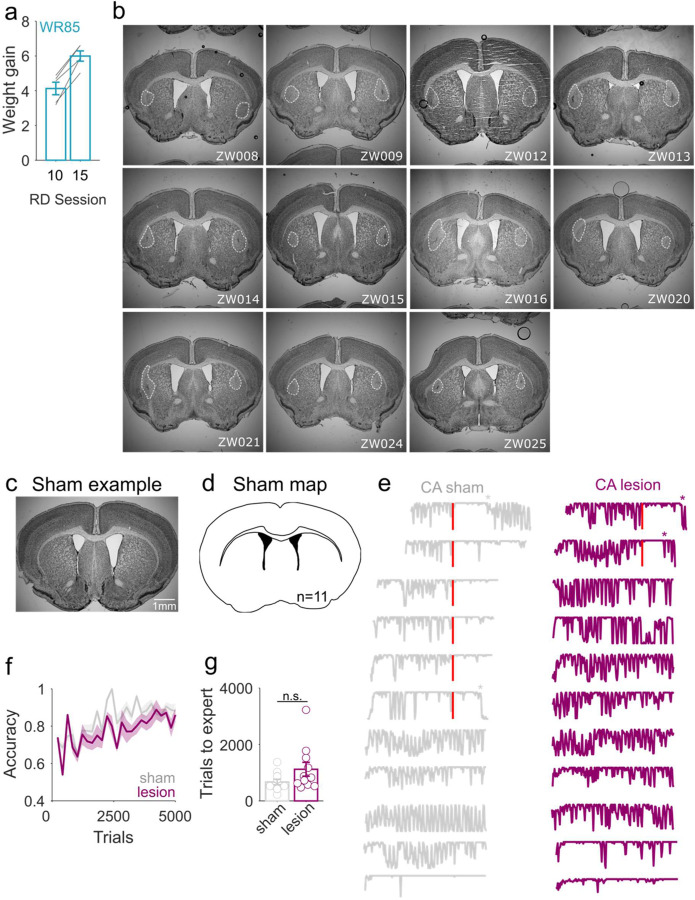
A fundamental tenet of animal behavior is that decision-making involves multiple 'controllers.' Initially, behavior is goal-directed, driven by desired outcomes, shifting later to habitual control, where cues trigger actions independent of motivational state. Clark Hull's question from 1943 still resonates today: "Is this transition abrupt, or is it gradual and progressive?" Despite a century-long belief in gradual transitions, this question remains unanswered as current methods cannot disambiguate goal-directed versus habitual control in real-time. Here, we introduce a novel 'volitional engagement' approach, motivating animals by palatability rather than biological need. Offering less palatable water in the home cage reduced motivation to 'work' for plain water in an auditory discrimination task when compared to water-restricted animals. Using quantitative behavior and computational modeling, we found that palatability-driven animals learned to discriminate as quickly as water-restricted animals but exhibited state-like fluctuations when responding to the reward-predicting cue-reflecting goal-directed behavior. These fluctuations spontaneously and abruptly ceased after thousands of trials, with animals now always responding to the reward-predicting cue. In line with habitual control, post-transition behavior displayed motor automaticity, decreased error sensitivity (assessed via pupillary responses), and insensitivity to outcome devaluation. Bilateral lesions of the habit-related dorsolateral striatum blocked transitions to habitual behavior. Thus, 'volitional engagement' reveals spontaneous and abrupt transitions from goal-directed to habitual behavior, suggesting the involvement of a higher-level process that arbitrates between the two.
动物行为的一个基本原理是,决策涉及多个“控制器”。最初,行为是目标导向的,由期望的结果驱动,随后转变为习惯性控制,即线索触发的行动独立于动机状态。克拉克·赫尔1943年提出的问题至今仍有共鸣:“这种转变是突然的,还是渐进的?”尽管一个世纪以来人们一直相信是渐进转变,但这个问题仍然没有答案,因为目前的方法无法实时区分目标导向行为和习惯性控制。在这里,我们引入了一种新颖的“意志参与”方法,通过适口性而非生物需求来激励动物。与限水动物相比,在家笼中提供适口性较差的水会降低动物在听觉辨别任务中为普通水“工作”的动机。通过定量行为和计算建模,我们发现适口性驱动的动物学习辨别速度与限水动物一样快,但在对奖励预测线索做出反应时表现出类似状态的波动——这反映了目标导向行为。经过数千次试验后,这些波动会自发且突然停止,此时动物总是对奖励预测线索做出反应。与习惯性控制一致,转变后的行为表现出运动自动化、错误敏感性降低(通过瞳孔反应评估)以及对结果贬值不敏感。与习惯相关的背外侧纹状体的双侧损伤阻止了向习惯性行为的转变。因此,“意志参与”揭示了从目标导向行为到习惯性行为的自发且突然的转变,表明存在一个在两者之间进行仲裁的高级过程。