Wojcik Kaitlyn M, Holle Ann Von, O'Brien Katie M, White Alexandra J, Karagas Margaret R, Levine Keith E, Jackson Brian P, Weinberg Clarice R
National Institute of Environmental Health Sciences.
Dartmouth College.
Res Sq. 2023 Jun 29:rs.3.rs-3093700. doi: 10.21203/rs.3.rs-3093700/v1.
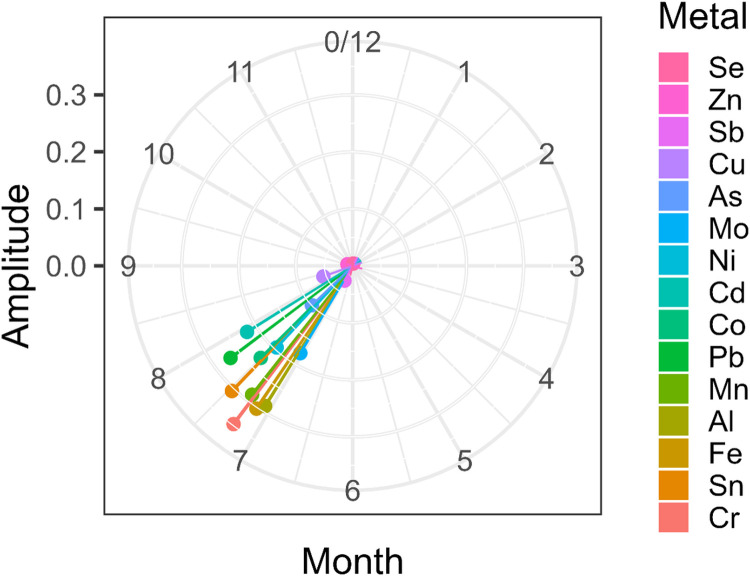
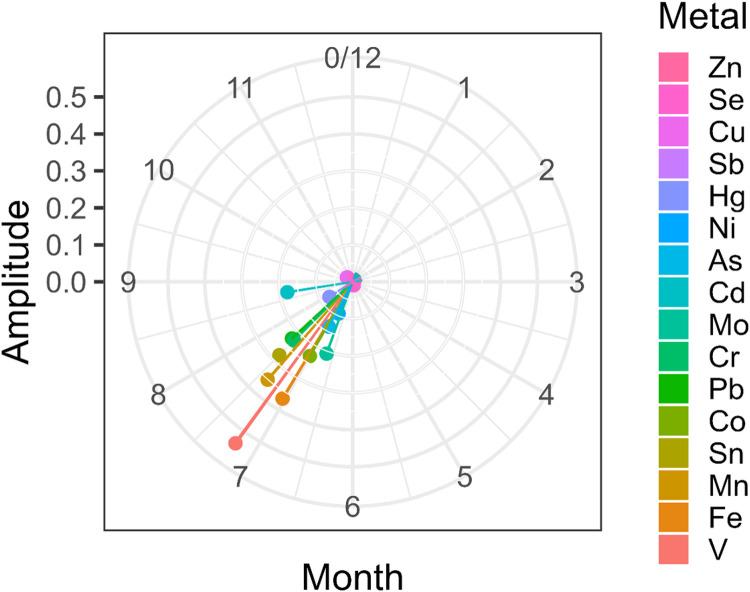
Seasonal patterns in measured exposure biomarkers can cause measurement error in epidemiological studies. There is little known about the seasonality of trace elements when measured in toenails. Adjusting for such patterns when estimating associations between long-term exposures and health outcomes could be needed to improve precision and reduce bias. Our goal was to assess seasonal patterns in toenail measurements of trace elements. At enrollment, Sister Study participants, who were US residents, removed polish and collected toenail clippings, which were cleaned before analysis. We measured: iron, vanadium, aluminum, chromium, manganese, cobalt, nickel, copper, zinc, arsenic, selenium, molybdenum, cadmium, tin, antimony, mercury, and lead. For a sample of the cohort we fit trigonometric regression models with toenail element measures as the outcome, using sine and cosine functions of the collection day of the year (transformed to an angle) to assess seasonality. Results were replicated in a second sample of women, with measurements done in a separate lab. There was a seasonal association between day of collection and toenail measures for iron, aluminum, vanadium, chromium, manganese, cobalt, arsenic, molybdenum, cadmium, tin, and lead, all of which peaked near mid-August. Seasonal patterns were concordant across the two samples of women. Given the evidence supporting seasonal patterns for 11 of the 17 elements measured in toenails, correcting for seasonality of toenail levels of those trace elements in models estimating the association between those exposures and health outcomes is important. The basis for higher concentrations in toenails collected during the summer remains unknown.
测量的暴露生物标志物中的季节性模式可能会在流行病学研究中导致测量误差。对于 toenails 中微量元素的季节性情况,人们了解甚少。在估计长期暴露与健康结果之间的关联时,考虑校正此类模式可能有助于提高精度并减少偏差。我们的目标是评估 toenails 中微量元素测量的季节性模式。在入组时,“姐妹研究”的参与者(均为美国居民)去除指甲油并收集 toenail 剪片,在分析前进行清洁。我们测量了:铁、钒、铝、铬、锰、钴、镍、铜、锌、砷、硒、钼、镉、锡、锑、汞和铅。对于队列中的一个样本,我们以 toenail 元素测量值为结果拟合三角回归模型,使用一年中收集日期的正弦和余弦函数(转换为角度)来评估季节性。结果在另一组女性样本中得到重复,测量在另一个实验室进行。收集日期与 toenail 中铁、铝、钒、铬、锰、钴、砷、钼、镉、锡和铅的测量值之间存在季节性关联,所有这些元素在 8 月中旬左右达到峰值。两个女性样本的季节性模式一致。鉴于有证据支持所测量的 17 种元素中有 11 种存在季节性模式,在估计这些暴露与健康结果之间的关联的模型中,校正那些微量元素的 toenail 水平的季节性很重要。夏季收集的 toenails 中浓度较高的原因仍然未知。