From the Biostatistics and Computational Biology Branch, National Institute of Environmental Health Sciences, Research Triangle Park, NC.
Epidemiology Branch, National Institute of Environmental Health Sciences, Research Triangle Park, NC.
Epidemiology. 2019 Jan;30(1):112-119. doi: 10.1097/EDE.0000000000000927.
Exposure to trace elements may affect health, including breast cancer risk. Trace element levels in toenails are potentially useful biomarkers of exposure, but their reliability is not established. We assessed the reproducibility of toenail element concentrations over time and whether concentrations change following a breast cancer diagnosis.
We assessed trace element levels in toenails collected at two time points from 221 women (111 with and 110 without an intervening breast cancer diagnosis). We measured levels of arsenic, cadmium, chromium, cobalt, copper, iron, mercury, manganese, molybdenum, nickel, lead, antimony, selenium, tin, vanadium, and zinc using inductively coupled plasma mass spectrometry in samples collected at baseline and 4-10 years later. We compared trace element concentrations over time using Spearman's rank correlation coefficient (R). We used linear models to examine the magnitude and direction of changes and the influence of a breast cancer diagnosis.
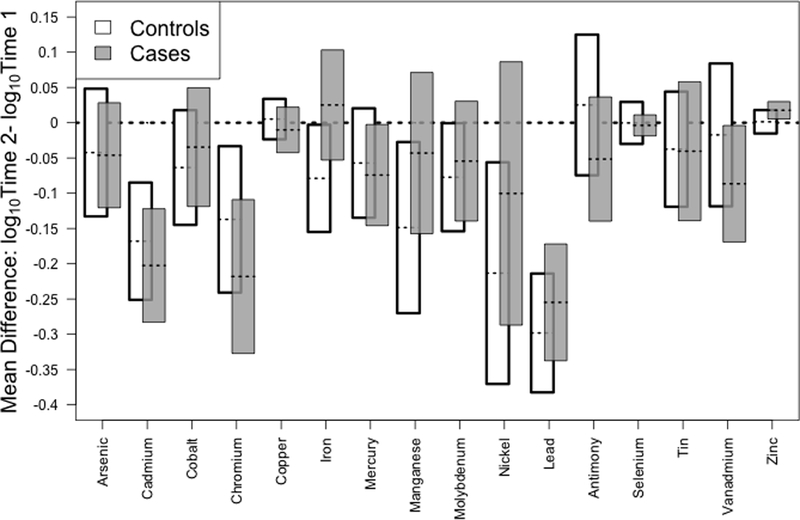
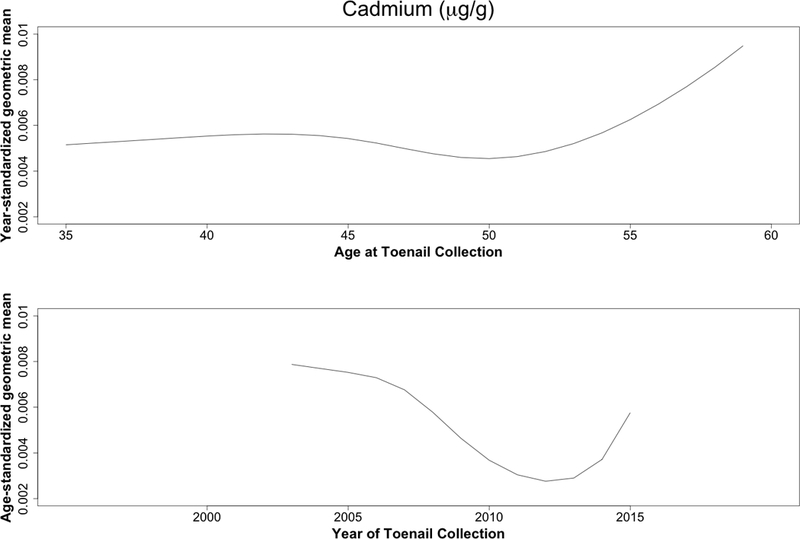
Overall, we observed positive correlations (R = 0.18-0.71) between paired samples for all trace elements. However, nickel (R = -0.02) and antimony (R = 0.12) were not correlated among cases. We observed decreases in cadmium, chromium, mercury, manganese, molybdenum, nickel, and lead between baseline and follow-up, but case status was unrelated to these changes. The declines are consistent with decreases over calendar time rather than age time.
Toenail trace element concentrations were correlated over time, but many elements showed systematic decreases by calendar year. Aside from nickel and antimony, postdiagnostic toenail levels correlated with prediagnostic levels, providing support for using postdiagnostic toenail samples in retrospective studies.
微量元素暴露可能会影响健康,包括乳腺癌风险。脚趾甲中的微量元素水平可能是暴露的有用生物标志物,但它们的可靠性尚未确定。我们评估了脚趾甲元素浓度随时间的重现性,以及在乳腺癌诊断后浓度是否会发生变化。
我们评估了 221 名女性(111 名有、110 名无乳腺癌诊断)的两次脚趾甲样本中的微量元素水平。我们使用电感耦合等离子体质谱法测量了基线和 4-10 年后采集的样本中砷、镉、铬、钴、铜、铁、汞、锰、钼、镍、铅、锑、硒、锡、钒和锌的水平。我们使用 Spearman 秩相关系数(R)比较了随时间变化的微量元素浓度。我们使用线性模型来检验变化的幅度和方向以及乳腺癌诊断的影响。
总体而言,我们观察到所有微量元素的配对样本之间存在正相关(R = 0.18-0.71)。然而,病例组中镍(R = -0.02)和锑(R = 0.12)之间没有相关性。我们观察到基线和随访之间镉、铬、汞、锰、钼、镍和铅的浓度降低,但病例状态与这些变化无关。这些下降与随日历时间而不是年龄时间的下降一致。
脚趾甲微量元素浓度随时间相关,但许多元素按日历年度呈系统性下降。除镍和锑外,诊断后脚趾甲水平与诊断前水平相关,支持在回顾性研究中使用诊断后脚趾甲样本。