Wheeler Diek W, Banduri Shaina, Sankararaman Sruthi, Vinay Samhita, Ascoli Giorgio A
Center for Neural Informatics, Krasnow Institute for Advanced Studies and Bioengineering Department, College of Engineering & Computing, George Mason University, Fairfax VA (USA).
Res Sq. 2023 Jul 3:rs.3.rs-3044664. doi: 10.21203/rs.3.rs-3044664/v1.
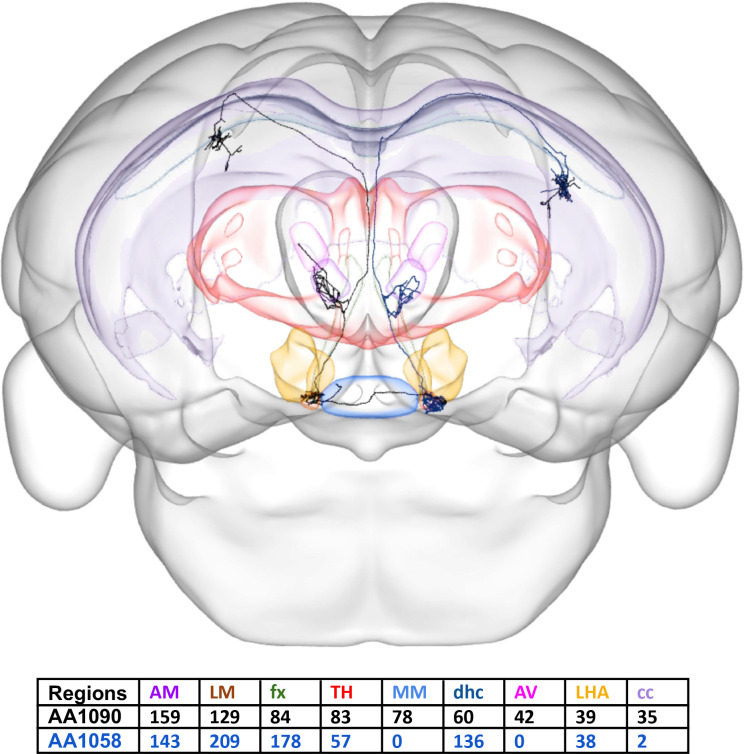
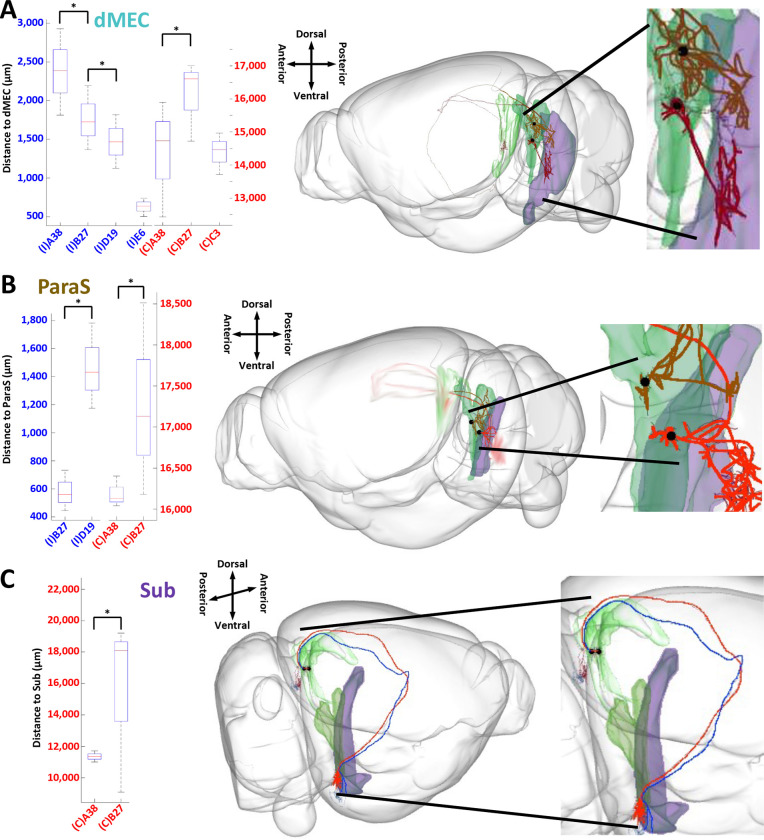
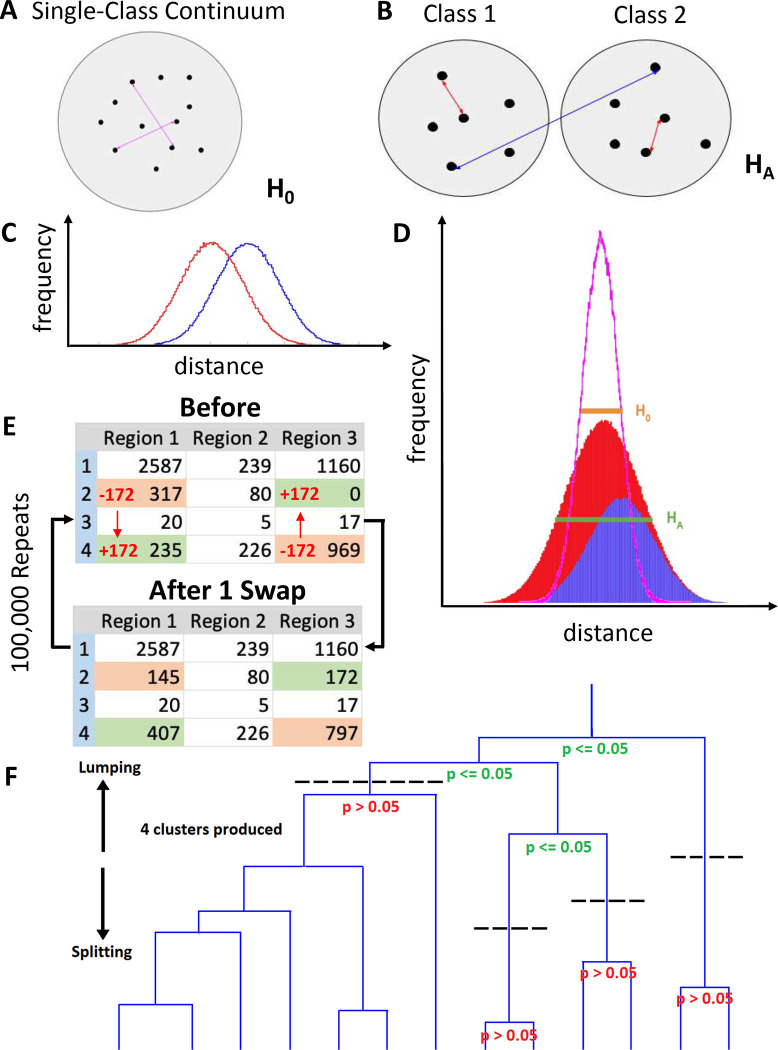
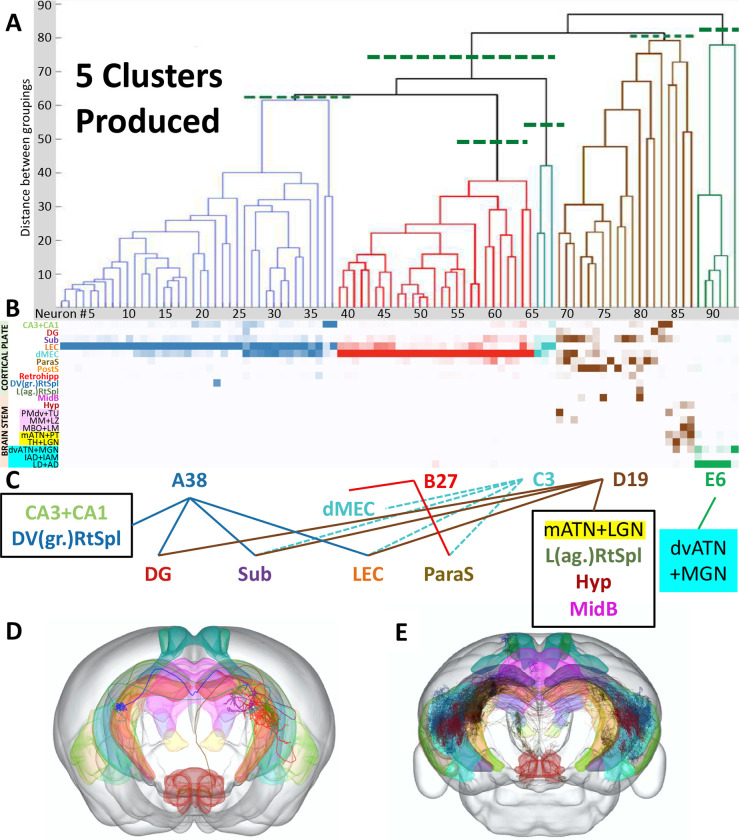
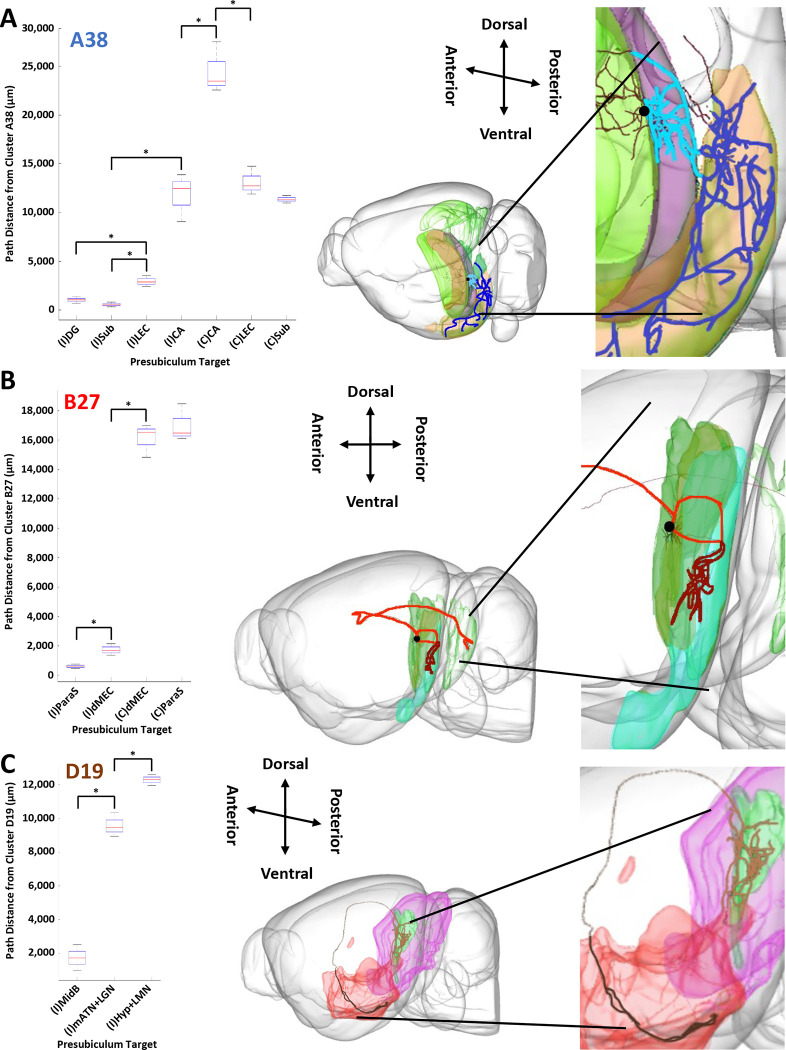
Long-range axonal projections are quintessential determinants of network connectivity, linking cellular organization and circuit architecture. Here we introduce a quantitative strategy to identify, from a given source region, all "projection neuron types" with statistically different patterns of anatomical targeting. We first validate the proposed technique with well-characterized data from layer 6 of the mouse primary motor cortex. The results yield two clusters, consistent with previously discovered cortico-thalamic and intra-telencephalic neuron classes. We next analyze neurons from the presubiculum, a less-explored region. Extending sparse knowledge from earlier retrograde tracing studies, we identify five classes of presubicular projecting neurons, revealing unique patterns of divergence, convergence, and specificity. We thus report several findings: (1) individual classes target multiple subregions along defined functions, such as spatial representation vs. sensory integration and visual vs. auditory input; (2) all hypothalamic regions are exclusively targeted by the same class also invading midbrain, a sharp subset of thalamic nuclei, and agranular retrosplenial cortex; (3) Cornu Ammonis, in contrast, receives input from the same presubicular axons projecting to granular retrosplenial cortex, also the purview of a single class; (4) path distances from the presubiculum to the same targets differ significantly between classes, as do the path distances to distinct targets within most classes, suggesting fine temporal coordination in activating distant areas; (5) the identified classes have highly non-uniform abundances, with substantially more neurons projecting to midbrain and hypothalamus than to medial and lateral entorhinal cortex; (6) lastly, presubicular soma locations are segregated among classes, indicating topographic organization of projections. This study thus demonstrates that classifying neurons based on statistically distinct axonal projection patterns sheds light on the functional organizational of their circuit.
长程轴突投射是网络连接性的关键决定因素,它连接着细胞组织和神经回路结构。在此,我们介绍一种定量策略,用于从给定的源区域识别所有具有统计学上不同解剖靶向模式的“投射神经元类型”。我们首先用来自小鼠初级运动皮层第6层的特征明确的数据验证了所提出的技术。结果产生了两个簇,与先前发现的皮质 - 丘脑和脑内神经元类别一致。接下来,我们分析了来自前扣带回(一个较少被探索的区域)的神经元。通过扩展早期逆行追踪研究的稀疏知识,我们识别出五类前扣带回投射神经元,揭示了独特的发散、汇聚和特异性模式。因此,我们报告了几个发现:(1)单个类别沿着定义的功能靶向多个子区域,如空间表征与感觉整合以及视觉与听觉输入;(2)所有下丘脑区域仅由同一类别靶向,该类别还侵入中脑、丘脑核的一个特定子集以及无颗粒后扣带回皮质;(3)相比之下,海马体从投射到颗粒后扣带回皮质的相同前扣带回轴突接收输入,这也属于单一类别的范围;(4)不同类别之间从前扣带回到相同目标的路径距离有显著差异,大多数类别中到不同目标的路径距离也是如此,这表明在激活远处区域时存在精细的时间协调;(5)所识别的类别具有高度不均匀的丰度,投射到中脑和下丘脑的神经元比投射到内侧和外侧内嗅皮质的神经元多得多;(6)最后,前扣带回神经元的胞体位置在不同类别之间是分开的,表明投射的拓扑组织。因此,这项研究表明,基于统计学上不同的轴突投射模式对神经元进行分类有助于揭示其神经回路的功能组织。