Unit of Epidemiological and Evaluation Psychiatry, IRCCS Istituto Centro San Giovanni di Dio Fatebenefratelli, Brescia, Italy.
Department of Psychology, University of Milano Bicocca, Milano, Italy.
J Med Internet Res. 2023 Jul 18;25:e42093. doi: 10.2196/42093.
The Experience Sampling Method (ESM) is a valid method of remotely recording activities and mood, but the predictors of adherence to ESM in patients with Schizophrenia Spectrum Disorder (SSD) are not known. Studies on adherence are significant as they highlight the strengths and weaknesses of ESM-based study designs and allow the development of recommendations and practical guidelines for implementing future studies or treatment plans.
The aim of this study was to compare the adherence to ESM in patients with SSD and unaffected control individuals, investigate their patterns, and report the predictors of adherence.
In total, 131 patients with SSD (74 in residential facilities and 57 outpatients) and 115 unaffected control individuals were recruited at 10 different centers in Italy as part of the DiAPAson project. Demographic information, symptom severity, disability level, and level of function were recorded for the clinical sample. Participants were evaluated for daily time use and mood through a smartphone-based ESM 8 times a day for 7 consecutive days. Adherence was measured by the response rate to ESM notifications. Results were analyzed using the chi-square test, ANOVA, Kruskal-Wallis test, and Friedman test, and a logistic regression model.
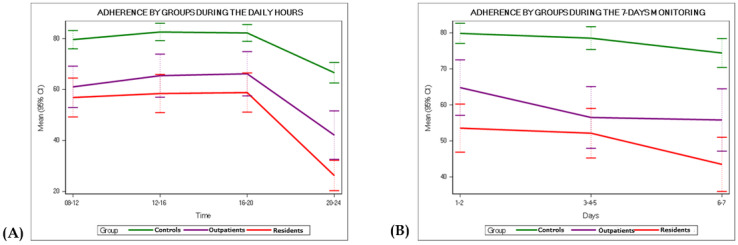
The overall adherence rate in this study was 50% for residents, 59% for outpatients, and 78% for unaffected control individuals. Indeed, patients with SSD had a lower rate of adherence to ESM than the unaffected control group (P≤.001), independent of time slot, day of monitoring, or day of the week. No differences in adherence rates between weekdays and weekends were found among the 3 groups. The adherence rate was the lowest in the late evening time slot (8 PM to 12 AM) and days 6-7 of the study for both patients with SSD and unaffected control individuals. The adherence rate among patients with SSD was not predicted by sociodemographic characteristics, cognitive function, or other clinical features. A higher adherence rate (ie, ≥70%) among patients with SSD was predicted by higher collaboration skills (odds ratio [OR] 2.952; P=.046) and self-esteem (OR 3.394; P=.03), and lower positive symptom severity (OR 0.835; P=.04).
Adherence to ESM prompts for both patients with SSD and unaffected control individuals decreased during late evening and after 6 days of monitoring. Higher self-esteem and collaboration skills predicted higher adherence to ESM among patients with SSD, while higher positive symptom scores predicted lower adherence rates. This study provides important information to guide protocols for future studies using ESM. Future clinical or research studies should set ESM monitoring to waking hours, limit the number of days of monitoring, select patients with more collaborative skills and avoid those with marked positive symptoms, provide intensive training sessions, and improve participants' self-confidence with technologies.
INTERNATIONAL REGISTERED REPORT IDENTIFIER (IRRID): RR2-10.1186/s12888-020-02588-y.
经验采样法(ESM)是一种远程记录活动和情绪的有效方法,但精神分裂症谱系障碍(SSD)患者对 ESM 的依从性的预测因素尚不清楚。对依从性的研究很重要,因为它们突出了基于 ESM 的研究设计的优缺点,并为实施未来的研究或治疗计划制定了建议和实用指南。
本研究旨在比较 SSD 患者和未受影响的对照组个体对 ESM 的依从性,调查他们的模式,并报告依从性的预测因素。
在意大利的 10 个不同中心,共招募了 131 名 SSD 患者(74 名住院患者和 57 名门诊患者)和 115 名未受影响的对照组个体,作为 DiAPAson 项目的一部分。为临床样本记录人口统计学信息、症状严重程度、残疾程度和功能水平。参与者通过智能手机接受 8 次每日 ESM 评估,连续 7 天,每天评估 8 次。通过对 ESM 通知的响应率来衡量依从性。使用卡方检验、方差分析、克鲁斯卡尔-沃利斯检验和弗里德曼检验以及逻辑回归模型分析结果。
本研究中,居民的整体依从率为 50%,门诊患者为 59%,未受影响的对照组个体为 78%。实际上,与未受影响的对照组相比,SSD 患者对 ESM 的依从性较低(P≤.001),这与时间插槽、监测日或监测周几无关。3 组之间在工作日和周末之间未发现依从率的差异。在晚上 8 点到 12 点(晚上 8 点至 12 点)和研究的第 6-7 天,SSD 患者和未受影响的对照组个体的依从率最低。SSD 患者的依从率不受社会人口特征、认知功能或其他临床特征的预测。SSD 患者较高的依从率(即≥70%)预测因素为较高的协作技能(比值比[OR]2.952;P=.046)和自尊心(OR 3.394;P=.03),较低的阳性症状严重程度(OR 0.835;P=.04)。
SSD 患者和未受影响的对照组个体对 ESM 提示的依从性在晚上和监测 6 天后均下降。较高的自尊心和协作技能预测 SSD 患者对 ESM 的依从性较高,而较高的阳性症状评分预测依从率较低。本研究为使用 ESM 的未来研究提供了重要信息,指导协议制定。未来的临床或研究应将 ESM 监测设置在清醒时间,限制监测天数,选择协作技能较高的患者,避免选择阳性症状明显的患者,提供密集的培训课程,并提高参与者对技术的自信心。
国际注册报告标识符(IRRID):RR2-10.1186/s12888-020-02588-y。
