Department of Neurology, China-Japan Union Hospital, Jilin University, Changchun, China.
Department of Rehabilitation, The Second Hospital of Jilin University, Changchun, China.
Curr Neuropharmacol. 2023;21(12):2465-2480. doi: 10.2174/1570159X21666230718104634.
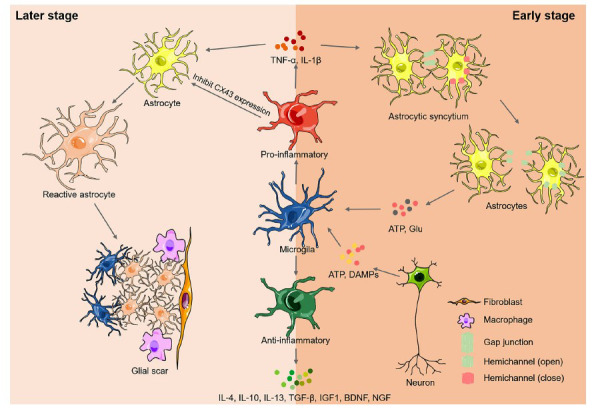
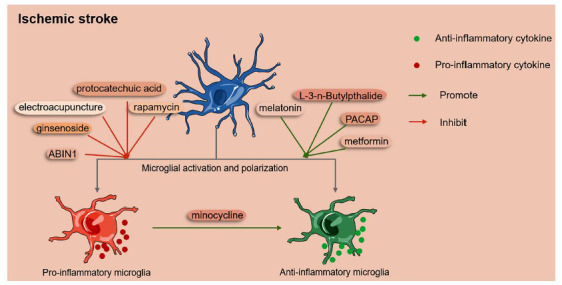
Ischemic stroke is the predominant cause of severe morbidity and mortality worldwide. Post-stroke neuroinflammation has recently received increasing attention with the aim of providing a new effective treatment strategy for ischemic stroke. Microglia and astrocytes are major components of the innate immune system of the central nervous system. They can be involved in all phases of ischemic stroke, from the early stage, contributing to the first wave of neuronal cell death, to the late stage involving phagocytosis and repair. In the early stage of ischemic stroke, a vicious cycle exists between the activation of microglia and astrocytes (through astrocytic connexin 43 hemichannels), aggravating neuroinflammatory injury post-stroke. However, in the late stage of ischemic stroke, repeatedly activated microglia can induce the formation of glial scars by triggering reactive astrogliosis in the peri-infarct regions, which may limit the movement of activated microglia in reverse and restrict the diffusion of inflammation to healthy brain tissues, alleviating the neuroinflammatory injury poststroke. In this review, we elucidated the various roles of astrocytes and microglia and summarized their relationship with neuroinflammation. We also examined how astrocytes and microglia influence each other at different stages of ischemic stroke. Several potential therapeutic approaches targeting astrocytes and microglia in ischemic stroke have been reviewed. Understanding the details of astrocytemicroglia interaction processes will contribute to a better understanding of the mechanisms underlying ischemic stroke, contributing to the identification of new therapeutic interventions.
缺血性脑卒中是全世界导致严重发病率和死亡率的主要原因。卒中后神经炎症最近受到越来越多的关注,旨在为缺血性脑卒中提供新的有效治疗策略。小胶质细胞和星形胶质细胞是中枢神经系统固有免疫系统的主要组成部分。它们可以参与缺血性脑卒中的所有阶段,从早期导致第一波神经元细胞死亡,到晚期涉及吞噬和修复。在缺血性脑卒中的早期,小胶质细胞和星形胶质细胞的激活(通过星形胶质细胞连接蛋白 43 半通道)之间存在一个恶性循环,加重卒中后的神经炎症损伤。然而,在缺血性脑卒中的晚期,反复激活的小胶质细胞可以通过在梗死周围区域触发反应性星形胶质细胞化来诱导神经胶质瘢痕的形成,这可能会限制激活的小胶质细胞的反向运动,并限制炎症向健康脑组织扩散,从而减轻卒中后的神经炎症损伤。在这篇综述中,我们阐明了星形胶质细胞和小胶质细胞的各种作用,并总结了它们与神经炎症的关系。我们还研究了星形胶质细胞和小胶质细胞在缺血性脑卒中的不同阶段如何相互影响。还回顾了几种针对缺血性脑卒中星形胶质细胞和小胶质细胞的潜在治疗方法。了解星形胶质细胞-小胶质细胞相互作用过程的细节将有助于更好地理解缺血性脑卒中的机制,并有助于确定新的治疗干预措施。