Donal Erwan, Tribouilloy Christophe, Sadeghpour Anita, Laroche Cécile, Tude Rodrigues Ana Clara, Pereira Nunes Maria do Carmo, Kang Duk-Hyun, Hernadez-Meneses Marta, Kobalava Zhanna, De Bonis Michele, Dworakowski Rafal, Ivanovic Branislava, Holicka Maria, Kitai Takeshi, Cruz Ines, Huttin Olivier, Colonna Paolo, Lancellotti Patrizio, Habib Gilbert
Cardiologie, CHU de RENNES, LTSI UMR1099, INSERM, Université de Rennes-1, hopital pontchaillou, 35000 Rennes, France.
Department of Cardiology, Amiens University Hospital Amiens, Amiens 80000, France.
Eur Heart J Open. 2023 Jul 3;3(4):oead064. doi: 10.1093/ehjopen/oead064. eCollection 2023 Jul.
Cardiac device-related infective endocarditis (CDRIE) is a severe complication of cardiac device (CD) implantation and is usually treated by antibiotic therapy and percutaneous device extraction. Few studies report the management and prognosis of CDRIE in real life. In particular, the rate of device extraction in clinical practice and the management of patients with left heart infective endocarditis (LHIE) and an apparently non-infected CD (LHIE+CDRIE-) are not well described.
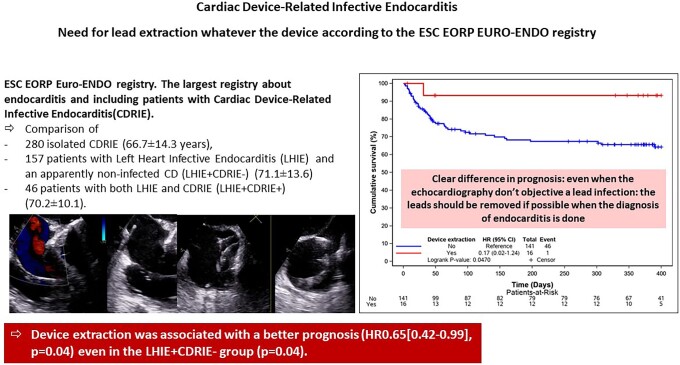
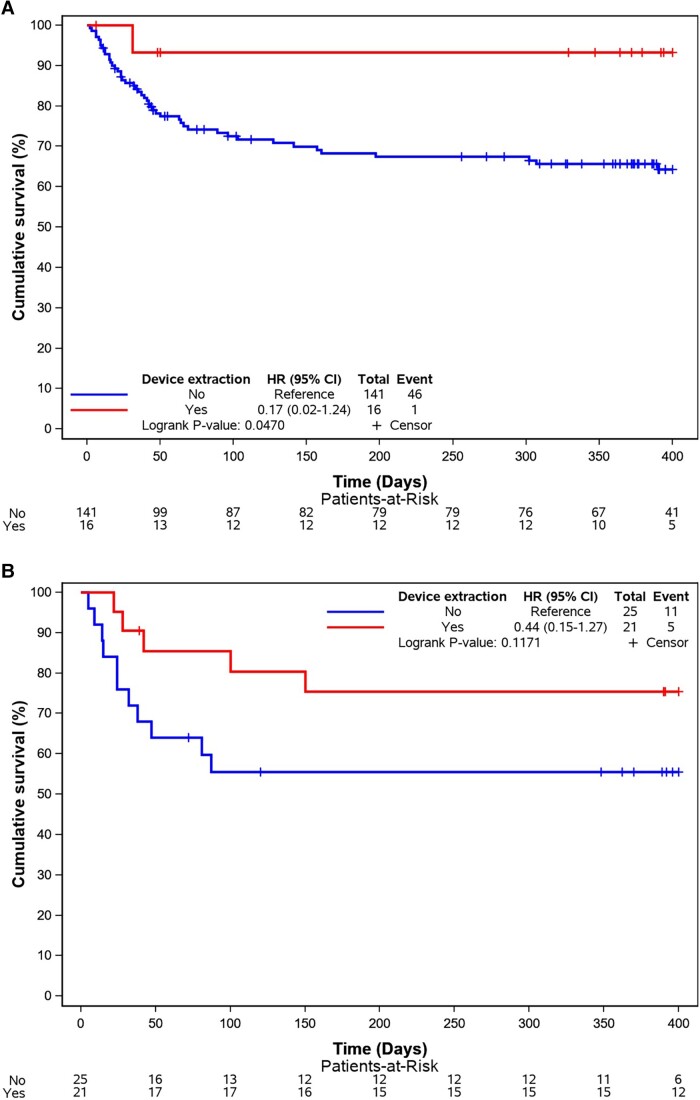
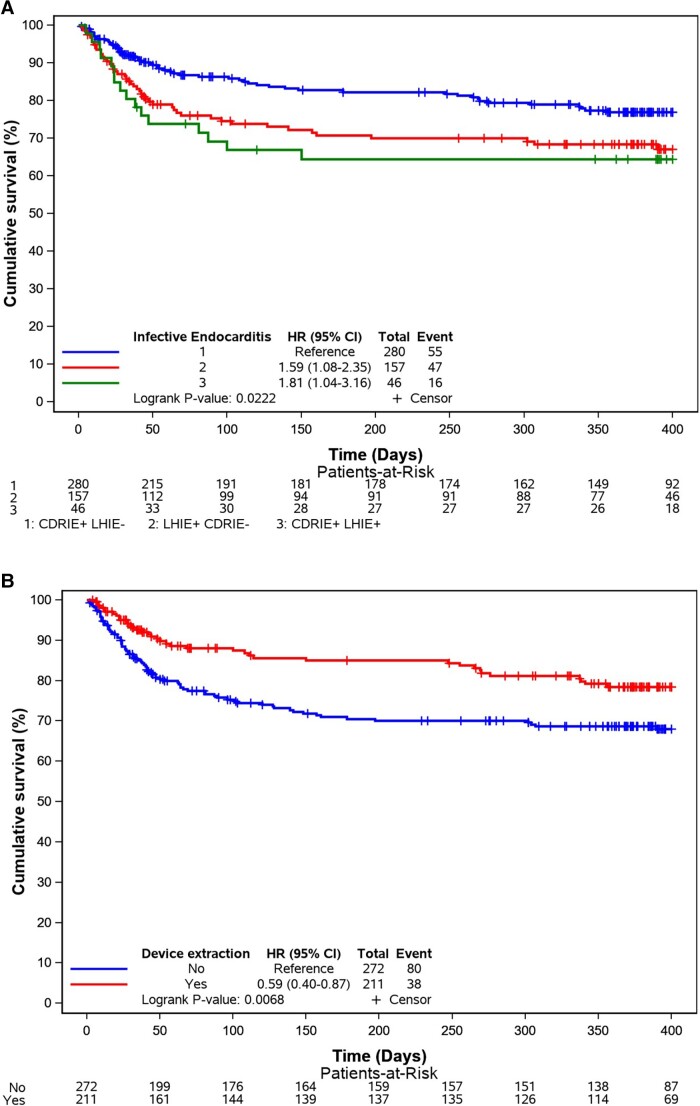
We sought to study in EURO-ENDO, the characteristics, prognosis, and management of 483 patients with a CD included in the European Society of Cardiology EurObservational Research Programme EURO-ENDO registry. Three populations were compared: 280 isolated CDRIE (66.7 ± 14.3 years), 157 patients with LHIE and an apparently non-infected CD (LHIE+CDRIE-) (71.1 ± 13.6), and 46 patients with both LHIE and CDRIE (LHIE+CDRIE+) (70.2 ± 10.1). Echocardiography was not always transoesophageal echography (TOE); it was transthoracic echography (TTE) for isolated CDRIE in 88.4% (TOE = 67.6%), for LHIE+CDRIE- TTE = 93.0% (TOE = 58.6%), and for CDRIE+LHIE+ TTE = 87.0% (TOE = 63.0%). Nuclear imaging was performed in 135 patients (positive for 75.6%). In-hospital mortality was lower in isolated CDRIE 13.2% vs. 22.3% and 30.4% for LHIE+CDRIE- and LHIE+CDRIE+ ( = 0004). Device extraction was performed in 62.1% patients with isolated CDRIE, 10.2% of LHIE+CDRIE- patients, and 45.7% of CDRIE+LHIE+ patients. Device extraction was associated with a better prognosis [hazard ratio 0.59 (0.40-0.87), = 0.0068] even in the LHIE+CDRIE- group ( = 0.047).
Prognosis of endocarditis in patients with a CD remains poor, particularly in the presence of an associated LHIE. Although recommended by guidelines, device extraction is not always performed. Device removal was associated with better prognosis, even in the LHIE+CDRIE- group.
心脏装置相关感染性心内膜炎(CDRIE)是心脏装置(CD)植入后的一种严重并发症,通常采用抗生素治疗和经皮装置拔除术。很少有研究报道现实生活中CDRIE的管理和预后情况。特别是,临床实践中装置拔除率以及左心感染性心内膜炎(LHIE)合并明显未感染CD(LHIE+CDRIE-)患者的管理情况尚未得到充分描述。
我们在欧洲心脏病学会EurObservational研究计划EURO-ENDO注册研究中,对483例植入CD的患者的特征、预后和管理情况进行了研究。比较了三组人群:280例孤立性CDRIE患者(66.7±14.3岁),157例LHIE合并明显未感染CD的患者(LHIE+CDRIE-)(71.1±13.6岁),以及46例同时患有LHIE和CDRIE的患者(LHIE+CDRIE+)(70.2±10.1岁)。超声心动图并非总是经食管超声心动图(TOE);对于孤立性CDRIE,88.4%采用经胸超声心动图(TTE)(TOE为67.6%),对于LHIE+CDRIE-,TTE为93.0%(TOE为58.6%),对于CDRIE+LHIE+患者,TTE为87.0%(TOE为63.0%)。135例患者进行了核成像(阳性率为75.6%)。孤立性CDRIE患者的院内死亡率较低,为13.2%,而LHIE+CDRIE-和LHIE+CDRIE+患者分别为22.3%和30.4%(P=0.004)。62.1%的孤立性CDRIE患者、10.2%的LHIE+CDRIE-患者和45.7%的CDRIE+LHIE+患者进行了装置拔除。装置拔除与更好的预后相关[风险比0.59(0.40-0.87),P=0.0068],即使在LHIE+CDRIE-组也是如此(P=0.047)。
植入CD患者的心内膜炎预后仍然很差,尤其是合并LHIE时。尽管指南推荐,但并非总是进行装置拔除。装置移除与更好的预后相关,即使在LHIE+CDRIE-组也是如此。