El-Gaaly Maged, Tomlinson James Steven, Ezzo Talal
Cardiology Department, Leeds Teaching Hospitals NHS Trust, Leeds, LS9 7, UK.
Cardiology Department, North Bristol NHS Trust, Southmead Hospital, Southmead Road, Westbury-On-Trym, Bristol BS10 5NB, UK.
Eur Heart J Case Rep. 2022 Aug 2;6(8):ytac294. doi: 10.1093/ehjcr/ytac294. eCollection 2022 Aug.
Culture-negative endocarditis is uncommon, occurring in less than a third of all cases of infective endocarditis (IE). Culture-negative IE related to a cardiac device is an even greater diagnostic challenge due to its insidious presentation, with onset of symptoms ranging between 3 and 12 months after device implantation. Sensitivity of the modified Duke's criteria remains low in culture-negative and cardiac device-related IE (CDRIE) since classical signs and symptoms of IE are often absent. Small vessel vasculitis has been reported as an immune response to IE. Recognizing immunological phenomenon related to IE is of paramount clinical importance, prompting the search for an underlying infection and avoiding the use of immunosuppressive medications which would otherwise result in an adverse outcome.
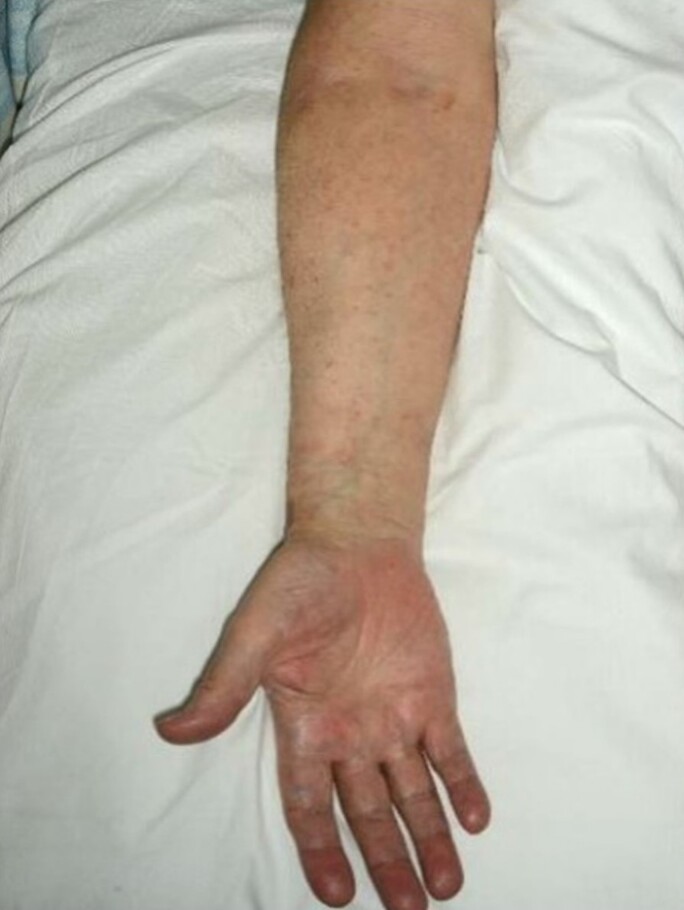
An 81-year-old Caucasian male presented to the ambulatory medical unit with a two-week history of a symmetrical, generalized purpuric rash. He had an indwelling permanent pacemaker following a transcatheter aortic valve implantation for severe aortic stenosis five years ago. Blood tests showed an iron deficiency anaemia, thrombocytopenia and normal renal function, both CRP and ESR were raised at 61 and 30 mm/hr, respectively. Skin biopsy demonstrated small vessel cutaneous vasculitis. Transthoracic echocardiography revealed a mobile mass measuring 0.9 × 1.7 cm, confirmed on transoesophageal echocardiogram as pacing lead endocarditis. Blood cultures were persistently negative. The patient underwent pacemaker lead extraction, following which the vasculitic rash improved.
Blood cultures in IE are more likely to be negative if there is a prior antibiotic administration or causative micro-organisms with limited proliferation which fail to grow in conventional media conditions. Transesophageal echocardiography (TOE) offers improved sensitivity and diagnostic yield when compared to transthoracic echocardiography (TTE) in patients with a high clinical suspicion of CDRIE. The evidence in the literature describing culture-negative IE associated with small vessel vasculitis is limited. However, it is recognized that cutaneous small vessel vasculitis may be associated with an underlying bacterial infection. IE produces an inflammatory response, resulting in the deposition of circulating immune complexes and cutaneous signs which are included in the modified Duke's criteria to aid diagnosis. Management of CDRIE requires a multi-disciplinary team approach with an 'Endocarditis Team.' Pacemaker lead infection requires transvenous lead extraction if it is a newly implanted lead. Locking stylets, extraction sheaths or snare retrieval are usually required in cases of older implanted leads. Surgical lead extraction remains the gold standard for larger vegetations (>20 mm) or associated valve endocarditis.

血培养阴性的心内膜炎并不常见,在所有感染性心内膜炎(IE)病例中占比不到三分之一。与心脏装置相关的血培养阴性IE是一个更大的诊断挑战,因为其表现隐匿,症状在装置植入后3至12个月出现。在血培养阴性及与心脏装置相关的心内膜炎(CDRIE)中,改良的杜克标准的敏感性仍然较低,因为IE的典型体征和症状往往不存在。据报道,小血管血管炎是对IE的一种免疫反应。认识到与IE相关的免疫现象具有至关重要的临床意义,有助于寻找潜在感染并避免使用会导致不良后果的免疫抑制药物。
一名81岁的白人男性因对称性、全身性紫癜性皮疹两周病史就诊于门诊医疗单元。他五年前因严重主动脉瓣狭窄接受经导管主动脉瓣植入术后植入了永久性起搏器。血液检查显示缺铁性贫血、血小板减少且肾功能正常,CRP和ESR分别升高至61 mg/L和30 mm/hr。皮肤活检显示小血管皮肤血管炎。经胸超声心动图显示一个大小为0.9×1.7 cm的活动团块,经食管超声心动图证实为起搏导线心内膜炎。血培养持续阴性。患者接受了起搏器导线拔除术,术后血管炎性皮疹有所改善。
如果之前使用过抗生素或致病微生物增殖受限而无法在传统培养基条件下生长,IE的血培养更有可能呈阴性。对于高度怀疑CDRIE的患者,与经胸超声心动图(TTE)相比,经食管超声心动图(TOE)的敏感性和诊断率更高。文献中描述与小血管血管炎相关的血培养阴性IE的证据有限。然而,人们认识到皮肤小血管血管炎可能与潜在的细菌感染有关。IE会产生炎症反应,导致循环免疫复合物沉积和皮肤体征,这些体征被纳入改良的杜克标准以辅助诊断。CDRIE的管理需要一个“心内膜炎团队”的多学科团队方法。如果是新植入的导线,起搏器导线感染需要经静脉拔除导线。对于植入时间较长的导线,通常需要锁定管心针、拔除鞘或圈套器取出。手术拔除导线仍然是较大赘生物(>20 mm)或相关瓣膜心内膜炎的金标准。