Key Laboratory of Organ Regeneration and Transplantation of Ministry of Education, First Hospital of Jilin University, Changchun, China.
National-Local Joint Engineering Laboratory of Animal Models for Human Disease, First Hospital of Jilin University, Changchun, China.
Front Immunol. 2023 Jul 3;14:1227797. doi: 10.3389/fimmu.2023.1227797. eCollection 2023.
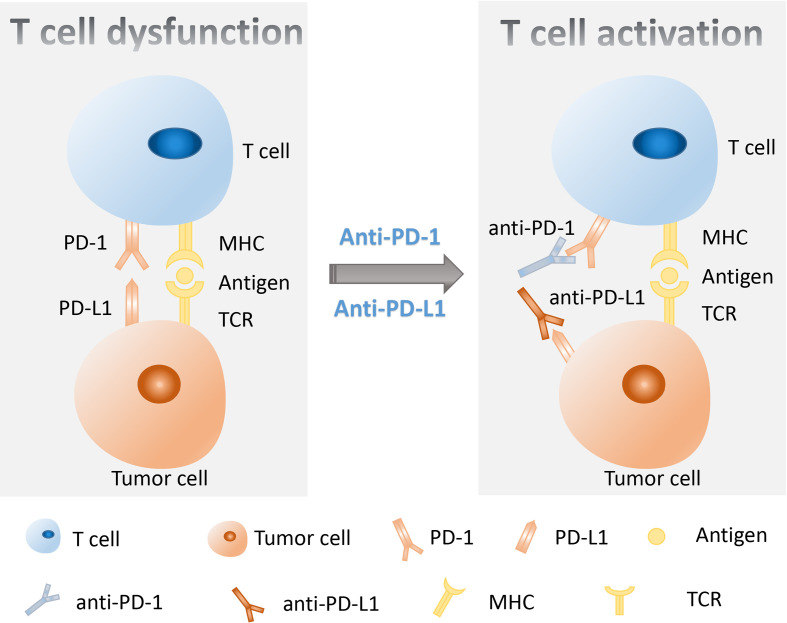
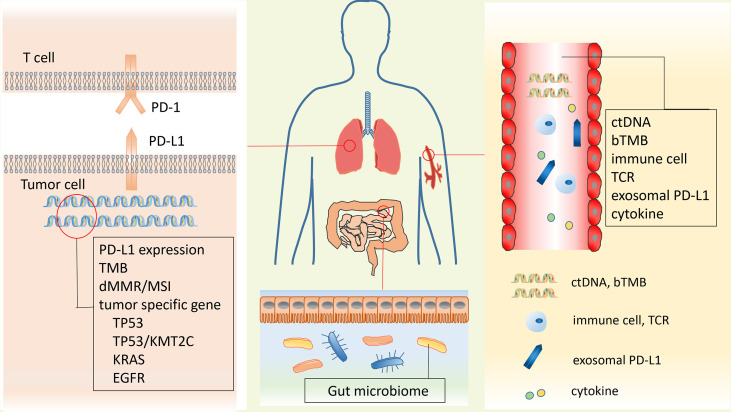
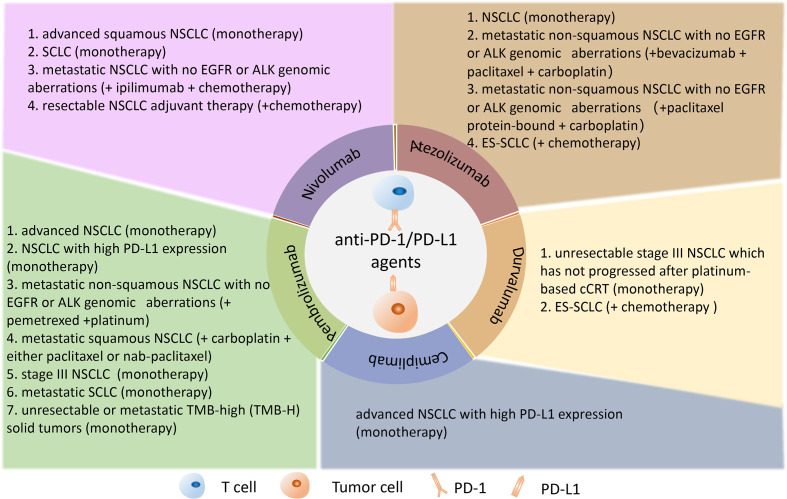
Currently, anti-PD-1/PD-L1 immunotherapy using immune checkpoint inhibitors is widely used in the treatment of multiple cancer types including lung cancer, which is a leading cause of cancer death in the world. However, only a limited proportion of lung cancer patients will benefit from anti-PD-1/PD-L1 therapy. Therefore, it is of importance to predict the response to immunotherapy for the precision treatment of patients. Although the expression of PD-L1 and tumor mutation burden (TMB) are commonly used to predict the clinical response of anti-PD-1/PD-L1 therapy, other factors such as tumor-specific genes, dMMR/MSI, and gut microbiome are also promising predictors for immunotherapy in lung cancer. Furthermore, invasive peripheral blood biomarkers including blood DNA-related biomarkers (e.g., ctDNA and bTMB), blood cell-related biomarkers (e.g., immune cells and TCR), and other blood-related biomarkers (e.g., soluble PD-L1 and cytokines) were utilized to predict the immunotherapeutic response. In this review, the current achievements of anti-PD-1/PD-L1 therapy and the potential biomarkers for the prediction of anti-PD-1/PD-L1 immunotherapy in lung cancer treatment were summarized and discussed.
目前,使用免疫检查点抑制剂的抗 PD-1/PD-L1 免疫疗法已广泛用于治疗多种癌症类型,包括肺癌,肺癌是世界上癌症死亡的主要原因。然而,只有有限比例的肺癌患者将从抗 PD-1/PD-L1 治疗中获益。因此,预测免疫治疗的反应对于患者的精准治疗非常重要。尽管 PD-L1 的表达和肿瘤突变负担(TMB)常用于预测抗 PD-1/PD-L1 治疗的临床反应,但其他因素,如肿瘤特异性基因、dMMR/MSI 和肠道微生物组,也是肺癌免疫治疗有前途的预测因子。此外,还利用包括血液 DNA 相关生物标志物(如 ctDNA 和 bTMB)、血细胞相关生物标志物(如免疫细胞和 TCR)和其他血液相关生物标志物(如可溶性 PD-L1 和细胞因子)在内的侵袭性外周血生物标志物来预测免疫治疗反应。在这篇综述中,总结和讨论了抗 PD-1/PD-L1 治疗的当前成就以及用于预测肺癌治疗中抗 PD-1/PD-L1 免疫治疗的潜在生物标志物。