AGE Research Group, Translational and Clinical Research Institute, Faculty of Medical Sciences, Newcastle University, Newcastle, UK.
NIHR Newcastle Biomedical Research Centre, Newcastle upon Tyne Hospitals NHS Foundation Trust, Cumbria, Northumberland, Tyne and Wear NHS Foundation Trust and Newcastle University, Newcastle, UK.
Age Ageing. 2023 Jul 1;52(7). doi: 10.1093/ageing/afad127.
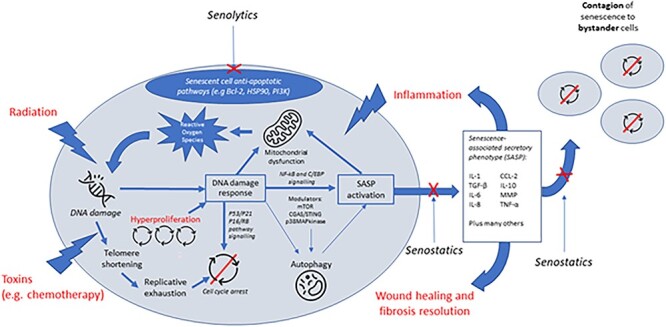
Cellular senescence has emerged as a fundamental biological mechanism underpinning the ageing process and has been implicated in the pathogenesis of an increasing number of age-related conditions. Cellular senescence is a cell fate originally defined as an irreversible loss of replicative potential although it is now clear that it can be induced by a variety of mechanisms independent of replication and telomere attrition. The drivers include a persistent DNA damage response causing multiple alterations in cellular function. Senescent cells secrete a range of mediators that drive chronic inflammation and can convert other cells to the senescent state-the senescence-associated secretory phenotype. Much research to date has been conducted in animal models, but it is now clear that senescent cells accompany ageing in humans and their presence is an important driver of disease across systems. Proof-of-concept work suggests that preventing or reversing senescence may be a viable strategy to counteract human ageing and age-related disease. Possible interventions include exercise, nutrition and senolytics/senostatic drugs although there are a number of potential limitations to the use of senotherapeutics. These interventions are generally tested for single-organ conditions, but the real power of this approach is the potential to tackle multiple age-related conditions. The litmus test for this exciting new class of therapies, however, will be whether they can improve healthy life expectancy rather than merely extending lifespan. The outcomes measured in clinical studies need to reflect these aims if senotherapeutics are to gain the trust of clinicians, patients and the public.
细胞衰老已成为支撑衰老过程的基本生物学机制,并与越来越多与年龄相关的疾病的发病机制有关。细胞衰老最初被定义为复制潜力的不可逆丧失的细胞命运,尽管现在很清楚它可以通过多种独立于复制和端粒损耗的机制来诱导。驱动因素包括导致细胞功能发生多种改变的持续 DNA 损伤反应。衰老细胞分泌一系列介质,引发慢性炎症,并可将其他细胞转化为衰老状态——衰老相关分泌表型。迄今为止,大量研究都是在动物模型中进行的,但现在很清楚,衰老细胞伴随着人类的衰老,它们的存在是跨系统疾病的重要驱动因素。概念验证工作表明,预防或逆转衰老可能是对抗人类衰老和与年龄相关疾病的可行策略。可能的干预措施包括运动、营养和衰老抑制剂/衰老稳定剂药物,尽管使用衰老治疗存在许多潜在的限制。这些干预措施通常针对单一器官疾病进行测试,但这种方法的真正力量在于有潜力解决多种与年龄相关的疾病。然而,对于这种令人兴奋的新型治疗方法来说,试金石将是它们是否能够提高健康预期寿命,而不仅仅是延长寿命。如果衰老治疗要获得临床医生、患者和公众的信任,那么临床研究中测量的结果就需要反映这些目标。