Sridharan Kannan, Madhoob Abdulraoof Al, Jufairi Muna Al, Ansari Eman Al, Marzooq Reem Al, Hubail Zakariya, Hasan Sadiq Jaafar
Department of Pharmacology and Therapeutics, College of Medicine and Medical Sciences, Arabian Gulf University, Manama, Kingdom of Bahrain.
Neonatology Intensive Care Unit, Department of Pediatrics, Salmaniya Medical Complex, Manama, Kingdom of Bahrain.
J Pharm Bioallied Sci. 2023 Apr-Jun;15(2):95-100. doi: 10.4103/jpbs.jpbs_420_22. Epub 2023 Jun 8.
Gentamicin has been shown to cause vasodilation in preclinical studies. Hemodynamically significant patent ductus arteriosus (hsPDA) is a commonly observed congenital heart disorder in preterm neonates. Concomitant gentamicin theoretically shall delay the closure/result in nonclosure of ductus arteriosus (DA). Similarly, hsPDA can alter the pharmacokinetics of gentamicin and so trough gentamicin concentrations. We carried out the present study to evaluate the association between gentamicin use and closure of hsPDA (treated with acetaminophen) as well as the effect of hsPDA on trough concentrations.
This study was a prospective, observational study that included 60 neonates diagnosed with hsPDA by echocardiography and 102 neonates without hsPDA. Demographic details, size of DA as per echocardiography at the end of treatment with acetaminophen, gentamicin-dosing regimen, and trough concentrations were collected. Standard definitions were adhered in classifying the gestational age, birth weights, and size of DA. The numerical values are reported in median (range).
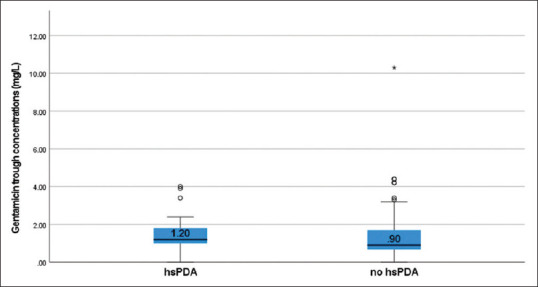
Neonates with hsPDA had significantly lower daily doses of gentamicin [4.5 (2.5-10), 7 (3.2-13) mg; < 0.001] but longer duration of therapy [8 (3-14), 5 (3-7) days; < 0.001] than those without hsPDA in very preterm neonates. No significant differences were observed in the trough concentrations of gentamicin between the groups. No association was observed between gentamicin use and closure of DA. However, those with successful closure of DA received gentamicin for a longer duration [6 (3-10), 4 (3-14) days; < 0.05] that was independent of acetaminophen duration and had received higher cumulative doses of gentamicin.
In conclusion, we observed a significantly longer duration of gentamicin therapy in neonates with hsPDA compared to those without hsPDA. No significant differences were observed in the rates of closure of DA with concomitant gentamicin administration and gentamicin trough concentrations.
在临床前研究中已表明庆大霉素可引起血管扩张。血流动力学显著的动脉导管未闭(hsPDA)是早产儿中常见的先天性心脏病。理论上,同时使用庆大霉素会延迟动脉导管(DA)的闭合/导致动脉导管不闭合。同样,hsPDA可改变庆大霉素的药代动力学以及庆大霉素的谷浓度。我们开展本研究以评估使用庆大霉素与hsPDA闭合(用对乙酰氨基酚治疗)之间的关联以及hsPDA对谷浓度的影响。
本研究是一项前瞻性观察性研究,纳入了60例经超声心动图诊断为hsPDA的新生儿和102例无hsPDA的新生儿。收集了人口统计学细节、对乙酰氨基酚治疗结束时超声心动图显示的DA大小、庆大霉素给药方案和谷浓度。在对胎龄、出生体重和DA大小进行分类时遵循标准定义。数值以中位数(范围)报告。
在极早产儿中,患有hsPDA的新生儿每日庆大霉素剂量显著低于无hsPDA的新生儿[4.5(2.5 - 10),7(3.2 - 13)mg;<0.001],但治疗持续时间更长[8(3 - 14),5(3 - 7)天;<0.001]。两组之间庆大霉素的谷浓度未观察到显著差异。未观察到使用庆大霉素与DA闭合之间的关联。然而,DA成功闭合的患儿接受庆大霉素治疗的时间更长[6(3 - 10),4(3 - 14)天;<0.05],这与对乙酰氨基酚的治疗时间无关,且接受的庆大霉素累积剂量更高。
总之,我们观察到与无hsPDA的新生儿相比,患有hsPDA的新生儿庆大霉素治疗持续时间显著更长。在同时使用庆大霉素的情况下,DA的闭合率和庆大霉素谷浓度未观察到显著差异。