Department of Microbiology and Immunology, University of Rochester School of Medicine and Dentistry, Rochester, NY, 14620, USA.
Department of Biomedical Genetics, University of Rochester School of Medicine and Dentistry, Rochester, NY, 14620, USA.
F1000Res. 2023 Jan 27;12:101. doi: 10.12688/f1000research.129863.1. eCollection 2023.
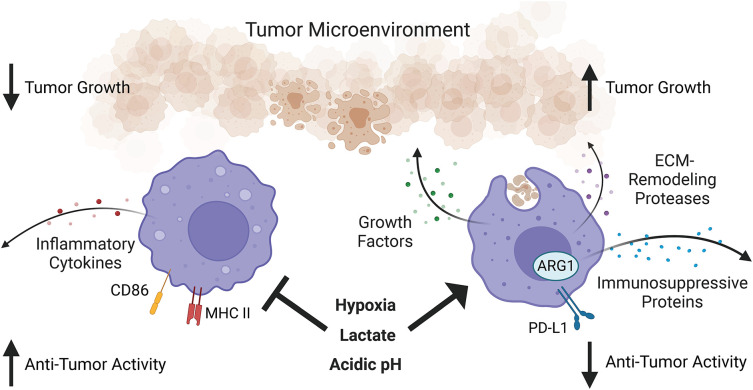
Advances in cancer research have made clear the critical role of the immune response in clearing tumors. This breakthrough in scientific understanding was heralded by the success of immune checkpoint blockade (ICB) therapies such as anti-programmed cell death protein 1 (PD-1)/ programmed death-ligand 1 (PD-L1) and anti-cytotoxic T-lymphocyte-associated protein 4 (CTLA-4), as well as the success of chimeric antigen receptor (CAR) T cells in treating liquid tumors. Thus, much effort has been made to further understand the role of the immune response in tumor progression, and how we may target it to treat cancer. Macrophages are a component of the tumor immune microenvironment (TIME) that can promote tumor growth both indirectly, by suppressing T cell responses necessary for tumor killing, as well as directly, through deposition of extracellular matrix and promotion of angiogenesis. Thus, understanding regulation of macrophages within the tumor microenvironment (TME) is key to targeting them for immunotherapy. However, circadian rhythms (24-hour cycles) are a fundamental aspect of macrophage biology that have yet to be investigated for their role in macrophage-mediated suppression of the anti-tumor immune response Circadian rhythms regulate macrophage-mediated immune responses through time-of-day-dependent regulation of macrophage function. A better understanding of the circadian biology of macrophages in the context of the TME may allow us to exploit synergy between existing and upcoming treatments and circadian regulation of immunity.
癌症研究的进展清楚地表明了免疫反应在清除肿瘤方面的关键作用。这一科学理解上的突破,预示着免疫检查点阻断(ICB)疗法的成功,如抗程序性细胞死亡蛋白 1(PD-1)/程序性死亡配体 1(PD-L1)和抗细胞毒性 T 淋巴细胞相关蛋白 4(CTLA-4),以及嵌合抗原受体(CAR)T 细胞在治疗液体肿瘤方面的成功。因此,人们做了大量努力来进一步了解免疫反应在肿瘤进展中的作用,以及我们如何靶向它来治疗癌症。巨噬细胞是肿瘤免疫微环境(TIME)的一个组成部分,它可以通过抑制杀伤肿瘤所需的 T 细胞反应,以及通过细胞外基质的沉积和促进血管生成,直接促进肿瘤生长。因此,了解肿瘤微环境(TME)中巨噬细胞的调节是靶向它们进行免疫治疗的关键。然而,昼夜节律(24 小时周期)是巨噬细胞生物学的一个基本方面,其在调节巨噬细胞介导的抗肿瘤免疫反应中的作用尚未得到研究。昼夜节律通过巨噬细胞功能的时间依赖性调节来调节巨噬细胞介导的免疫反应。更好地了解 TME 中巨噬细胞的昼夜生物学,可能使我们能够利用现有和即将出现的治疗方法与免疫的昼夜调节之间的协同作用。