Qin Jianwei, Monje Oscar, Nugent Matthew R, Finn Joshua R, O'Rourke Aubrie E, Wilson Kristine D, Fritsche Ralph F, Baek Insuck, Chan Diane E, Kim Moon S
Environmental Microbial and Food Safety Laboratory, Agricultural Research Service, U.S. Department of Agriculture, Beltsville, MD, United States.
Amentum, NASA Kennedy Space Center, Merritt Island, FL, United States.
Front Plant Sci. 2023 Jul 4;14:1133505. doi: 10.3389/fpls.2023.1133505. eCollection 2023.
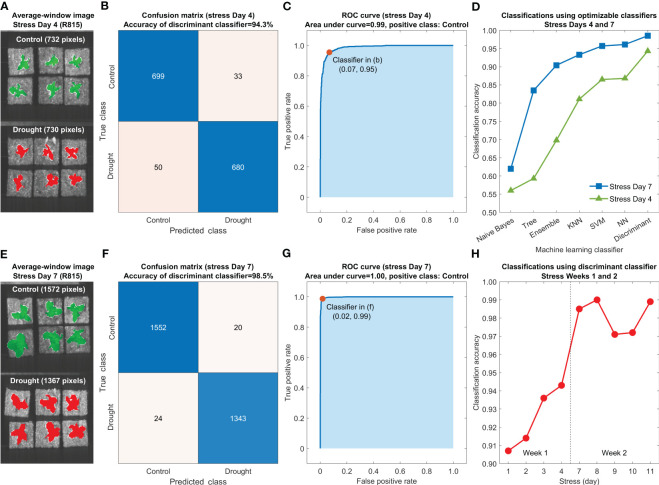
Compact and automated sensing systems are needed to monitor plant health for NASA's controlled-environment space crop production. A new hyperspectral system was designed for early detection of plant stresses using both reflectance and fluorescence imaging in visible and near-infrared (VNIR) wavelength range (400-1000 nm). The prototype system mainly includes two LED line lights providing VNIR broadband and UV-A (365 nm) light for reflectance and fluorescence measurement, respectively, a line-scan hyperspectral camera, and a linear motorized stage with a travel range of 80 cm. In an overhead sensor-to-sample arrangement, the stage translates the lights and camera over the plants to acquire reflectance and fluorescence images in sequence during one cycle of line-scan imaging. System software was developed using LabVIEW to realize hardware parameterization, data transfer, and automated imaging functions. The imaging unit was installed in a plant growth chamber at NASA Kennedy Space Center for health monitoring studies for pick-and-eat salad crops. A preliminary experiment was conducted to detect plant drought stress for twelve Dragoon lettuce samples, of which half were well-watered and half were under-watered while growing. A machine learning method using an optimized discriminant classifier based on VNIR reflectance spectra generated classification accuracies over 90% for the first four days of the stress treatment, showing great potential for early detection of the drought stress on lettuce leaves before any visible symptoms and size differences were evident. The system is promising to provide useful information for optimization of growth environment and early mitigation of stresses in space crop production.
为了美国国家航空航天局(NASA)的可控环境太空作物生产监测植物健康状况,需要紧凑且自动化的传感系统。设计了一种新的高光谱系统,用于在可见光和近红外(VNIR)波长范围(400 - 1000 nm)内利用反射率和荧光成像早期检测植物胁迫。该原型系统主要包括两个LED线光源,分别提供VNIR宽带光和UV - A(365 nm)光用于反射率和荧光测量,一台线扫描高光谱相机,以及一个行程范围为80厘米的线性电动平台。在头顶式传感器到样本的布置中,平台在植物上方移动光源和相机,以便在一次线扫描成像周期内依次获取反射率和荧光图像。使用LabVIEW开发了系统软件,以实现硬件参数化、数据传输和自动成像功能。成像单元安装在美国国家航空航天局肯尼迪航天中心的植物生长室内,用于对即摘即食沙拉作物进行健康监测研究。针对12个龙骑兵生菜样本进行了初步实验,以检测植物干旱胁迫,其中一半在生长期间浇水良好,另一半浇水不足。一种基于VNIR反射光谱使用优化判别分类器的机器学习方法在胁迫处理的前四天产生了超过90%的分类准确率,这表明在生菜叶片出现任何可见症状和大小差异之前,该方法在早期检测干旱胁迫方面具有巨大潜力。该系统有望为太空作物生产中生长环境的优化和胁迫的早期缓解提供有用信息。