Geospatial Institute, Saint Louis University, Saint Louis, MO 63108, USA.
Department of Earth and Atmospheric Sciences, Saint Louis University, St. Louis, MO 63108, USA.
Sensors (Basel). 2021 Jan 22;21(3):742. doi: 10.3390/s21030742.
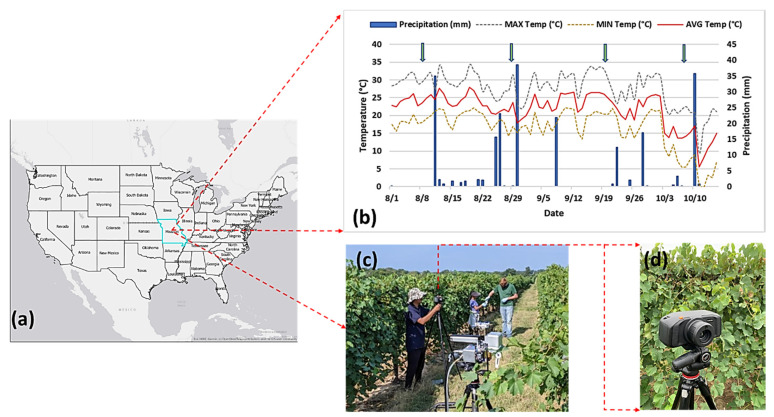
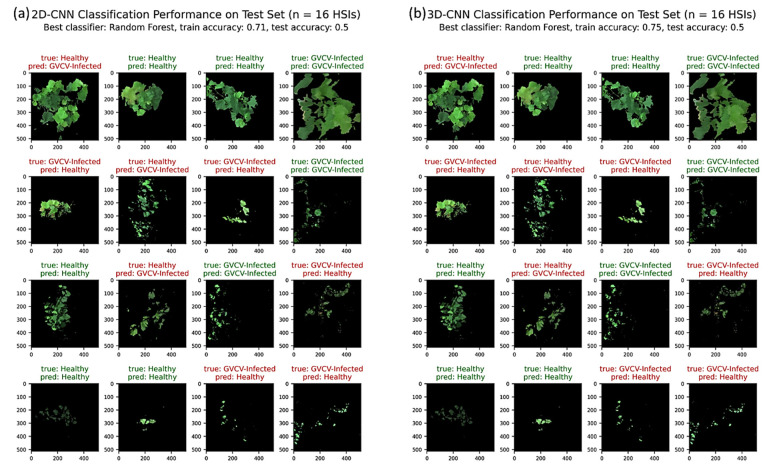
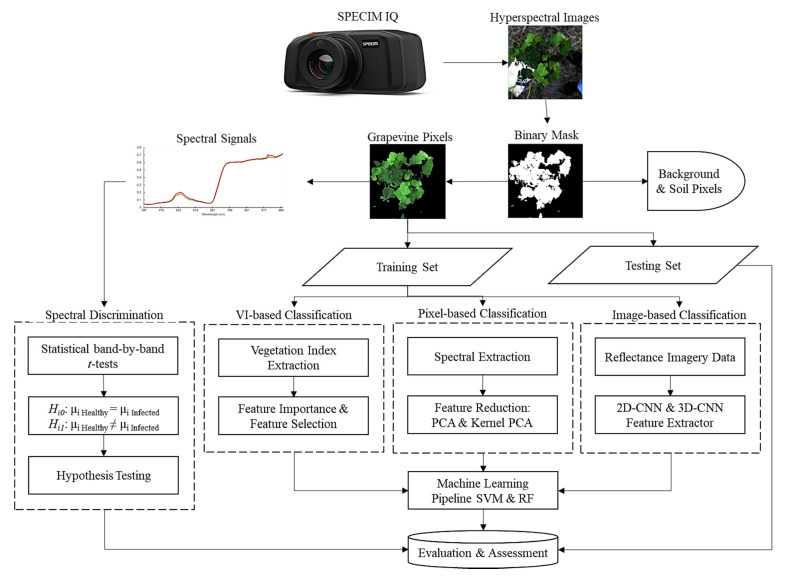
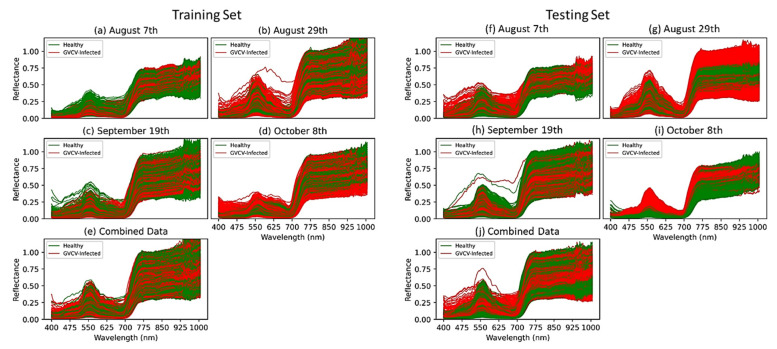
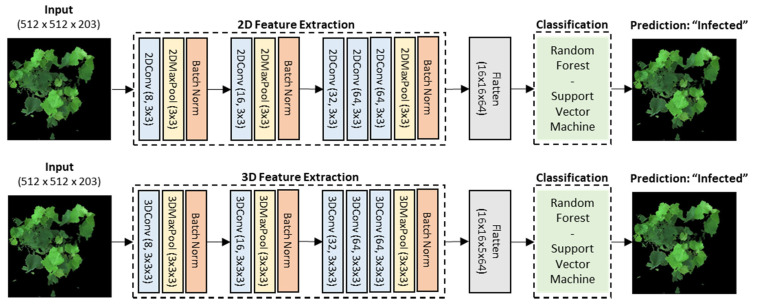
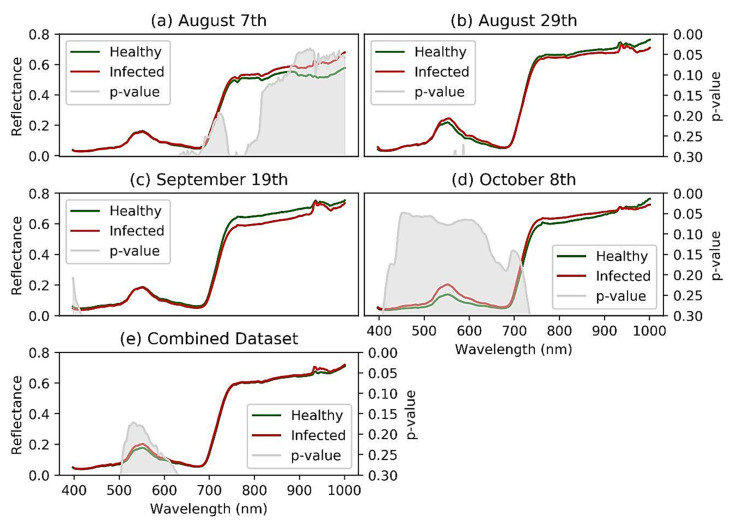
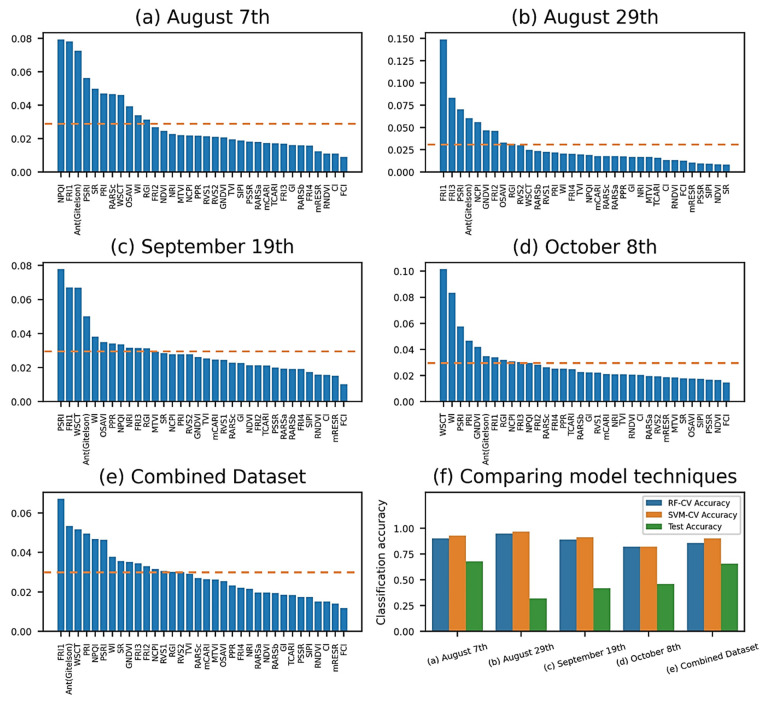
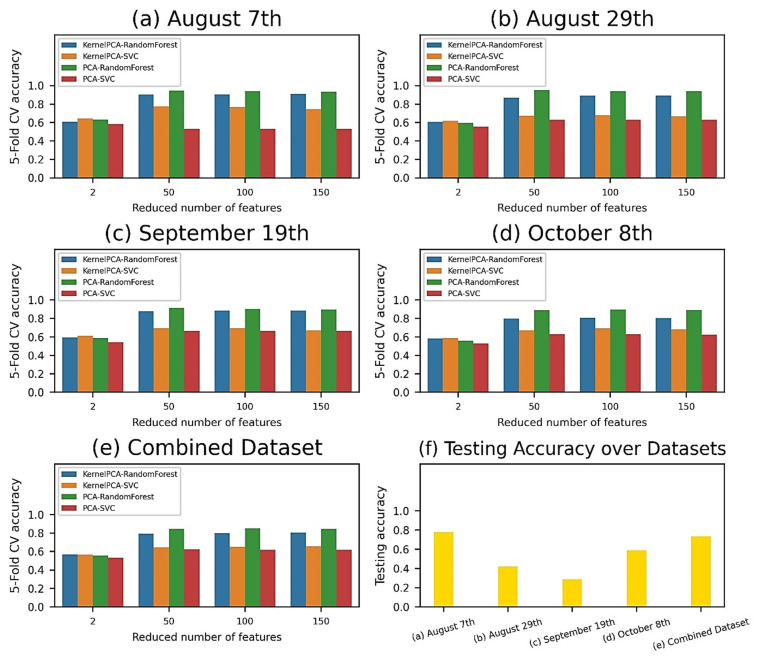
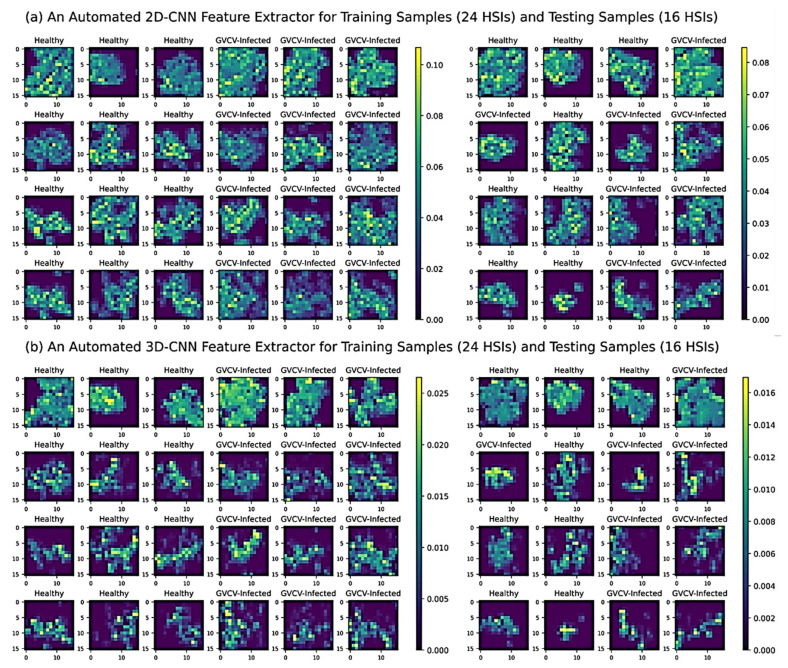
Early detection of grapevine viral diseases is critical for early interventions in order to prevent the disease from spreading to the entire vineyard. Hyperspectral remote sensing can potentially detect and quantify viral diseases in a nondestructive manner. This study utilized hyperspectral imagery at the plant level to identify and classify grapevines inoculated with the newly discovered DNA virus grapevine vein-clearing virus (GVCV) at the early asymptomatic stages. An experiment was set up at a test site at South Farm Research Center, Columbia, MO, USA (38.92 N, -92.28 W), with two grapevine groups, namely healthy and GVCV-infected, while other conditions were controlled. Images of each vine were captured by a SPECIM IQ 400-1000 nm hyperspectral sensor (Oulu, Finland). Hyperspectral images were calibrated and preprocessed to retain only grapevine pixels. A statistical approach was employed to discriminate two reflectance spectra patterns between healthy and GVCV vines. Disease-centric vegetation indices (VIs) were established and explored in terms of their importance to the classification power. Pixel-wise (spectral features) classification was performed in parallel with image-wise (joint spatial-spectral features) classification within a framework involving deep learning architectures and traditional machine learning. The results showed that: (1) the discriminative wavelength regions included the 900-940 nm range in the near-infrared (NIR) region in vines 30 days after sowing (DAS) and the entire visual (VIS) region of 400-700 nm in vines 90 DAS; (2) the normalized pheophytization index (NPQI), fluorescence ratio index 1 (FRI1), plant senescence reflectance index (PSRI), anthocyanin index (AntGitelson), and water stress and canopy temperature (WSCT) measures were the most discriminative indices; (3) the support vector machine (SVM) was effective in VI-wise classification with smaller feature spaces, while the RF classifier performed better in pixel-wise and image-wise classification with larger feature spaces; and (4) the automated 3D convolutional neural network (3D-CNN) feature extractor provided promising results over the 2D convolutional neural network (2D-CNN) in learning features from hyperspectral data cubes with a limited number of samples.
早期发现葡萄病毒病对于早期干预至关重要,以防止疾病蔓延到整个葡萄园。高光谱遥感有可能以非破坏性的方式检测和量化病毒病。本研究利用植物水平的高光谱图像,在无症状早期阶段识别和分类感染新发现的 DNA 病毒葡萄脉带清除病毒(GVCV)的葡萄藤。在美国密苏里州哥伦比亚南农场研究中心(38.92 N,-92.28 W)的一个试验点设立了一个实验,有两个葡萄群体,即健康和 GVCV 感染,同时控制其他条件。每个葡萄藤的图像由 SPECIM IQ 400-1000nm 高光谱传感器(奥卢,芬兰)捕获。高光谱图像经过校准和预处理,只保留葡萄像素。采用统计方法来区分健康和 GVCV 葡萄藤之间的两种反射光谱模式。建立了以疾病为中心的植被指数(VIs),并探讨了它们对分类能力的重要性。在涉及深度学习架构和传统机器学习的框架内,在像素级(光谱特征)分类和图像级(联合空间-光谱特征)分类中并行进行。结果表明:(1)在播种后 30 天(DAS)的葡萄藤中,近红外(NIR)区域的 900-940nm 范围和 90DAS 的葡萄藤的整个可见光(VIS)区域 400-700nm 范围内包含有区分能力的波长区域;(2)归一化叶绿素荧光指数(NPQI)、荧光比值指数 1(FRI1)、植物衰老反射率指数(PSRI)、花青素指数(AntGitelson)和水分胁迫和冠层温度(WSCT)措施是最具区分能力的指数;(3)支持向量机(SVM)在 VI 分类方面效果较好,特征空间较小,而随机森林(RF)分类器在像素级和图像级分类方面效果较好,特征空间较大;(4)自动化 3D 卷积神经网络(3D-CNN)特征提取器在从高光谱数据立方体中学习特征方面优于 2D 卷积神经网络(2D-CNN),在使用有限样本时效果较好。