Arif Haad, Arif Fatima, Morales Jose, Waldrop Ian W, Sheets Nicholas W
School of Medicine, University of California Riverside School of Medicine, Riverside, USA.
School of Medicine, Eastern Virginia Medical School, Norfolk, USA.
Cureus. 2023 Jun 18;15(6):e40589. doi: 10.7759/cureus.40589. eCollection 2023 Jun.
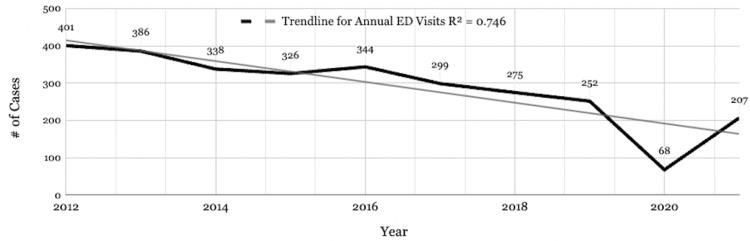
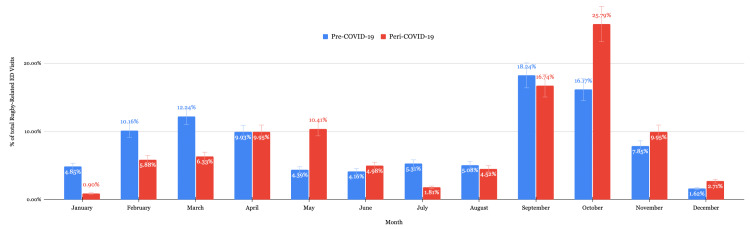
Background Rugby is a popular contact sport played with little to no protective clothing. There exist few comprehensive studies investigating emergency department (ED) visit patterns for rugby-related injuries.We hypothesize that male athletes remain the most common patient demographic to present to the ED with rugby-related injuries and that the number of patients diagnosed with soft tissue injuries such as sprains and strains decreased during the COVID-19 pandemic. Methodology The National Electronic Injury Surveillance System database was examined for rugby injuries from January 2012 through December 2021. Cases were stratified by sex, age, and injury type to monitor epidemiological patterns. This is a descriptive epidemiology study. Level of evidence III. Results A total of 2,896 individuals with rugby-related ED visits were identified. ED patients were most common among males (73.9%), Caucasians (45.3%), and in the 15-19-year-old age range (44.9%). Injuries most commonly affected the upper body, specifically the head (23.1%), face (13.8%), and shoulder (12.4%) with fractures and sprains comprising 22.3% and 18.5% of ED diagnoses, respectively. Concussions were the most frequent injury to any one body part (11.2%). During the COVID-19 pandemic, ED patients with rugby-related injuries were significantly more likely to be males presenting with lacerations or hemorrhages. ED visits for sprains and strains significantly decreased in the peri-COVID-19 period. Conclusions Annual ED visits due to rugby injuries are declining. The head and neck are the most common sites of injuries. Decreased presentation to the ED during the COVID-19 pandemic may raise concern for the potential for untreated injuries. Physicians should anticipate the presence of chronic sports-related injuries when evaluating future patients.
背景 橄榄球是一项广受欢迎的接触性运动,运动员几乎不穿或根本不穿防护服。关于橄榄球相关损伤的急诊科(ED)就诊模式,很少有全面的研究。我们假设,男性运动员仍然是因橄榄球相关损伤前往急诊科就诊的最常见患者群体,并且在新冠疫情期间,被诊断为扭伤和拉伤等软组织损伤的患者数量有所减少。 方法 对国家电子伤害监测系统数据库中2012年1月至2021年12月期间的橄榄球损伤病例进行了检查。病例按性别、年龄和损伤类型进行分层,以监测流行病学模式。这是一项描述性流行病学研究。证据级别为III级。 结果 共识别出2896名因橄榄球相关损伤前往急诊科就诊的患者。急诊科患者中男性(73.9%)、白种人(45.3%)以及年龄在15 - 19岁之间(44.9%)的人群最为常见。损伤最常累及上半身,特别是头部(23.1%)、面部(13.8%)和肩部(12.4%),骨折和扭伤分别占急诊科诊断病例的22.3%和18.5%。脑震荡是任何一个身体部位最常见的损伤(11.2%)。在新冠疫情期间,因橄榄球相关损伤前往急诊科就诊的患者中,男性出现撕裂伤或出血的可能性显著更高。在新冠疫情前后期间,扭伤和拉伤的急诊科就诊人数显著减少。 结论 因橄榄球损伤导致的年度急诊科就诊人数正在下降。头部和颈部是最常见的损伤部位。在新冠疫情期间前往急诊科就诊人数的减少可能会引发对潜在未治疗损伤的担忧。医生在评估未来患者时应考虑到慢性运动相关损伤的存在。