Byun Jung-Ick, Bae Ji-Yeon, Moon Jangsup, Lee Soon-Tae, Jung Keun-Hwa, Park Kyung-Il, Kim Manho, Lee Sang Kun, Chu Kon
Department of Neurology, Kyung Hee University Hospital at Gangdong, Kyung Hee University College of Medicine, Seoul, Korea.
Department of Neurology, Seoul National University Hospital, Seoul, Korea.
Encephalitis. 2021 Jul;1(3):68-72. doi: 10.47936/encephalitis.2021.00052. Epub 2021 May 27.
Regulatory T cells (Tregs) play a crucial role in maintaining immune tolerance. Any deficiency or dysfunction of the Tregs can influence the pathogenesis of autoimmune disease. This study aimed to assess the role of Tregs among patients with autoimmune encephalitis (AE) with different autoantibody types and to evaluate their association with clinical features.
This was a cross-sectional observational study involving 29 patients with AE. Peripheral blood was sampled from each patient for flow cytometric analysis. Proportions of CD4CD25 and CD4CD25Foxp3 Tregs were calculated and compared between the antibody types (synaptic, paraneoplastic, and undetermined). Associations between the proportion of Tregs and clinical features were also evaluated.
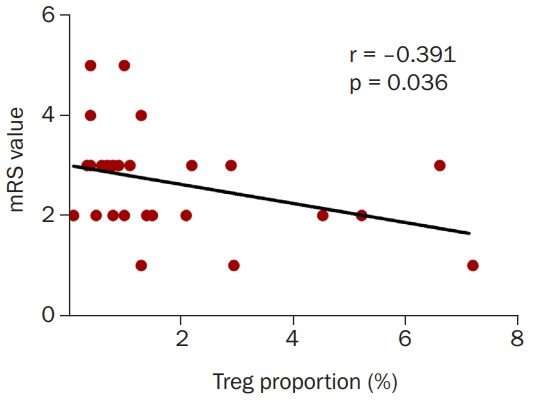
Five patients had synaptic autoantibodies, five had paraneoplastic autoantibodies, and the others were of an undetermined type. The proportion of CD4CD25 Tregs tended to be higher in those with paraneoplastic antibodies than in those with synaptic antibodies ( p = 0.028) and undetermined antibody status ( p = 0.043). A significant negative correlation was found between the proportion of Tregs and the initial modified Rankin score (r = -0.391, p = 0.036). Those who received intravenous immunoglobulin had lower proportions of Tregs than those who did not.
The results of the present study suggest that Tregs may play different roles according to the type of AE and may be linked to disease severity.
调节性T细胞(Tregs)在维持免疫耐受中起关键作用。Tregs的任何缺陷或功能障碍都可能影响自身免疫性疾病的发病机制。本研究旨在评估不同自身抗体类型的自身免疫性脑炎(AE)患者中Tregs的作用,并评估它们与临床特征的关联。
这是一项横断面观察性研究,纳入了29例AE患者。采集每位患者的外周血进行流式细胞术分析。计算并比较抗体类型(突触型、副肿瘤型和未确定型)之间CD4CD25和CD4CD25Foxp3 Tregs的比例。还评估了Tregs比例与临床特征之间的关联。
5例患者有突触自身抗体,5例有副肿瘤自身抗体,其余为未确定类型。副肿瘤抗体患者的CD4CD25 Tregs比例往往高于突触抗体患者(p = 0.028)和抗体状态未确定的患者(p = 0.043)。Tregs比例与初始改良Rankin评分之间存在显著负相关(r = -0.391,p = 0.036)。接受静脉注射免疫球蛋白治疗的患者Tregs比例低于未接受治疗的患者。
本研究结果表明,Tregs可能根据AE的类型发挥不同作用,并且可能与疾病严重程度相关。