McEvoy Laurence, Cliff Joanne, Carr Daniel F, Jorgensen Andrea, Lord Rosemary, Pirmohamed Munir
Department of Pharmacology and Therapeutics, University of Liverpool, Liverpool, United Kingdom.
Clatterbridge Cancer Centre, Liverpool, United Kingdom.
Front Pharmacol. 2023 Jul 4;14:1178421. doi: 10.3389/fphar.2023.1178421. eCollection 2023.
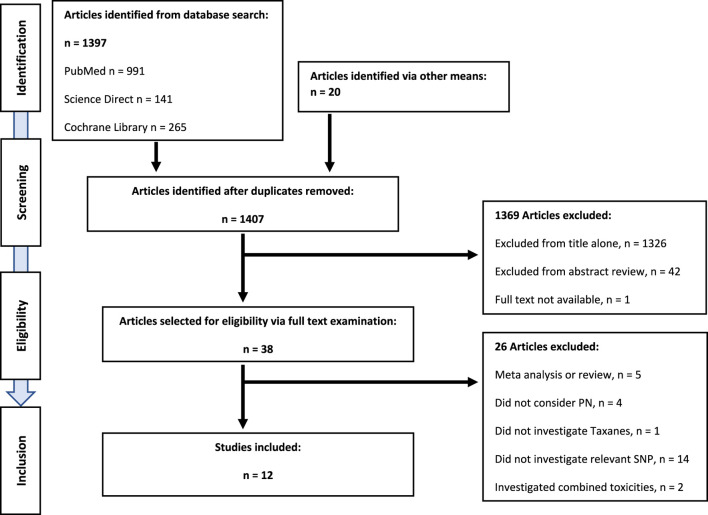
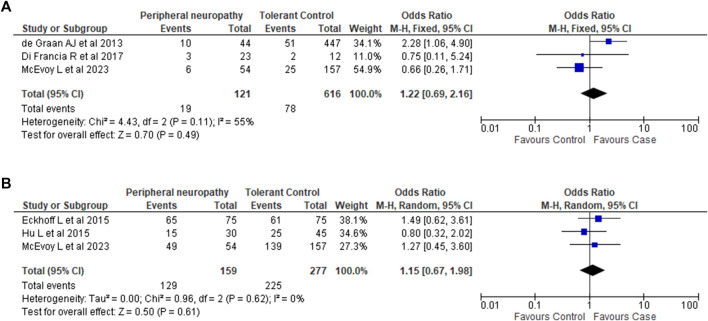
Taxane-induced peripheral neuropathy (TIPN) is an important cause of premature treatment cessation and dose-limitation in cancer therapy. It also reduces quality of life and survivorship in affected patients. Genetic polymorphisms in the CYP3A family have been investigated but the findings have been inconsistent and contradictory. A systematic review identified 12 pharmacogenetic studies investigating genetic variation in and and TIPN. In our candidate gene study, 288 eligible participants (211 taxane participants receiving docetaxel or paclitaxel, and 77 control participants receiving oxaliplatin) were successfully genotyped for and . Genotyping data was transformed into a combined CYP3A metaboliser phenotype: Poor metabolisers, intermediate metabolisers and extensive metabolisers. Individual genotypes and combined CYP3A metaboliser phenotypes were assessed in relation to neurotoxicity, including by meta-analysis where possible. In the systematic review, no significant association was found between and TIPN in seven studies, with one study reporting a protective association. For , one study has reported an association with TIPN, while four other studies failed to show an association. Evaluation of our patient cohort showed that paclitaxel was found to be more neurotoxic than docetaxel ( < 0.001). Diabetes was also significantly associated with the development of TIPN. The candidate gene analysis showed no significant association between either SNP () and the development of TIPN overall, or severe TIPN. Meta-analysis showed no association between these two variants and TIPN. Transformed into combined CYP3A metaboliser phenotypes, 30 taxane recipients were poor metabolisers, 159 were intermediate metabolisers, and 22 were extensive metabolisers. No significant association was observed between metaboliser status and case-control status. We have shown that the risk of peripheral neuropathy during taxane chemotherapy is greater in patients who have diabetes. CYP3A genotype or phenotype was not identified as a risk factor in either the candidate gene analysis or the systematic review/meta-analysis, although we cannot exclude the possibility of a minor contribution, which would require a larger sample size.
紫杉烷诱导的周围神经病变(TIPN)是癌症治疗中导致过早停药和剂量受限的重要原因。它还会降低受影响患者的生活质量和生存期。人们对细胞色素P450 3A(CYP3A)家族的基因多态性进行了研究,但结果并不一致且相互矛盾。一项系统评价确定了12项药物遗传学研究,这些研究调查了CYP3A基因变异与TIPN之间的关系。在我们的候选基因研究中,对288名符合条件的参与者(211名接受多西他赛或紫杉醇的紫杉烷参与者,以及77名接受奥沙利铂的对照参与者)成功进行了CYP3A基因分型。基因分型数据被转化为CYP3A代谢表型组合:代谢不良者、中间代谢者和代谢广泛者。针对神经毒性评估了个体基因型和CYP3A代谢表型组合,如有可能还进行了荟萃分析。在系统评价中,七项研究未发现CYP3A与TIPN之间存在显著关联,一项研究报告了保护性关联。对于CYP3A5,一项研究报告其与TIPN有关联,而其他四项研究未显示出关联。对我们的患者队列进行评估发现,紫杉醇的神经毒性比多西他赛更强(P<0.001)。糖尿病也与TIPN的发生显著相关。候选基因分析表明,无论是单核苷酸多态性(SNP)(CYP3A5)还是总体TIPN的发生,或是严重TIPN之间均未发现显著关联。荟萃分析表明这两个变异与TIPN之间无关联。转化为CYP3A代谢表型组合后,30名紫杉烷接受者为代谢不良者,159名为中间代谢者,22名为代谢广泛者。未观察到代谢状态与病例对照状态之间存在显著关联。我们已经表明,糖尿病患者在紫杉烷化疗期间发生周围神经病变的风险更高。在候选基因分析或系统评价/荟萃分析中,CYP3A基因型或表型均未被确定为风险因素,尽管我们不能排除其有微小作用的可能性,而这需要更大的样本量。