Park Youngjae, Li Mei-Ling, Kim Ji-Won, Koh Jung Hee, Park Yune-Jung, Kim Wan-Uk
Division of Rheumatology, Department of Internal Medicine, Seoul St. Mary's Hospital, College of Medicine, The Catholic University of Korea, Seoul, Korea.
Department of Biomedicine and Health Sciences, College of Medicine, The Catholic University of Korea, Seoul, Korea.
J Rheum Dis. 2022 Apr 1;29(2):98-107. doi: 10.4078/jrd.2022.29.2.98.
With many chronic inflammatory diseases, outcomes are determined by assessing both disease activity at presentation and cumulative activity over time. Here, we investigated whether cumulative activity better reflects the radiographic progression (RP) of rheumatoid arthritis (RA) than measurement of activity at a single time point.
From a prospective cohort of RA patients, most of whom were treated with anti-rheumatic drugs, we selected 117 subjects for whom laboratory, clinical, and radiographic parameters potentially influencing RP were monitored serially for more than 1 year. X-ray images of both hands and both feet were scored using the van der Heijde modified total Sharp score (mTSS). In addition to cross-sectional values at baseline, longitudinal and cumulative values for each parameter were calculated in a time-integrated and averaged manner.
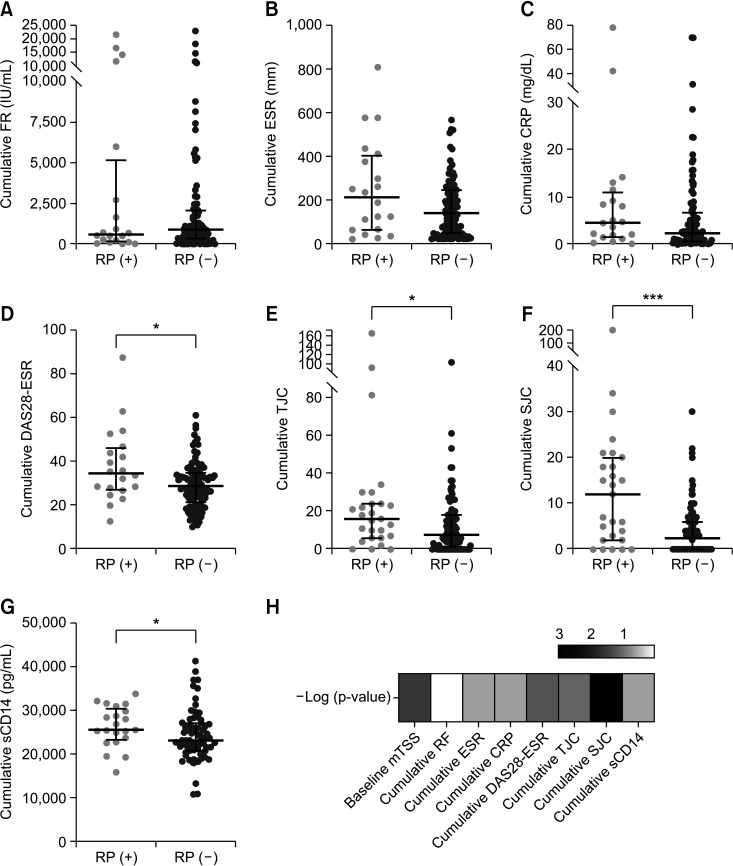
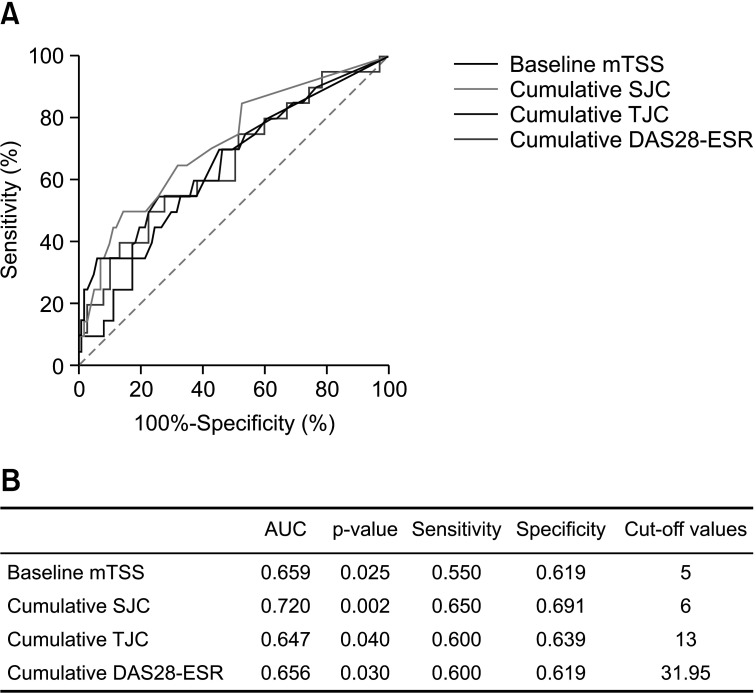
Among the values measured at baseline, mTSS, but not the baseline erythrocyte sedimentation rate (ESR) or C-reactive protein level, was associated with RP. By contrast, multivariate analyses identified cumulative values such as the cumulative ESR, cumulative tender joint count, cumulative swollen joint count (SJC), and cumulative Disease Activity Score 28-ESR as major determinants of RP. In particular, the cumulative SJC showed the best predictive performance for RP.
This study highlights the importance of cumulative indices for predicting progression of RA. Specifically, dynamic and cumulative values of RA activity-related factors, particularly the cumulative SJC, may be the major determinants of RP in the current practice.
对于许多慢性炎症性疾病,其预后是通过评估疾病初发时的活动度以及随时间累积的活动度来确定的。在此,我们研究了累积活动度相较于单次时间点的活动度测量,是否能更好地反映类风湿关节炎(RA)的影像学进展(RP)。
从一个大部分患者接受抗风湿药物治疗的RA患者前瞻性队列中,我们选取了117名受试者,对其可能影响RP的实验室、临床和影像学参数进行了连续1年多的监测。使用范德海伊德改良总Sharp评分(mTSS)对手和脚的X线图像进行评分。除了基线时的横断面值外,还以时间积分和平均的方式计算了每个参数的纵向和累积值。
在基线测量值中,与RP相关的是mTSS,而非基线红细胞沉降率(ESR)或C反应蛋白水平。相比之下,多变量分析确定累积值如累积ESR、累积压痛关节计数、累积肿胀关节计数(SJC)以及累积疾病活动评分28-ESR是RP的主要决定因素。特别是,累积SJC对RP显示出最佳的预测性能。
本研究强调了累积指标在预测RA进展中的重要性。具体而言,RA活动相关因素的动态和累积值,尤其是累积SJC,可能是当前实践中RP的主要决定因素。