Division of Hematology Oncology, Department of Medicine, University of Pittsburgh, Hemophilia Center of Western Pennsylvania, Pittsburgh, PA.
Division of Cardiology, Department of Medicine, Vascular Medicine Institute, Pittsburgh, PA.
Blood. 2023 Nov 9;142(19):1613-1621. doi: 10.1182/blood.2022018661.
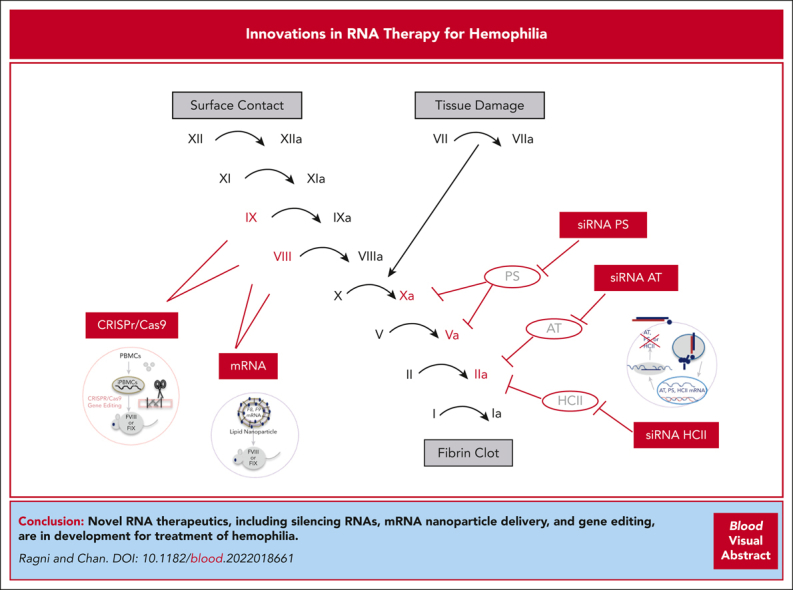
Given the shortcomings of current factor-, nonfactor-, and adeno-associated virus gene-based therapies, the recent advent of RNA-based therapeutics for hemophilia is changing the fundamental approach to hemophilia management. From small interfering RNA therapeutics that knockdown clot regulators antithrombin, protein S, and heparin cofactor II, to CRISPR/Cas9 gene editing that may personalize treatment, improved technologies have the potential to reduce bleeds and factor use and avoid inhibitor formation. These novel agents, some in preclinical studies and others in early phase trials, have the potential to simplify treatment and improve hemostasis and quality of life. Furthermore, because these therapies arise from manipulation of the coagulation cascade and thrombin generation and its regulation, they will enhance our understanding of hemostasis and thrombosis and ultimately lead to better therapies for children and adults with inherited bleeding disorders. What does the future hold? With the development of novel preclinical technologies at the bench, there will be fewer joint bleeds, debilitating joint disease, orthopedic surgery, and improved physical and mental health, which were not previously possible. In this review, we identify current limitations of treatment and progress in the development of novel RNA therapeutics, including messenger RNA nanoparticle delivery and gene editing for the treatment of hemophilia.
鉴于当前基于因子、非因子和腺相关病毒基因的治疗方法存在的缺陷,最近用于血友病的基于 RNA 的治疗方法的出现正在改变血友病管理的基本方法。从降低抗凝血酶、蛋白 S 和肝素辅因子 II 等凝血调节剂的小干扰 RNA 治疗药物,到可能实现个体化治疗的 CRISPR/Cas9 基因编辑,改进的技术有可能减少出血和因子使用,并避免抑制剂的形成。这些新型药物,有些处于临床前研究阶段,有些处于早期临床试验阶段,有可能简化治疗并改善止血和生活质量。此外,由于这些治疗方法源于对凝血级联和凝血酶生成及其调节的操纵,它们将增强我们对止血和血栓形成的理解,并最终为患有遗传性出血性疾病的儿童和成人提供更好的治疗方法。未来会怎样?随着实验室新的临床前技术的发展,将减少关节出血、使人衰弱的关节疾病、骨科手术以及改善身心健康,这些在以前是不可能的。在这篇综述中,我们确定了治疗的当前局限性以及新型 RNA 治疗方法的进展,包括信使 RNA 纳米颗粒递药和基因编辑治疗血友病。