Faculty of Biotechnology, Department of Protein Engineering, University of Wroclaw, Joliot-Curie 14a, 50-383, Wroclaw, Poland.
Institute of Biochemistry and Biophysics, Polish Academy of Sciences, Pawińskiego 5a, 02-106, Warsaw, Poland.
Cell Commun Signal. 2023 Jul 21;21(1):177. doi: 10.1186/s12964-023-01203-3.
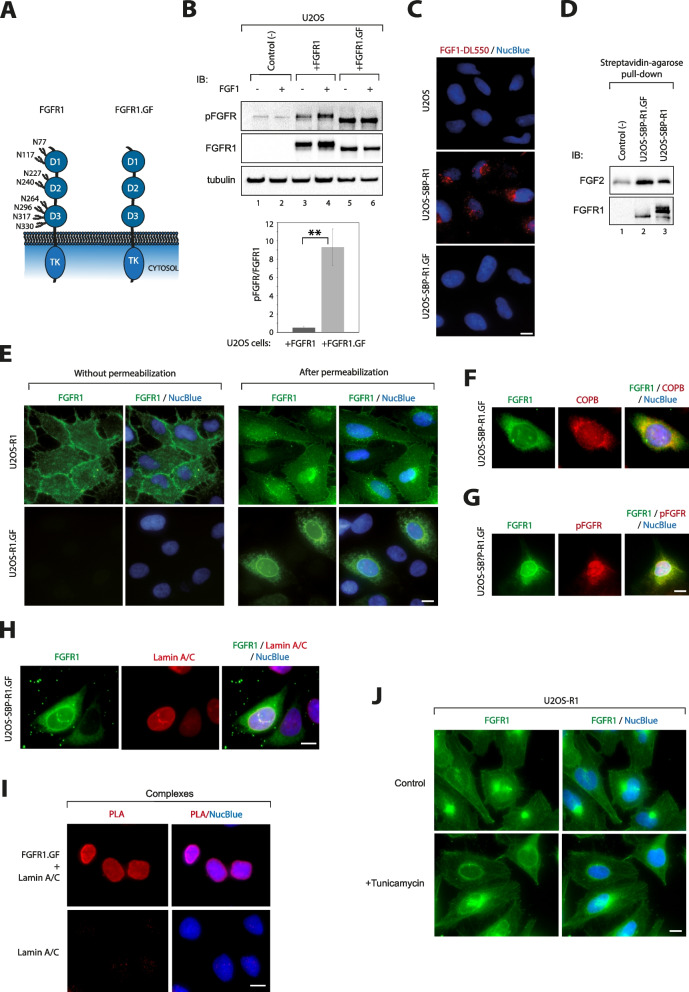
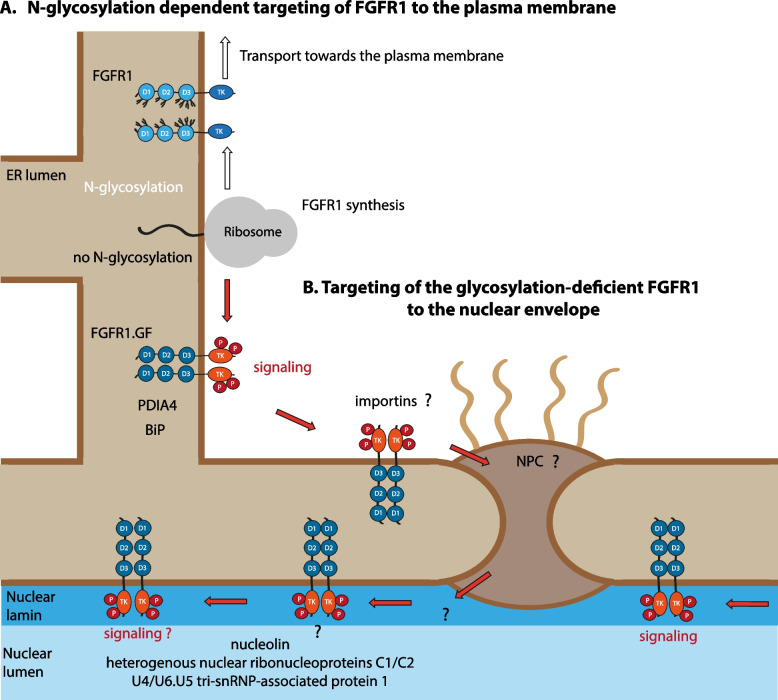
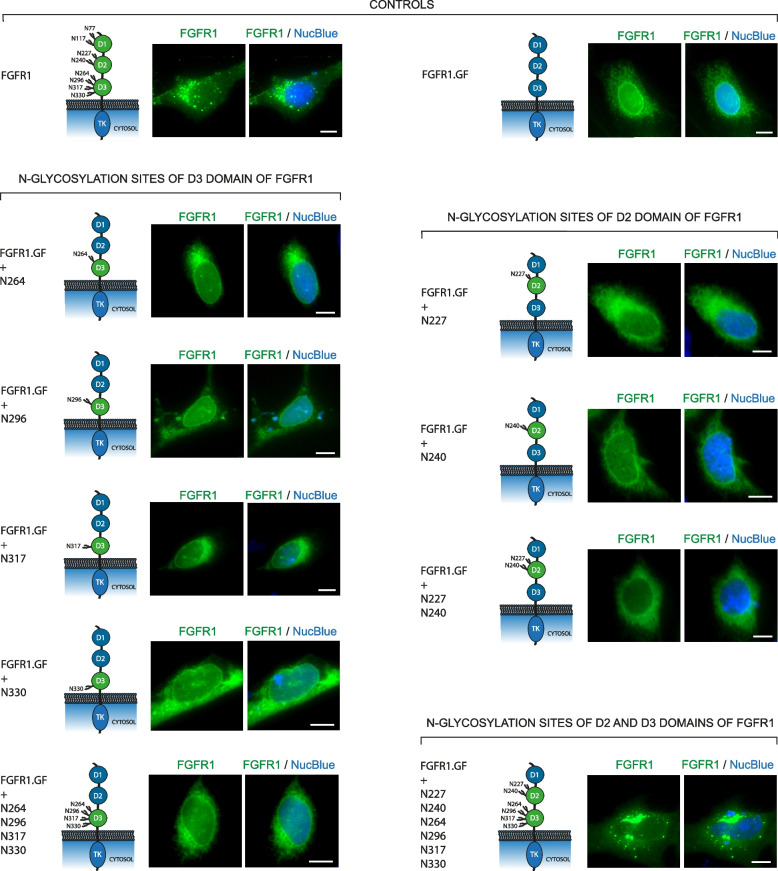
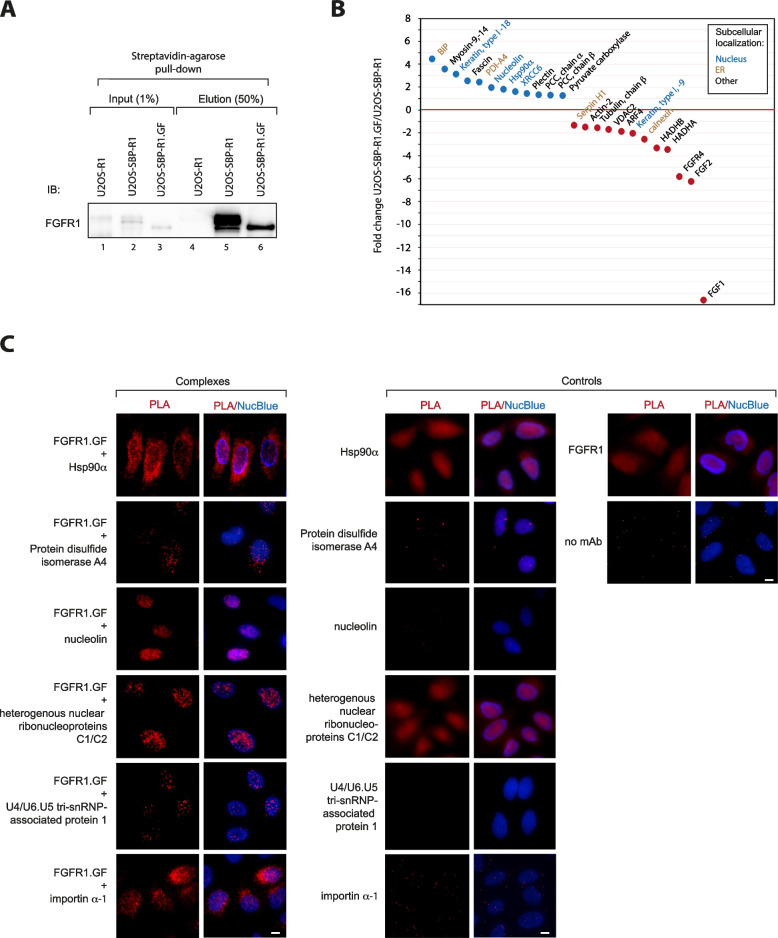
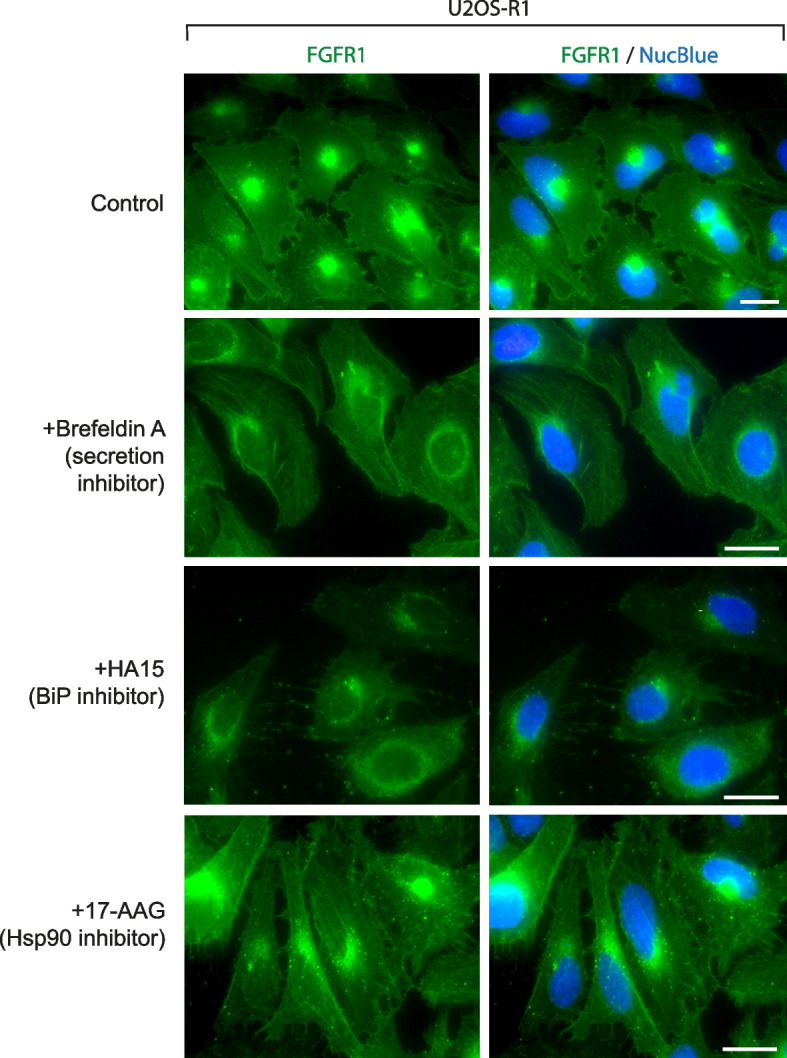
Fibroblast growth factor receptor 1 (FGFR1) is a heavily N-glycosylated cell surface receptor tyrosine kinase that transmits signals across the plasma membrane, in response to fibroblast growth factors (FGFs). Balanced FGF/FGFR1 signaling is crucial for the development and homeostasis of the human body, and aberrant FGFR1 is frequently observed in various cancers. In addition to its predominant localization to the plasma membrane, FGFR1 has also been detected inside cells, mainly in the nuclear lumen, where it modulates gene expression. However, the exact mechanism of FGFR1 nuclear transport is still unknown. In this study, we generated a glycosylation-free mutant of FGFR1, FGFR1.GF, and demonstrated that it is localized primarily to the nuclear envelope. We show that reintroducing N-glycans into the D3 domain cannot redirect FGFR1 to the plasma membrane or exclude the receptor from the nuclear envelope. Reestablishment of D2 domain N-glycans largely inhibits FGFR1 accumulation in the nuclear envelope, but the receptor continues to accumulate inside the cell, mainly in the ER. Only the simultaneous presence of N-glycans of the D2 and D3 domains of FGFR1 promotes efficient transport of FGFR1 to the plasma membrane. We demonstrate that while disturbed FGFR1 folding results in partial FGFR1 accumulation in the ER, impaired FGFR1 secretion drives FGFR1 trafficking to the nuclear envelope. Intracellular FGFR1.GF displays a high level of autoactivation, suggesting the presence of nuclear FGFR1 signaling, which is independent of FGF. Using mass spectrometry and proximity ligation assay, we identified novel binding partners of the nuclear envelope-localized FGFR1, providing insights into its cellular functions. Collectively, our data define N-glycosylation of FGFR1 as an important regulator of FGFR1 kinase activity and, most importantly, as a switchable signal for FGFR1 trafficking between the nuclear envelope and plasma membrane, which, due to spatial restrictions, shapes FGFR1 interactome and cellular function. Video Abstract.
成纤维细胞生长因子受体 1(FGFR1)是一种高度糖基化的细胞表面受体酪氨酸激酶,它通过质膜传递信号,对成纤维细胞生长因子(FGFs)作出反应。平衡的 FGF/FGFR1 信号对人体的发育和稳态至关重要,而异常的 FGFR1 经常在各种癌症中观察到。除了主要定位于质膜外,FGFR1 也在内细胞中检测到,主要在核腔中,在那里它调节基因表达。然而,FGFR1 核转运的确切机制仍不清楚。在这项研究中,我们生成了 FGFR1 的无糖基化突变体 FGFR1.GF,并证明它主要定位于核膜。我们表明,将 N-糖基重新引入 D3 结构域不能将 FGFR1 重新定向到质膜或将受体排除在核膜之外。D2 结构域 N-糖基的重建在很大程度上抑制了 FGFR1 在核膜中的积累,但受体仍继续在细胞内积累,主要在 ER 中。只有 FGFR1 的 D2 和 D3 结构域的 N-糖基同时存在,才能促进 FGFR1 向质膜的有效转运。我们证明,虽然 FGFR1 折叠受损导致部分 FGFR1 在 ER 中积累,但 FGFR1 分泌受损会导致 FGFR1 向核膜转运。细胞内 FGFR1.GF 显示出高水平的自动激活,表明存在核 FGFR1 信号,该信号独立于 FGF。通过质谱和邻近连接测定,我们鉴定了定位于核膜的 FGFR1 的新结合伴侣,为其细胞功能提供了新的见解。总的来说,我们的数据将 FGFR1 的糖基化定义为 FGFR1 激酶活性的重要调节剂,最重要的是,作为 FGFR1 在核膜和质膜之间运输的可切换信号,由于空间限制,它塑造了 FGFR1 相互作用组和细胞功能。视频摘要。