
通过网络药理学、分子对接和体内实验揭示比尤dMar 25治疗阿尔茨海默病的机制
Revealing the Mechanisms of Byu dMar 25 in the Treatment of Alzheimer's Disease through Network Pharmacology, Molecular Docking, and In Vivo Experiment.
作者信息
Du Yikuan, Guo Jinyan, Zhou Yuqi, Yan Simin, Xu Bijun, Wang Yuni, Lu Duoduo, Ma Zhendong, Chen Qianwen, Tang Qibin, Zhang Weichui, Zhu Jinfeng, Huang Yixing, Yang Chun
机构信息
Central Laboratory, The Tenth Affiliated Hospital of Southern Medical University, Dongguan 523059, China.
Dongguan Key Laboratory of Chronic Inflammatory Diseases, The First Dongguan Affiliated Hospital, Guangdong Medical University, Dongguan 523000, China.
出版信息
ACS Omega. 2023 Jun 13;8(28):25066-25080. doi: 10.1021/acsomega.3c01683. eCollection 2023 Jul 18.
BACKGROUND
Alzheimer's disease (AD) is the most common neurodegenerative disease, severely reducing the cognitive level and life quality of patients. Byu dMar 25 (BM25) has been proved to have a therapeutic effect on AD. However, the pharmacological mechanism is still unclear. Therefore, this study aims to reveal the potential mechanism of BM25 affecting AD from the perspective of network pharmacology and experimental validation.
METHODS
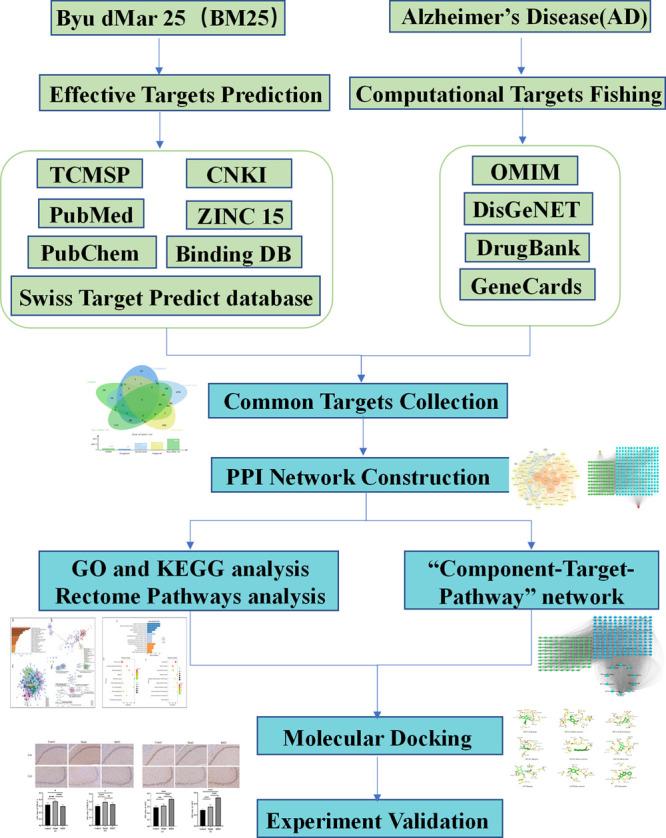
The potential active ingredients of BM25 were obtained from the TCMSP database and literature. Possible targets were predicted using SwissTargetPrediction tools. AD-related genes were identified by using GeneCards, OMIM, DisGeNET, and Drugbank databases. The candidate genes were obtained by extraction of the intersection network. Additionally, the "drug-target-disease" network was constructed by Cytoscape 3.7.2 for visualization. The PPI network was constructed by the STRING database, and the core network modules were filtered by Cytoscape 3.7.2. Enrichment analysis of GO and KEGG was carried out in the Metascape platform. Ledock software was used to dock the critical components with the core target. Furthermore, protein levels were evaluated by immunohistochemistry.
RESULTS
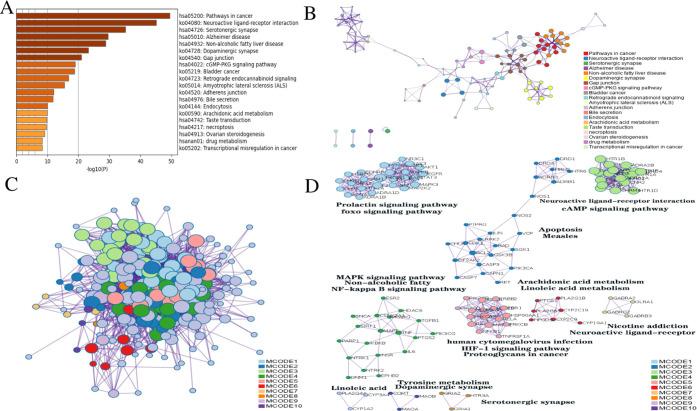
In this study, 112 active components, 1112 disease candidate genes, 3084 GO functions, and 277 KEGG pathways were obtained. Molecular docking showed that the effective components of BM25 in treating AD were β-asarone and hydroxysafflor yellow A. The most important targets were APP, PIK3R1, and PIK3CA. Enrichment analysis indicated that the Golgi genetic regulation, peroxidase activity regulation, phosphatidylinositol 3-kinase complex IA, 5-hydroxytryptamine receptor complexes, cancer pathways, and neuroactive ligand-receptor interactions played vital roles against AD. The rat experiment verified that BM25 affected PI3K-Akt pathway activation in AD.
CONCLUSIONS
This study reveals the mechanism of BM25 in treating AD with network pharmacology, which provides a foundation for further study on the molecular mechanism of AD treatment.
背景
阿尔茨海默病(AD)是最常见的神经退行性疾病,严重降低患者的认知水平和生活质量。研究表明,25味马钱子丸(BM25)对AD具有治疗作用。然而,其药理机制尚不清楚。因此,本研究旨在从网络药理学和实验验证的角度揭示BM25影响AD的潜在机制。
方法
从中药系统药理学数据库与分析平台(TCMSP)数据库及文献中获取BM25的潜在活性成分。使用瑞士靶点预测工具预测可能的靶点。通过基因卡片(GeneCards)、在线人类孟德尔遗传数据库(OMIM)、疾病基因数据库(DisGeNET)和药物银行(Drugbank)数据库鉴定AD相关基因。通过提取交集网络获得候选基因。此外,利用Cytoscape 3.7.2构建“药物-靶点-疾病”网络进行可视化。通过STRING数据库构建蛋白质-蛋白质相互作用(PPI)网络,并利用Cytoscape 3.7.2筛选核心网络模块。在Metascape平台上进行基因本体(GO)和京都基因与基因组百科全书(KEGG)富集分析。使用Leadock软件将关键成分与核心靶点进行对接。此外,通过免疫组织化学评估蛋白水平。
结果
本研究共获得112种活性成分、1112个疾病候选基因、3084个GO功能和277条KEGG通路。分子对接结果显示,BM25治疗AD的有效成分是β-细辛醚和羟基红花黄色素A。最重要的靶点是淀粉样前体蛋白(APP)、磷脂酰肌醇-3激酶调节亚基1(PIK3R1)和磷脂酰肌醇-3激酶催化亚基α(PIK3CA)。富集分析表明,高尔基体遗传调控、过氧化物酶活性调节、磷脂酰肌醇3激酶复合物IA、5-羟色胺受体复合物、癌症通路和神经活性配体-受体相互作用在对抗AD中起着至关重要的作用。大鼠实验证实,BM25影响AD中PI3K-Akt信号通路的激活。
结论
本研究通过网络药理学揭示了BM25治疗AD的机制,为进一步研究AD治疗的分子机制提供了依据。





 Zotero 插件