Shen Yanjia, Zhang Baoyue, Pang Xiaocong, Yang Ran, Chen Miao, Zhao Jiaying, Wang Jinhua, Wang Zhe, Yu Ziru, Wang Yuehua, Li Li, Liu Ailin, Du Guanhua
Beijing Key Laboratory of Drug Targets Identification and Drug Screening, Institute of Materia Medica, Chinese Academy of Medical Sciences and Peking Union Medical College, Beijing, China.
Front Pharmacol. 2020 Dec 4;11:595254. doi: 10.3389/fphar.2020.595254. eCollection 2020.
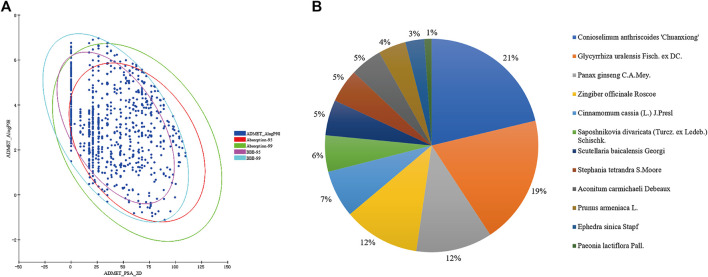
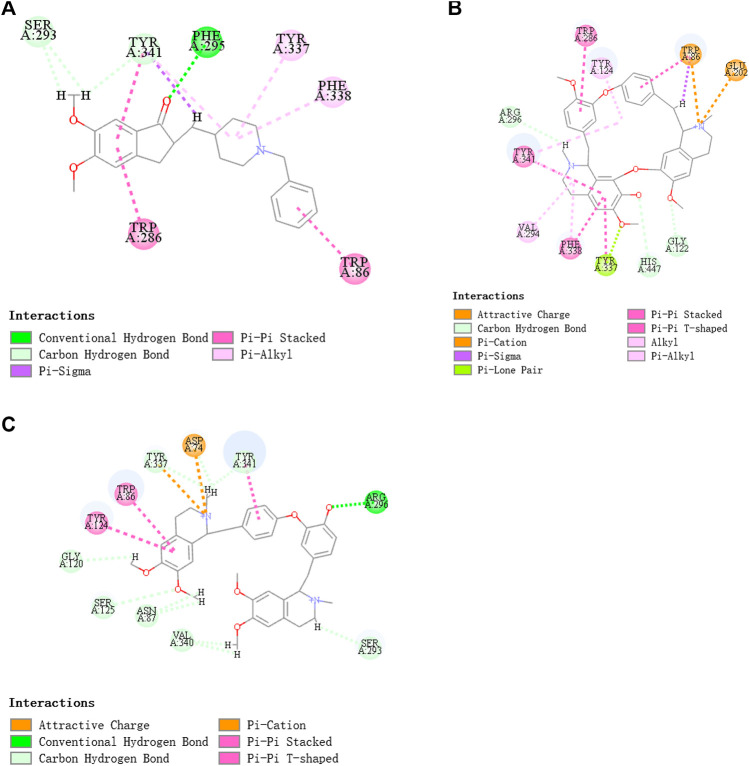
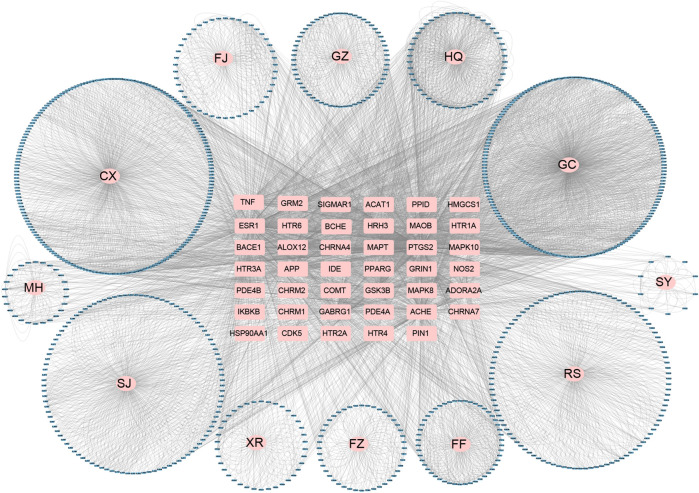
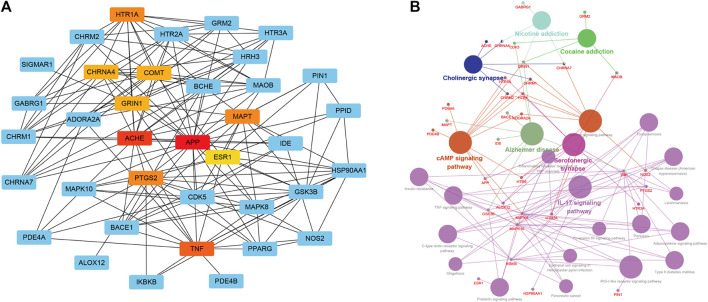
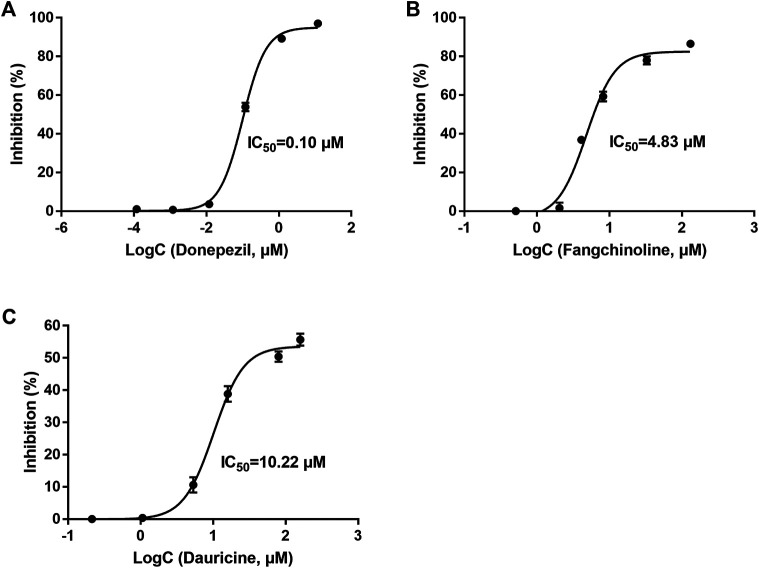
Alzheimer's disease (AD) has become a worldwide disease that is harmful to human health and brings a heavy economic burden to healthcare system. Xiao-Xu-Ming Decoction (XXMD) has been widely used to treat stroke and other neurological diseases for more than 1000 years in China. However, the synergistic mechanism of the constituents in XXMD for the potential treatment of AD is still unclear. Therefore, the present study aimed to predict the potential targets and uncover the material basis of XXMD for the potential treatment of AD. A network pharmacology-based method, which combined data collection, drug-likeness filtering and absorption, distribution, metabolism, excretion and toxicity (ADME/T) properties filtering, target prediction and network analysis, was used to decipher the effect and potential targets of XXMD for the treatment of AD. Then, the acetylcholinesterase (AChE) inhibitory assay was used to screen the potential active constituents in XXMD for the treatment of AD, and the molecular docking was furtherly used to identify the binding ability of active constituents with AD-related target of AChE. Finally, three cell models were applied to evaluate the neuroprotective effects of potential lead compounds in XXMD. Through the China Natural Products Database, Traditional Chinese Medicine Systems Pharmacology (TCMSP) Database, Traditional Chinese Medicine (TCM)-Database @Taiwan and literature, a total of 1481 compounds in XXMD were finally collected. After ADME/T properties filtering, 908 compounds were used for the further study. Based on the prediction data, the constituents in XXMD formula could interact with 41 AD-related targets. Among them, cyclooxygenase-2 (COX-2), estrogen receptor α (ERα) and AChE were the major targets. The constituents in XXMD were found to have the potential to treat AD through multiple AD-related targets. 62 constituents in it were found to interact with more than or equal to 10 AD-related targets. The prediction results were further validated by biology experiment, resulting in several potential anti-AD multitarget-directed ligands (MTDLs), including two AChE inhibitors with the IC values ranging from 4.83 to 10.22 μM. Moreover, fanchinoline was furtherly found to prevent SH-SY5Y cells from the cytotoxicities induced by sodium nitroprusside, sodium dithionate and potassium chloride. In conclusion, XXMD was found to have the potential to treat AD by targeting multiple AD-related targets and canonical pathways. Fangchinoline and dauricine might be the potential lead compounds in XXMD for the treatment of AD.
阿尔茨海默病(AD)已成为一种危害人类健康的全球性疾病,给医疗保健系统带来了沉重的经济负担。消虚明汤(XXMD)在中国已有1000多年的历史,被广泛用于治疗中风和其他神经系统疾病。然而,XXMD中各成分协同治疗AD的潜在机制仍不清楚。因此,本研究旨在预测XXMD治疗AD的潜在靶点并揭示其物质基础。采用基于网络药理学的方法,结合数据收集、药物相似性筛选以及吸收、分布、代谢、排泄和毒性(ADME/T)性质筛选、靶点预测和网络分析,来解读XXMD治疗AD的作用及潜在靶点。然后,通过乙酰胆碱酯酶(AChE)抑制试验筛选XXMD中治疗AD的潜在活性成分,并进一步利用分子对接来确定活性成分与AChE的AD相关靶点的结合能力。最后,应用三种细胞模型评估XXMD中潜在先导化合物的神经保护作用。通过中国天然产物数据库、中药系统药理学(TCMSP)数据库、台湾中医药数据库以及文献,最终共收集到XXMD中的1481种化合物。经过ADME/T性质筛选后,908种化合物用于进一步研究。基于预测数据,XXMD配方中的成分可与41个AD相关靶点相互作用。其中,环氧化酶-2(COX-2)、雌激素受体α(ERα)和AChE是主要靶点。发现XXMD中的成分有可能通过多个AD相关靶点治疗AD。其中62种成分被发现与10个或更多的AD相关靶点相互作用。通过生物学实验进一步验证了预测结果,得到了几种潜在的抗AD多靶点导向配体(MTDL),包括两种IC值在4.83至10.22μM之间的AChE抑制剂。此外,还进一步发现防己诺林碱可保护SH-SY5Y细胞免受硝普钠、连二亚硫酸钠和氯化钾诱导的细胞毒性。总之,发现XXMD有可能通过靶向多个AD相关靶点和经典途径来治疗AD。防己诺林碱和蝙蝠葛碱可能是XXMD中治疗AD的潜在先导化合物。