Ventin Marco, Cattaneo Giulia, Maggs Luke, Jia Jingyu, Arya Shahrzad, Ferrone Soldano, Wang Xinhui, Ferrone Cristina R
Division of Gastrointestinal and Oncologic Surgery, Department of Surgery, Massachusetts General Hospital, Harvard Medical School, Boston, MA, United States.
Department of Orthopaedic Surgery, Massachusetts General Hospital, Harvard Medical School, Boston, MA, United States.
Front Oncol. 2023 Jul 7;13:1193963. doi: 10.3389/fonc.2023.1193963. eCollection 2023.
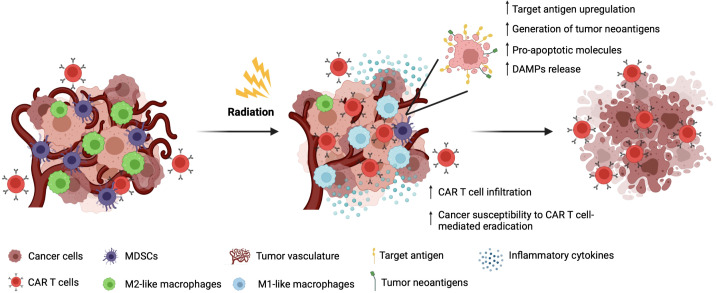
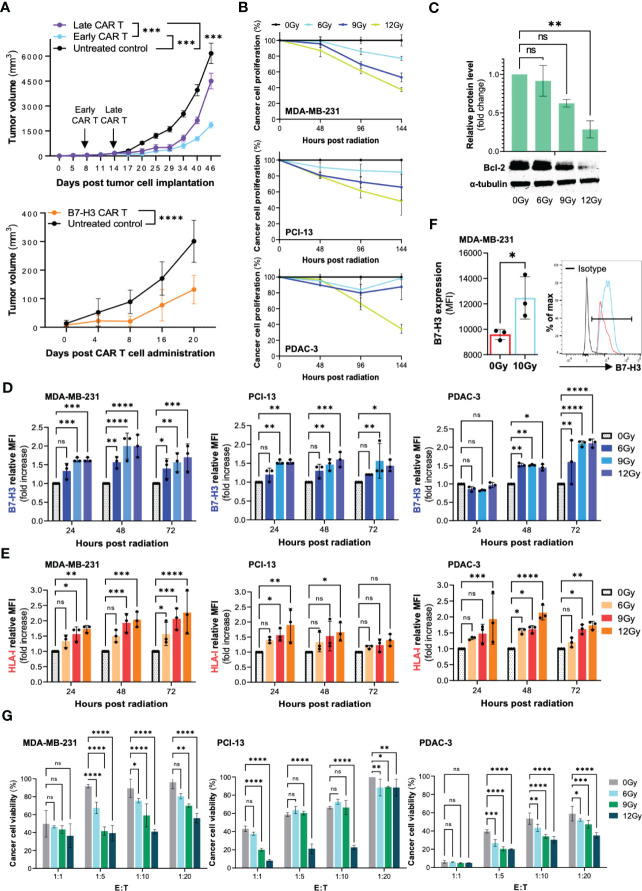
Adoptive cell therapy utilizing T cells genetically modified to express a chimeric antigen receptor (CAR) has demonstrated promising clinical results in hematological malignancies. However, solid cancers have not seen a similar success due to multiple obstacles. Investigating these escape mechanisms and designing strategies to counteract such limitations is crucial and timely. Growing evidence in the literature supports the hypothesis that radiotherapy has the potential to enhance the susceptibility of solid tumors to CAR T cell therapy, by overcoming mechanisms of resistance. Radiation treatment can increase the susceptibility of different types of solid cancers (TNBC, HNSCC, PDAC) to B7-H3 CAR T cell-mediated eradication. Multiple mechanisms, including reduced cancer cell proliferation, upregulation of the targeted antigen, modulation of apoptotic molecules may contribute to this signal. The information in the literature and the results we describesupport the ability of radiotherapy to improve the efficacy of CAR T cell therapy in solid tumors.
利用经过基因改造以表达嵌合抗原受体(CAR)的T细胞进行的过继性细胞疗法已在血液系统恶性肿瘤中显示出有前景的临床结果。然而,由于多种障碍,实体癌尚未取得类似的成功。研究这些逃逸机制并设计应对此类限制的策略至关重要且迫在眉睫。文献中越来越多的证据支持这样的假设,即放疗有可能通过克服耐药机制来增强实体瘤对CAR T细胞疗法的敏感性。放射治疗可增加不同类型实体癌(三阴性乳腺癌、头颈部鳞状细胞癌、胰腺导管腺癌)对B7-H3 CAR T细胞介导的根除的敏感性。多种机制,包括癌细胞增殖减少、靶向抗原上调、凋亡分子的调节,可能促成了这一信号。文献中的信息以及我们描述的结果支持放疗提高CAR T细胞疗法在实体瘤中疗效的能力。