Bartholomeyczik Karen, Knierim Michael T, Weinhardt Christof
Department of Economics and Management, Karlsruhe Institute of Technology, Karlsruhe, Germany.
Front Psychol. 2023 Jul 7;14:1143654. doi: 10.3389/fpsyg.2023.1143654. eCollection 2023.
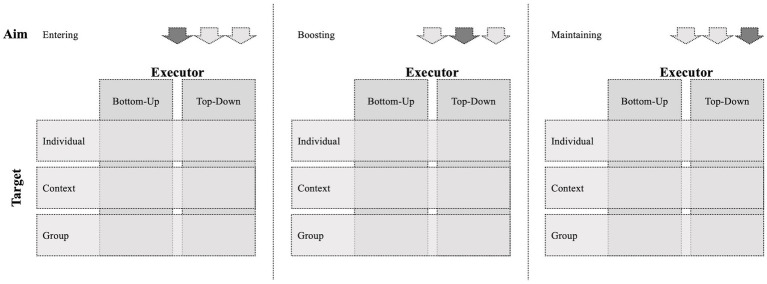
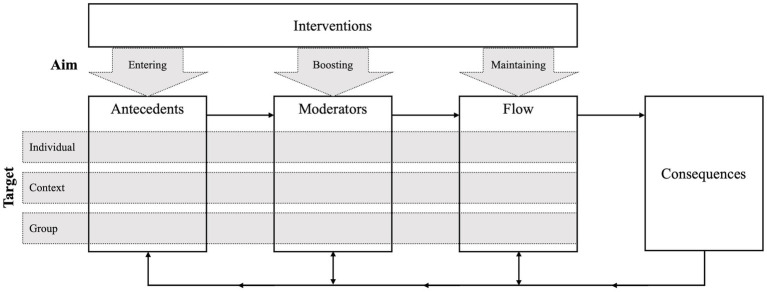
Flow, the holistic experience of intrinsic motivation and effortless attention, is positively associated with job performance, work engagement, and well-being. As many individuals struggle to enter and maintain flow states, interventions that foster flow at work represent valuable catalysts for organizational and individual improvement. Since the literature on work-related flow interventions is still sparse, this article aims to provide a foundation for the systematic development of these interventions. Through a narrative review of the empirical and theoretical field, we develop a comprehensive framework with three dimensions, (1) the intervention aim (entering, boosting, or maintaining flow), (2) the target (context, individual, or group), and (3) the executor (top-down or bottom-up), for systematically classifying flow interventions at work. We complement the framework with guiding questions and concrete starting points for designing novel interventions. In addition, we explain how to build on these dimensions when operationalizing flow as the outcome variable in evaluating intervention effectiveness. By acknowledging individual and situational variability in flow states and the contingent limitations of flow interventions, we offer a broad perspective on the potential for fostering flow at work by using adaptive interventions.
心流,即内在动机和轻松专注的整体体验,与工作绩效、工作投入度和幸福感呈正相关。由于许多人难以进入并维持心流状态,因此在工作中促进心流的干预措施是组织和个人提升的宝贵催化剂。鉴于有关与工作相关的心流干预措施的文献仍然稀少,本文旨在为系统开发这些干预措施提供基础。通过对实证和理论领域的叙述性综述,我们构建了一个包含三个维度的综合框架:(1)干预目标(进入、增强或维持心流),(2)目标对象(情境、个人或群体),以及(3)实施者(自上而下或自下而上),用于对工作中的心流干预措施进行系统分类。我们为该框架补充了设计新颖干预措施的指导问题和具体切入点。此外,我们还解释了在将心流作为评估干预效果的结果变量进行操作化时,如何基于这些维度展开。通过认识到心流状态中的个体和情境差异以及心流干预措施的偶然局限性,我们提供了一个关于通过使用适应性干预措施在工作中促进心流的潜力的广阔视角。