Rabiei Samira, Nazari Maryam
Department of Nutrition Research, National Nutrition and Food Technology Research Institute, Faculty of Nutrition and Food Technology Sciences, Shahid Beheshti University of Medical Sciences and Health Services, Tehran, Iran.
Food Safety Research Center (Salt), Semnan University of Medical Sciences, Semnan, Iran.
Iran J Public Health. 2023 Jun;52(6):1289-1296. doi: 10.18502/ijph.v52i6.12995.
Adolescence obesity and its health consequent on adulthood is affected by various environmental factors. Recently, dishware size or color is considered as a probable critical point to manage intake and weight. We investigated visual perception effects of plate size and color on fullness sensation regarding the Body Mass Index (BMI) for age percentiles in Tehran, Iran in 2019.
A cross sectional study conducted on 408 students aged 13-18 year from both sexes with different socioeconomic status through convenience sampling method. Anthropometric characteristics were measured to determine BMI for Age categories based on the WHO protocol. Visual analog scale (VAS) was used to assess participants' perceived satiety when faced to images of different plate's size and color with the same food volume. SPSS 21 was used to statistical analyze.
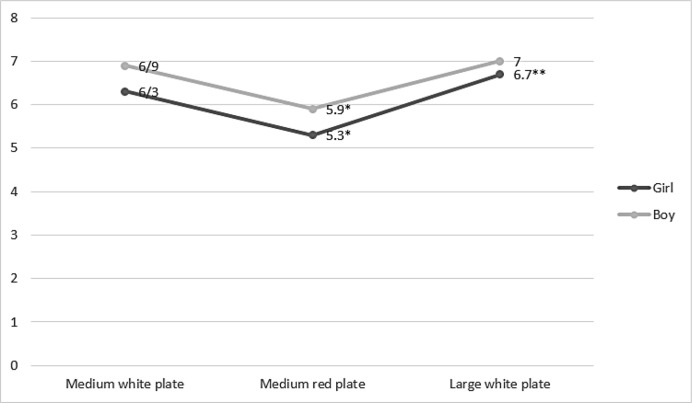
41.2% of student were on >85th percentile of BMI for age. Mean of score of VAS for medium red plate was significantly lower than medium and large white plates in both sexes (<0.001), while mean of score of VAS for small white plate was significantly lower than large white plates only in girls (<0.001). The adolescents who were on >85th percentile of BMI for age, gave higher score to large white plate than medium white plate and to medium white plate than medium red plate, significantly (<0.001), while the scores given by the adolescent on 5th percentile of BMI, were not significant.
Considering dramatic trend of obesity in adolescents in Iran, there is an urgent need to make supportive policies. Manipulating food containers seems to be an effective and simple approach to control feeling satiety. It may be a cost-effective approach to prevent obesity in adolescents before progressing to adulthood.
青少年肥胖及其成年后的健康状况受到多种环境因素的影响。最近,餐具的尺寸或颜色被认为是控制摄入量和体重的一个可能的关键点。2019年,我们在伊朗德黑兰调查了餐盘尺寸和颜色对不同年龄百分位数的身体质量指数(BMI)饱腹感的视觉感知影响。
通过便利抽样法对408名年龄在13 - 18岁、具有不同社会经济地位的男女学生进行了一项横断面研究。根据世界卫生组织的方案测量人体测量特征,以确定年龄类别对应的BMI。当面对相同食物量但不同餐盘尺寸和颜色的图像时,使用视觉模拟量表(VAS)来评估参与者的饱腹感。使用SPSS 21进行统计分析。
结果:41.2%的学生BMI处于年龄对应的第85百分位数以上。中等红色餐盘的VAS评分均值在男女中均显著低于中等和大白色餐盘(<0.001),而小白色餐盘的VAS评分均值仅在女孩中显著低于大白色餐盘(<0.001)。BMI处于年龄对应的第85百分位数以上的青少年,对大白餐盘的评分显著高于中白餐盘,对中白餐盘的评分显著高于中等红色餐盘(<0.001),而BMI处于第5百分位数的青少年给出的评分则无显著差异。 结论:考虑到伊朗青少年肥胖的急剧趋势,迫切需要制定支持性政策。操纵食物容器似乎是控制饱腹感的一种有效且简单的方法。这可能是一种在青少年成年前预防肥胖的经济有效的方法。