Pan Guo-Qiang, Jiao Yan, Meng Guang-Xiao, Dong Zhao-Ru, Li Tao
Department of General Surgery, Qilu Hospital, Shandong University, Jinan, China.
Department of Hepatobiliary and Pancreatic Surgery, The First Hospital of Jilin University, Changchun, China.
Heliyon. 2023 Jun 8;9(6):e17126. doi: 10.1016/j.heliyon.2023.e17126. eCollection 2023 Jun.
Although several studies have found that the serum lipid profile may be correlated with hepatocellular carcinoma (HCC), the causal relationships between the serum lipid profile and HCC have not been determined due to potential confounder. Here, Mendelian randomization (MR) analysis was performed to identify the relationship between the serum lipid profile and HCC in the East Asian population.
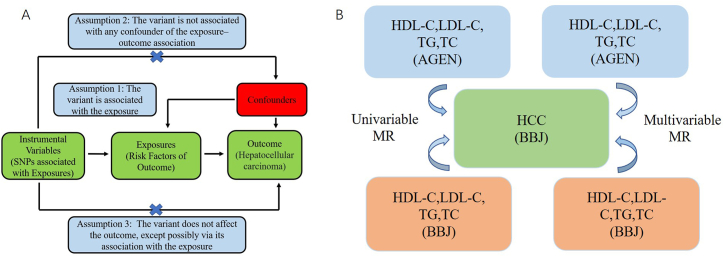
Our study made a MR analysis with the validation of two data sets. We obtained genome-wide association study (GWAS) data related to the serum lipid profile from Asian Genetic Epidemiology Network (AGEN). Then, the data from a recent large GWAS of the East Asian ancestry in Japan (BioBank Japan, BBJ) were extracted. Summary-level statistical data for HCC were obtained from a large GWAS of the East Asian ancestry in Japan. Univariable MR analysis were performed to identify whether the genetic evidence of serum lipid profile was significantly associated with HCC risk. Multivariable MR analysis was conducted to estimate the independent effects of exposures on HCC.
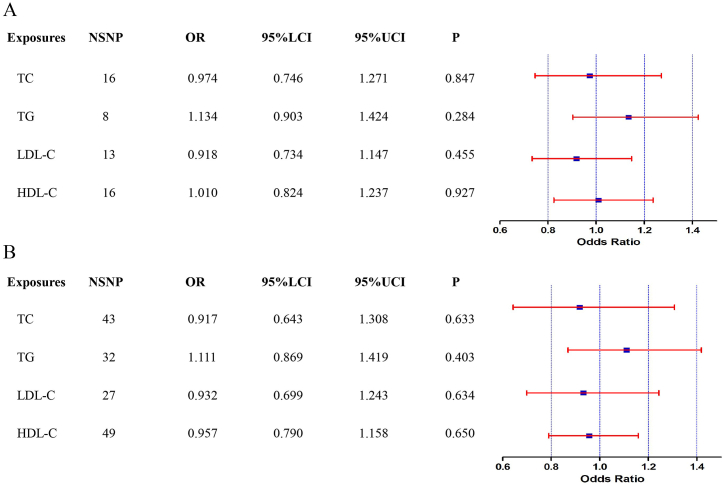
Univariable and multivariable MR analyses indicated that the serum lipid profile was not a risk factor for HCC incidence in either data set based on the East Asian population. Multivariable MR analysis revealed that the hazard ratios of the probability of HCC in AGEN were 1.134 (95% confidence interval (CI), 0.903-1.424) for TG, 1.010 (95% CI: 0.824-1.237) for HDL-C, 0.974 (95% CI: 0.746-1.271) for TC, 0.918 (95% CI: 0.734-1.147) for LDL-C, while the results in BBJ were also non-significant: 1.111 (95% CI: 0.869-1.419) for TG, 0.957 (95% CI: 0.790-1.158) for HDL-C, 0.917 (95% CI: 0.643-1.308) for TC, 0.932 (95% CI: 0.699-1.243) for LDL-C.
Our MR study with the validation of two data sets found no strong evidence to support causal associations between the serum lipid profile and HCC risk.
尽管多项研究发现血清脂质谱可能与肝细胞癌(HCC)相关,但由于潜在的混杂因素,血清脂质谱与HCC之间的因果关系尚未确定。在此,我们进行了孟德尔随机化(MR)分析,以确定东亚人群中血清脂质谱与HCC之间的关系。
我们的研究对两个数据集进行了MR分析及验证。我们从亚洲遗传流行病学网络(AGEN)获取了与血清脂质谱相关的全基因组关联研究(GWAS)数据。然后,提取了日本近期一项针对东亚血统人群的大型GWAS(日本生物银行,BBJ)的数据。HCC的汇总统计数据来自日本一项针对东亚血统人群的大型GWAS。进行单变量MR分析以确定血清脂质谱的遗传证据是否与HCC风险显著相关。进行多变量MR分析以估计暴露因素对HCC的独立影响。
单变量和多变量MR分析表明,基于东亚人群的两个数据集中,血清脂质谱均不是HCC发病的危险因素。多变量MR分析显示,AGEN中HCC发生概率的风险比为:甘油三酯(TG)为1.134(95%置信区间(CI),0.903 - 1.424),高密度脂蛋白胆固醇(HDL - C)为1.010(95% CI:0.824 - 1.237),总胆固醇(TC)为0.974(95% CI:0.746 - 1.271),低密度脂蛋白胆固醇(LDL - C)为0.918(95% CI:0.734 - 1.147),而BBJ中的结果也无统计学意义:TG为1.111(95% CI:0.869 - 1.419),HDL - C为0.957(95% CI:0.790 - 1.158),TC为0.917(95% CI:0.643 - 1.308),LDL - C为0.932(95% CI:0.699 - 1.243)。
我们对两个数据集进行验证的MR研究未发现有力证据支持血清脂质谱与HCC风险之间的因果关联。