• 文献检索
  • 文档翻译
  • 深度研究
  • 学术资讯
  • Suppr Zotero 插件Zotero 插件
  • 邀请有礼
  • 套餐&价格
  • 历史记录
应用&插件
Suppr Zotero 插件Zotero 插件浏览器插件Mac 客户端Windows 客户端微信小程序
定价
高级版会员购买积分包购买API积分包
服务
文献检索文档翻译深度研究API 文档MCP 服务
关于我们
关于 Suppr公司介绍联系我们用户协议隐私条款
关注我们

Suppr 超能文献

核心技术专利:CN118964589B侵权必究
粤ICP备2023148730 号-1Suppr @ 2026

文献检索

告别复杂PubMed语法,用中文像聊天一样搜索,搜遍4000万医学文献。AI智能推荐,让科研检索更轻松。

立即免费搜索

文件翻译

保留排版,准确专业,支持PDF/Word/PPT等文件格式,支持 12+语言互译。

免费翻译文档

深度研究

AI帮你快速写综述,25分钟生成高质量综述,智能提取关键信息,辅助科研写作。

立即免费体验

使用统计过程控制对经导管主动脉瓣植入术30天死亡率预测模型进行时间验证——一项全国性人群的观察性研究

Temporal validation of 30-day mortality prediction models for transcatheter aortic valve implantation using statistical process control - An observational study in a national population.

作者信息

Lopes Ricardo R, Yordanov Tsvetan T R, Ravelli Anita A C J, Houterman Saskia, Vis Marije, de Mol Bas A J M, Marquering Henk, Abu-Hanna Ameen

机构信息

Amsterdam UMC Location University of Amsterdam, Biomedical Engineering and Physics, Meibergdreef 9, Amsterdam, the Netherlands.

Amsterdam UMC Location University of Amsterdam, Radiology and Nuclear Medicine, Meibergdreef 9, Amsterdam, the Netherlands.

出版信息

Heliyon. 2023 Jun 10;9(6):e17139. doi: 10.1016/j.heliyon.2023.e17139. eCollection 2023 Jun.

DOI:10.1016/j.heliyon.2023.e17139
PMID:37484279
原文链接:https://pmc.ncbi.nlm.nih.gov/articles/PMC10361331/
Abstract

BACKGROUND

Various mortality prediction models for Transcatheter Aortic Valve Implantation (TAVI) have been developed in the past years. The effect of time on the performance of such models, however, is unclear given the improvements in the procedure and changes in patient selection, potentially jeopardizing the usefulness of the prediction models in clinical practice. We aim to explore how time affects the performance and stability of different types of prediction models of 30-day mortality after TAVI.

METHODS

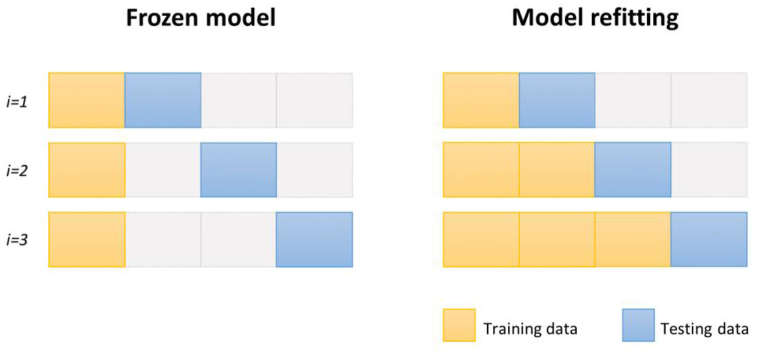
We developed both parametric (Logistic Regression) and non-parametric (XGBoost) models to predict 30-day mortality after TAVI using data from the Netherlands Heart Registration. The models were trained with data from 2013 to the beginning of 2016 and pre-control charts from Statistical Process Control were used to analyse how time affects the models' performance on independent data from the mid of 2016 to the end of 2019. The area under the Receiver Operating Characteristics curve (AUC) was used to evaluate the models in terms of discrimination and the Brier Score (BS), which is related to calibration, in terms of accuracy of the predicted probabilities. To understand the extent to which refitting the models contribute to the models' stability, we also allowed the models to be updated over time.

RESULTS

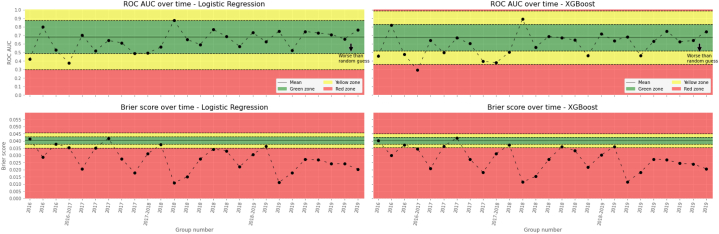
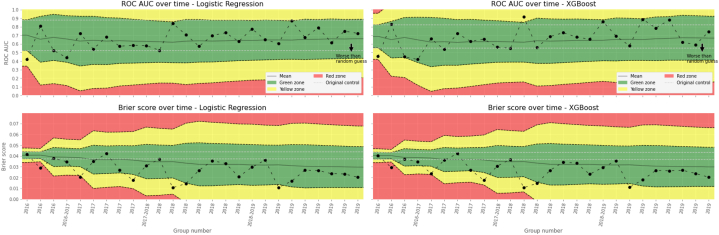
We included data from 11,291 consecutive TAVI patients from hospitals in the Netherlands. The parametric model without re-training had a median AUC of 0.64 (IQR 0.54-0.73) and BS of 0.028 (IQR 0.021-0.035). For the non-parametric model, the median AUC was 0.63 (IQR 0.48-0.68) and BS was 0.027 (IQR 0.021-0.036). Over time, the developed parametric model was stable in terms of AUC and unstable in terms of BS. The non-parametric model was considered unstable in both AUC and BS. Repeated model refitting resulted in stable models in terms of AUC and decreased the variability of BS, although BS was still unstable. The refitted parametric model had a median AUC of 0.66 (IQR 0.57-0.73) and BS of 0.027 (IQR 0.020-0.035) while the non-parametric model had a median AUC of 0.66 (IQR 0.57-0.74) and BS of 0.027 (IQR 0.023-0.035).

CONCLUSIONS

The temporal validation of the TAVI 30-day mortality prediction models showed that the models refitted over time are more stable and accurate when compared to the frozen models. This highlights the importance of repeatedly refitted models over time to improve or at least maintain their performance stability. The non-parametric approach did not show improvement over the parametric approach.

摘要

背景

在过去几年中,已经开发了各种用于经导管主动脉瓣植入术(TAVI)的死亡率预测模型。然而,鉴于该手术的改进和患者选择的变化,时间对这些模型性能的影响尚不清楚,这可能会危及预测模型在临床实践中的实用性。我们旨在探讨时间如何影响TAVI术后30天死亡率不同类型预测模型的性能和稳定性。

方法

我们使用来自荷兰心脏注册的数据,开发了参数模型(逻辑回归)和非参数模型(XGBoost)来预测TAVI术后30天死亡率。这些模型使用2013年至2016年初的数据进行训练,并使用统计过程控制的预控制图来分析时间如何影响模型对2016年年中至2019年底独立数据的性能。受试者操作特征曲线(AUC)下的面积用于评估模型的辨别能力,而Brier评分(BS)与校准相关,用于评估预测概率的准确性。为了了解重新拟合模型对模型稳定性的贡献程度,我们还允许模型随时间更新。

结果

我们纳入了来自荷兰医院的11291例连续TAVI患者的数据。未经重新训练的参数模型的AUC中位数为0.64(IQR 0.54 - 0.73),BS为0.028(IQR 0.021 - 0.035)。对于非参数模型,AUC中位数为0.63(IQR 0.48 - 0.68),BS为0.027(IQR 0.021 - 0.036)。随着时间的推移,所开发的参数模型在AUC方面是稳定的,而在BS方面是不稳定的。非参数模型在AUC和BS方面均被认为是不稳定的。重复模型重新拟合导致模型在AUC方面稳定,并且降低了BS的变异性,尽管BS仍然不稳定。重新拟合的参数模型的AUC中位数为0.66(IQR 0.57 - 0.73),BS为0.027(IQR 0.020 - 0.035),而非参数模型的AUC中位数为0.66(IQR 0.57 - 0.74),BS为0.027(IQR 0.023 - 0.035)。

结论

TAVI术后30天死亡率预测模型的时间验证表明,与固定模型相比,随时间重新拟合的模型更稳定、更准确。这突出了随着时间重复重新拟合模型以改善或至少维持其性能稳定性的重要性。非参数方法并未显示出优于参数方法的改进。
https://cdn.ncbi.nlm.nih.gov/pmc/blobs/d289/10361331/56993c2c9de7/gr5.jpg
https://cdn.ncbi.nlm.nih.gov/pmc/blobs/d289/10361331/4eccc79d200e/gr1.jpg
https://cdn.ncbi.nlm.nih.gov/pmc/blobs/d289/10361331/8aaf36838ebc/gr2.jpg
https://cdn.ncbi.nlm.nih.gov/pmc/blobs/d289/10361331/d137d7d7f724/gr3.jpg
https://cdn.ncbi.nlm.nih.gov/pmc/blobs/d289/10361331/2f4ee3b9bca8/gr4.jpg
https://cdn.ncbi.nlm.nih.gov/pmc/blobs/d289/10361331/56993c2c9de7/gr5.jpg
https://cdn.ncbi.nlm.nih.gov/pmc/blobs/d289/10361331/4eccc79d200e/gr1.jpg
https://cdn.ncbi.nlm.nih.gov/pmc/blobs/d289/10361331/8aaf36838ebc/gr2.jpg
https://cdn.ncbi.nlm.nih.gov/pmc/blobs/d289/10361331/d137d7d7f724/gr3.jpg
https://cdn.ncbi.nlm.nih.gov/pmc/blobs/d289/10361331/2f4ee3b9bca8/gr4.jpg
https://cdn.ncbi.nlm.nih.gov/pmc/blobs/d289/10361331/56993c2c9de7/gr5.jpg

相似文献

1
Temporal validation of 30-day mortality prediction models for transcatheter aortic valve implantation using statistical process control - An observational study in a national population.使用统计过程控制对经导管主动脉瓣植入术30天死亡率预测模型进行时间验证——一项全国性人群的观察性研究
Heliyon. 2023 Jun 10;9(6):e17139. doi: 10.1016/j.heliyon.2023.e17139. eCollection 2023 Jun.
2
Development and validation of a prediction model for early mortality after transcatheter aortic valve implantation (TAVI) based on the Netherlands Heart Registration (NHR): The TAVI-NHR risk model.基于荷兰心脏注册研究(NHR)的经导管主动脉瓣植入术(TAVI)后早期死亡率预测模型的建立与验证:TAVI-NHR 风险模型。
Catheter Cardiovasc Interv. 2022 Nov;100(5):879-889. doi: 10.1002/ccd.30398. Epub 2022 Sep 7.
3
Update and, internal and temporal-validation of the FRANCE-2 and ACC-TAVI early-mortality prediction models for Transcatheter Aortic Valve Implantation (TAVI) using data from the Netherlands heart registration (NHR).利用荷兰心脏注册(NHR)的数据,对用于经导管主动脉瓣植入术(TAVI)的FRANCE - 2和ACC - TAVI早期死亡率预测模型进行更新、内部及时间验证。
Int J Cardiol Heart Vasc. 2021 Jan 23;32:100716. doi: 10.1016/j.ijcha.2021.100716. eCollection 2021 Feb.
4
External validation of existing prediction models of 30-day mortality after Transcatheter Aortic Valve Implantation (TAVI) in the Netherlands Heart Registration.荷兰心脏注册研究中经导管主动脉瓣植入术(TAVI)后30天死亡率现有预测模型的外部验证
Int J Cardiol. 2020 Oct 15;317:25-32. doi: 10.1016/j.ijcard.2020.05.039. Epub 2020 May 22.
5
Outcome prediction following transcatheter aortic valve implantation: Multiple risk scores comparison.经导管主动脉瓣植入术后的结局预测:多种风险评分比较
Cardiol J. 2016;23(2):169-77. doi: 10.5603/CJ.a2015.0081. Epub 2015 Dec 29.
6
Machine learning-based predictive risk models for 30-day and 1-year mortality in severe aortic stenosis patients undergoing transcatheter aortic valve implantation.基于机器学习的经导管主动脉瓣植入术严重主动脉瓣狭窄患者30天和1年死亡率预测风险模型。
Int J Cardiol. 2023 Mar 1;374:20-26. doi: 10.1016/j.ijcard.2022.12.023. Epub 2022 Dec 15.
7
Pre-procedural CT angiography inferior vena cava measurements: a predictor of mortality in patients undergoing transcatheter aortic valve implantation.经导管主动脉瓣植入术前 CT 血管造影下腔静脉测量:预测患者死亡率的指标。
Eur Radiol. 2019 Feb;29(2):975-984. doi: 10.1007/s00330-018-5613-x. Epub 2018 Jul 17.
8
Usefulness and validation of the survival posT TAVI score for survival after transcatheter aortic valve implantation for aortic stenosis.经导管主动脉瓣植入术治疗主动脉瓣狭窄后生存的生存post TAVI评分的实用性及验证
Am J Cardiol. 2014 Dec 15;114(12):1867-74. doi: 10.1016/j.amjcard.2014.09.031. Epub 2014 Sep 28.
9
Performance of federated learning-based models in the Dutch TAVI population was comparable to central strategies and outperformed local strategies.基于联邦学习的模型在荷兰经导管主动脉瓣植入术人群中的表现与集中式策略相当,且优于局部策略。
Front Cardiovasc Med. 2024 Jul 5;11:1399138. doi: 10.3389/fcvm.2024.1399138. eCollection 2024.
10
Performance of EuroSCORE II in a large US database: implications for transcatheter aortic valve implantation.欧洲心脏手术风险评估系统II(EuroSCORE II)在美国大型数据库中的表现:对经导管主动脉瓣植入术的影响
Eur J Cardiothorac Surg. 2014 Sep;46(3):400-8; discussion 408. doi: 10.1093/ejcts/ezu033. Epub 2014 Feb 26.

引用本文的文献

1
Performance of federated learning-based models in the Dutch TAVI population was comparable to central strategies and outperformed local strategies.基于联邦学习的模型在荷兰经导管主动脉瓣植入术人群中的表现与集中式策略相当,且优于局部策略。
Front Cardiovasc Med. 2024 Jul 5;11:1399138. doi: 10.3389/fcvm.2024.1399138. eCollection 2024.

本文引用的文献

1
Using real-world data to monitor and improve quality of care in coronary artery disease: results from the Netherlands Heart Registration.利用真实世界数据监测和改善冠心病护理质量:荷兰心脏注册研究结果
Neth Heart J. 2022 Dec;30(12):546-556. doi: 10.1007/s12471-022-01672-0. Epub 2022 Apr 7.
2
Temporal trends of TAVI treatment characteristics in high volume centers in Germany 2013-2020.2013-2020 年德国大容量中心 TAVI 治疗特征的时间趋势。
Clin Res Cardiol. 2022 Aug;111(8):881-888. doi: 10.1007/s00392-021-01963-3. Epub 2021 Nov 9.
3
Update and, internal and temporal-validation of the FRANCE-2 and ACC-TAVI early-mortality prediction models for Transcatheter Aortic Valve Implantation (TAVI) using data from the Netherlands heart registration (NHR).
利用荷兰心脏注册(NHR)的数据,对用于经导管主动脉瓣植入术(TAVI)的FRANCE - 2和ACC - TAVI早期死亡率预测模型进行更新、内部及时间验证。
Int J Cardiol Heart Vasc. 2021 Jan 23;32:100716. doi: 10.1016/j.ijcha.2021.100716. eCollection 2021 Feb.
4
Artificial Intelligence Trumps TAVI-SCORE and CoreValve Score in Predicting 1-Year Mortality Post-Transcatheter Aortic Valve Replacement.人工智能在预测经导管主动脉瓣置换术后 1 年死亡率方面优于 TAVI-SCORE 和 CoreValve 评分。
Cardiovasc Revasc Med. 2021 Mar;24:33-41. doi: 10.1016/j.carrev.2020.08.010. Epub 2020 Aug 15.
5
Risk modeling in transcatheter aortic valve replacement remains unsolved: an external validation study in 2946 German patients.经导管主动脉瓣置换术的风险建模仍未解决:2946 例德国患者的外部验证研究。
Clin Res Cardiol. 2021 Mar;110(3):368-376. doi: 10.1007/s00392-020-01731-9. Epub 2020 Aug 26.
6
External validation of existing prediction models of 30-day mortality after Transcatheter Aortic Valve Implantation (TAVI) in the Netherlands Heart Registration.荷兰心脏注册研究中经导管主动脉瓣植入术(TAVI)后30天死亡率现有预测模型的外部验证
Int J Cardiol. 2020 Oct 15;317:25-32. doi: 10.1016/j.ijcard.2020.05.039. Epub 2020 May 22.
7
"The changing paradigm": TAVR for low-risk patients approved by the FDA.“不断变化的模式”:经美国食品药品监督管理局批准用于低风险患者的经导管主动脉瓣置换术
J Card Surg. 2020 Jan;35(1):5-7. doi: 10.1111/jocs.14336. Epub 2019 Nov 25.
8
Transcatheter aortic valve implantation versus surgical aortic valve replacement in patients at low and intermediate risk: A risk specific meta-analysis of randomized controlled trials.经导管主动脉瓣植入术与低、中度风险患者外科主动脉瓣置换术的比较:随机对照试验的风险特异性荟萃分析。
PLoS One. 2019 Sep 24;14(9):e0221922. doi: 10.1371/journal.pone.0221922. eCollection 2019.
9
Value of machine learning in predicting TAVI outcomes.机器学习在预测经导管主动脉瓣置入术(TAVI)结果中的价值。
Neth Heart J. 2019 Sep;27(9):443-450. doi: 10.1007/s12471-019-1285-7.
10
Dynamic models to predict health outcomes: current status and methodological challenges.预测健康结果的动态模型:现状与方法学挑战
Diagn Progn Res. 2018 Dec 18;2:23. doi: 10.1186/s41512-018-0045-2. eCollection 2018.