Cappello Giovanni, Giannini Valentina, Cannella Roberto, Tabone Emanuele, Ambrosini Ilaria, Molea Francesca, Damiani Nicolò, Landolfi Ilenia, Serra Giovanni, Porrello Giorgia, Gozzo Cecilia, Incorvaia Lorena, Badalamenti Giuseppe, Grignani Giovanni, Merlini Alessandra, D'Ambrosio Lorenzo, Bartolotta Tommaso Vincenzo, Regge Daniele
Department of Radiology, Candiolo Cancer Institute, FPO-IRCCS, Strada Provinciale 142 Km 3.95, Candiolo, Turin 10060, Italy.
Department of Surgical Sciences, University of Turin, Turin 10124, Italy.
Eur J Radiol Open. 2023 Jul 10;11:100505. doi: 10.1016/j.ejro.2023.100505. eCollection 2023 Dec.
To develop a mutation-based radiomics signature to predict response to imatinib in Gastrointestinal Stromal Tumors (GISTs).
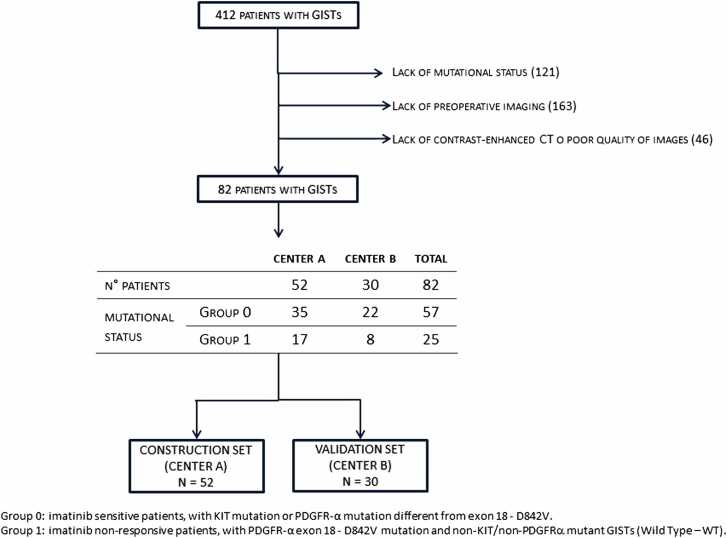
Eighty-two patients with GIST were enrolled in this retrospective study, including 52 patients from one center that were used to develop the model, and 30 patients from a second center to validate it. Reference standard was the mutational status of tyrosine-protein kinase (KIT) and platelet-derived growth factor α (PDGFRA). Patients were dichotomized in imatinib sensitive (group 0 - mutation in KIT or PDGFRA, different from exon 18-D842V), and imatinib non-responsive (group 1 - PDGFRA exon 18-D842V mutation or absence of mutation in KIT/PDGFRA). Initially, 107 texture features were extracted from the tumor masks of baseline computed tomography scans. Different machine learning methods were then implemented to select the best combination of features for the development of the radiomics signature.
The best performance was obtained with the 5 features selected by the ANOVA model and the Bayes classifier, using a threshold of 0.36. With this setting the radiomics signature had an accuracy and precision for sensitive patients of 82 % (95 % CI:60-95) and 90 % (95 % CI:73-97), respectively. Conversely, a precision of 80 % (95 % CI:34-97) was obtained in non-responsive patients using a threshold of 0.9. Indeed, with the latter setting 4 patients out of 5 were correctly predicted as non-responders.
The results are a first step towards using radiomics to improve the management of patients with GIST, especially when tumor tissue is unavailable for molecular analysis or when molecular profiling is inconclusive.
开发一种基于突变的放射组学特征,以预测胃肠道间质瘤(GIST)患者对伊马替尼的反应。
82例GIST患者纳入本回顾性研究,其中52例来自一个中心用于建立模型,30例来自另一个中心用于验证模型。参考标准为酪氨酸蛋白激酶(KIT)和血小板衍生生长因子α(PDGFRA)的突变状态。患者被分为伊马替尼敏感组(0组——KIT或PDGFRA突变,不同于外显子18-D842V)和伊马替尼无反应组(1组——PDGFRA外显子18-D842V突变或KIT/PDGFRA无突变)。最初,从基线计算机断层扫描的肿瘤掩码中提取107个纹理特征。然后采用不同的机器学习方法选择最佳特征组合,以建立放射组学特征。
使用方差分析模型和贝叶斯分类器选择的5个特征,阈值为0.36时性能最佳。在此设置下,放射组学特征对敏感患者的准确率和精确率分别为82%(95%CI:60-95)和90%(95%CI:73-97)。相反,使用阈值0.9时,无反应患者的精确率为80%(95%CI:34-97)。事实上,在后一种设置下,5例患者中有4例被正确预测为无反应者。
这些结果是朝着利用放射组学改善GIST患者管理迈出的第一步,特别是在无法获得肿瘤组织进行分子分析或分子谱分析不确定的情况下。