Desgres Manon, Lima Correa Bruna, Petrusca Lorena, Autret Gwennhael, Pezzana Chloé, Marigny Céline, Guillas Chloé, Bellamy Valérie, Vilar José, Perier Marie-Cécile, Dingli Florent, Loew Damarys, Humbert Camille, Larghero Jérôme, Churlaud Guillaume, Renault Nisa, Croisille Pierre, Hagège Albert, Silvestre Jean-Sébastien, Menasché Philippe
Université Paris Cité, Inserm, PARCC, Paris, France.
Université de Lyon, INSA, Université Claude Bernard Lyon 1, UJM-Saint-Etienne, CNRS UMR 5520, INSERM U1206, CREATIS, Saint-Etienne, France.
Front Cardiovasc Med. 2023 Jul 7;10:1206279. doi: 10.3389/fcvm.2023.1206279. eCollection 2023.
Current treatments of chemotherapy-induced cardiomyopathy (CCM) are of limited efficacy. We assessed whether repeated intravenous injections of human extracellular vesicles from cardiac progenitor cells (EV-CPC) could represent a new therapeutic option and whether EV manufacturing according to a Good Manufacturing Practices (GMP)-compatible process did not impair their bioactivity.
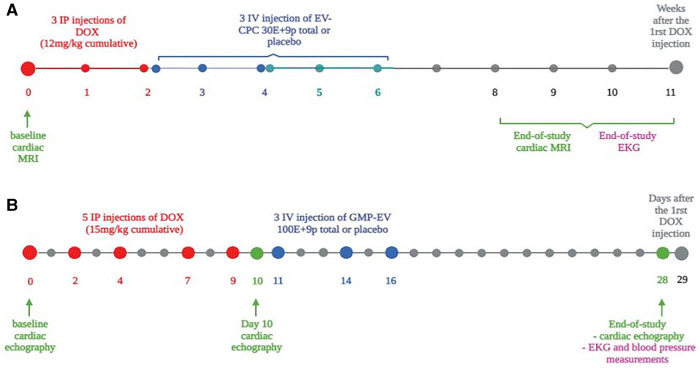
Immuno-competent mice received intra-peritoneal injections (IP) of doxorubicin (DOX) (4 mg/kg each; cumulative dose: 12 mg/kg) and were then intravenously (IV) injected three times with EV-CPC (total dose: 30 billion). Cardiac function was assessed 9-11 weeks later by cardiac magnetic resonance imaging (CMR) using strain as the primary end point. Then, immuno-competent rats received 5 IP injections of DOX (3 mg/kg each; cumulative dose 15 mg/kg) followed by 3 equal IV injections of GMP-EV (total dose: 100 billion). Cardiac function was assessed by two dimensional-echocardiography.
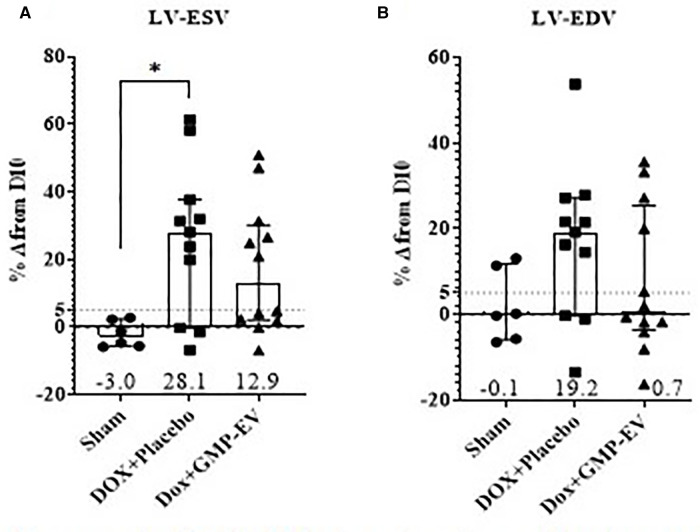
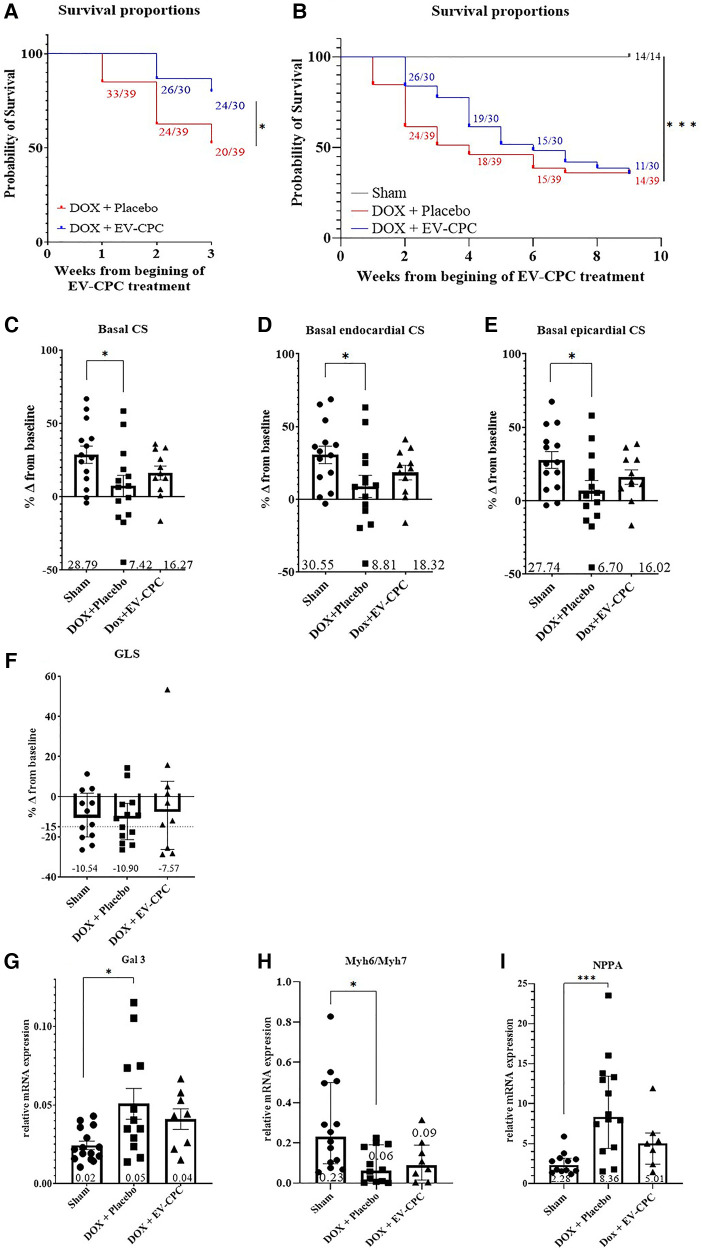
In the chronic mouse model of CCM, DOX + placebo-injected hearts incurred a significant decline in basal (global, epi- and endocardial) circumferential strain compared with sham DOX-untreated mice ( = 0.043, = 0.042, = 0.048 respectively) while EV-CPC preserved these indices. Global longitudinal strain followed a similar pattern. In the rat model, IV injections of GMP-EV also preserved left ventricular end-systolic and end-diastolic volumes compared with untreated controls.
Intravenously-injected extracellular vesicles derived from CPC have cardio-protective effects which may make them an attractive user-friendly option for the treatment of CCM.
目前化疗所致心肌病(CCM)的治疗效果有限。我们评估了重复静脉注射来自心脏祖细胞的人细胞外囊泡(EV-CPC)是否可成为一种新的治疗选择,以及按照药品生产质量管理规范(GMP)兼容流程生产的EV是否不会损害其生物活性。
免疫活性小鼠接受腹腔注射(IP)阿霉素(DOX)(每次4 mg/kg;累积剂量:12 mg/kg),然后静脉注射(IV)3次EV-CPC(总剂量:300亿个)。9至11周后,通过心脏磁共振成像(CMR)以应变作为主要终点评估心脏功能。然后,免疫活性大鼠接受5次IP注射DOX(每次3 mg/kg;累积剂量15 mg/kg),随后3次等量IV注射GMP-EV(总剂量:1000亿个)。通过二维超声心动图评估心脏功能。
在CCM的慢性小鼠模型中,与未接受DOX治疗的假手术小鼠相比,注射DOX+安慰剂的心脏在基础(整体、心外膜和心内膜)圆周应变方面显著下降(分别为=0.043、=0.042、=0.048),而EV-CPC可维持这些指标。整体纵向应变呈现相似模式。在大鼠模型中,与未治疗的对照组相比,IV注射GMP-EV也可维持左心室收缩末期和舒张末期容积。
静脉注射源自CPC的细胞外囊泡具有心脏保护作用,这可能使其成为治疗CCM的一种有吸引力且使用方便的选择。