Escudero Marcial, Marques André, Lucek Kay, Hipp Andrew L
Department of Plant Biology and Ecology, University of Seville, Sevilla, Spain.
Department of Chromosome Biology, Max Planck Institute for Plant Breeding Research, Cologne, Germany.
Mol Ecol. 2024 Dec;33(24):e17086. doi: 10.1111/mec.17086. Epub 2023 Jul 24.
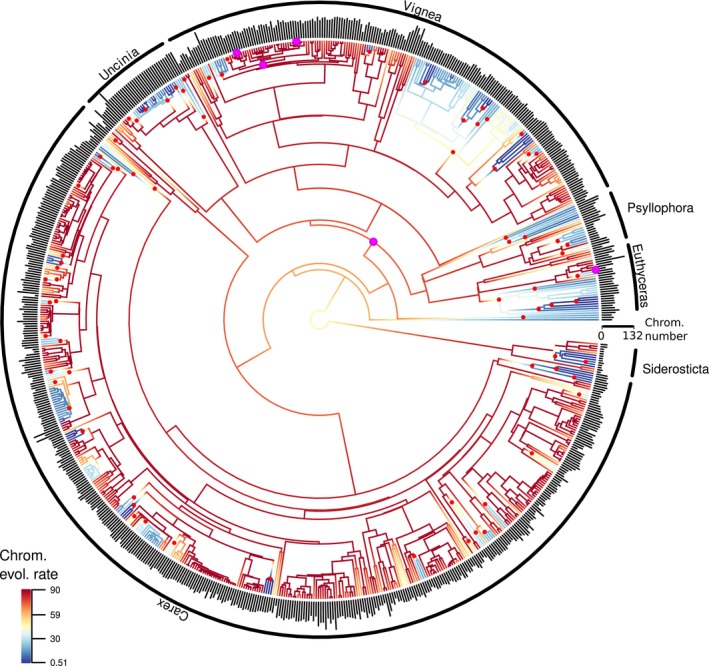
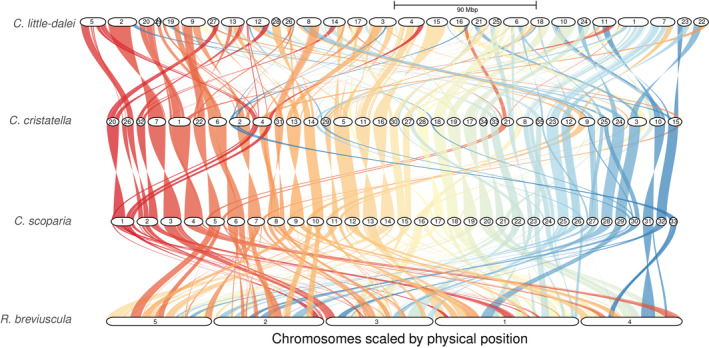
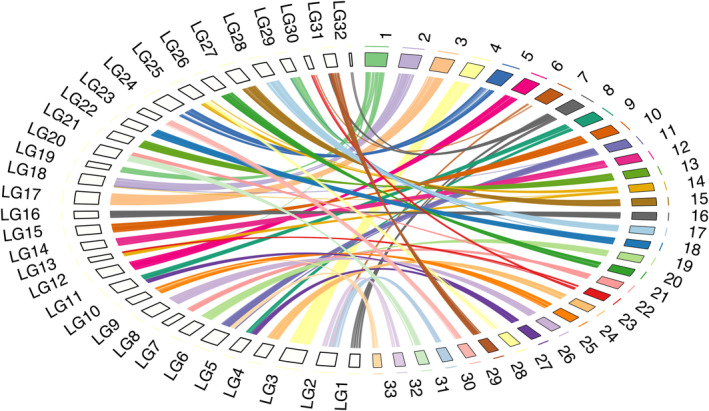
Holocentric organisms, unlike typical monocentric organisms, have kinetochore activity distributed along almost the whole length of the chromosome. Because of this, chromosome rearrangements through fission and fusion are more likely to become fixed in holocentric species, which may account for the extraordinary rates of chromosome evolution that many holocentric lineages exhibit. Long blocks of genome synteny have been reported in animals with holocentric chromosomes despite high rates of chromosome rearrangements. Nothing is known from plants, however, despite the fact that holocentricity appears to have played a key role in the diversification of one of the largest angiosperm genera, Carex (Cyperaceae). In the current study, we compared genomes of Carex species and a distantly related Cyperaceae species to characterize conserved and rearranged genome regions. Our analyses span divergence times ranging between 2 and 50 million years. We also compared a C. scoparia chromosome-level genome assembly with a linkage map of the same species to study rearrangements at a population level and suppression of recombination patterns. We found longer genome synteny blocks than expected under a null model of random rearrangement breakpoints, even between very distantly related species. We also found repetitive DNA to be non-randomly associated with holocentromeres and rearranged regions of the genome. The evidence of conserved synteny in sedges despite high rates of chromosome fission and fusion suggests that conserved genomic hotspots of chromosome evolution related to repetitive DNA shape the evolution of recombination, gene order and crossability in sedges. This finding may help explain why sedges are able to maintain species cohesion even in the face of high interspecific chromosome rearrangements.
与典型的单着丝粒生物不同,全着丝粒生物的动粒活性沿染色体几乎整个长度分布。正因如此,通过裂变和融合进行的染色体重排更有可能在全着丝粒物种中固定下来,这或许可以解释许多全着丝粒谱系所展现出的非凡染色体进化速率。尽管染色体重排速率很高,但在具有全着丝粒染色体的动物中已报道了长片段的基因组同线性。然而,对于植物却一无所知,尽管全着丝粒似乎在最大的被子植物属之一苔草属(莎草科)的多样化过程中发挥了关键作用。在本研究中,我们比较了苔草属物种和一个远缘莎草科物种的基因组,以表征保守和重排的基因组区域。我们的分析涵盖了200万至5000万年的分歧时间。我们还将一种 scoparia苔草的染色体水平基因组组装与同一物种的连锁图谱进行了比较,以研究群体水平的重排和重组模式的抑制。我们发现,即使在亲缘关系非常远的物种之间,基因组同线性块也比随机重排断点的零模型预期的要长。我们还发现重复DNA与全着丝粒和基因组的重排区域非随机相关。尽管染色体裂变和融合速率很高,但莎草中保守同线性的证据表明,与重复DNA相关的保守基因组染色体进化热点塑造了莎草中重组、基因顺序和杂交亲和性的进化。这一发现或许有助于解释为什么莎草即使面对种间高频率的染色体重排仍能保持物种凝聚力。