Mata-Sucre Yennifer, Parteka Letícia Maria, Ritz Christiane M, Gatica-Arias Andrés, Félix Leonardo P, Thomas William Wayt, Souza Gustavo, Vanzela André L L, Pedrosa-Harand Andrea, Marques André
Department of Chromosome Biology, Max Planck Institute for Plant Breeding Research, Cologne, Germany.
Laboratório de Citogenética e Evolução Vegetal, Departamento de Botânica, Centro de Biociências, Universidade Federal de Pernambuco, Recife, Brazil.
Front Plant Sci. 2024 Feb 7;15:1330927. doi: 10.3389/fpls.2024.1330927. eCollection 2024.
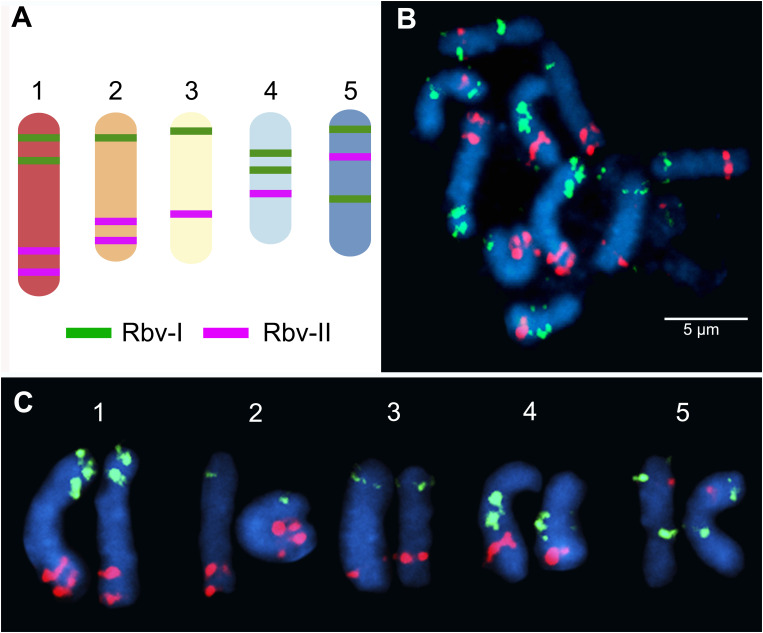
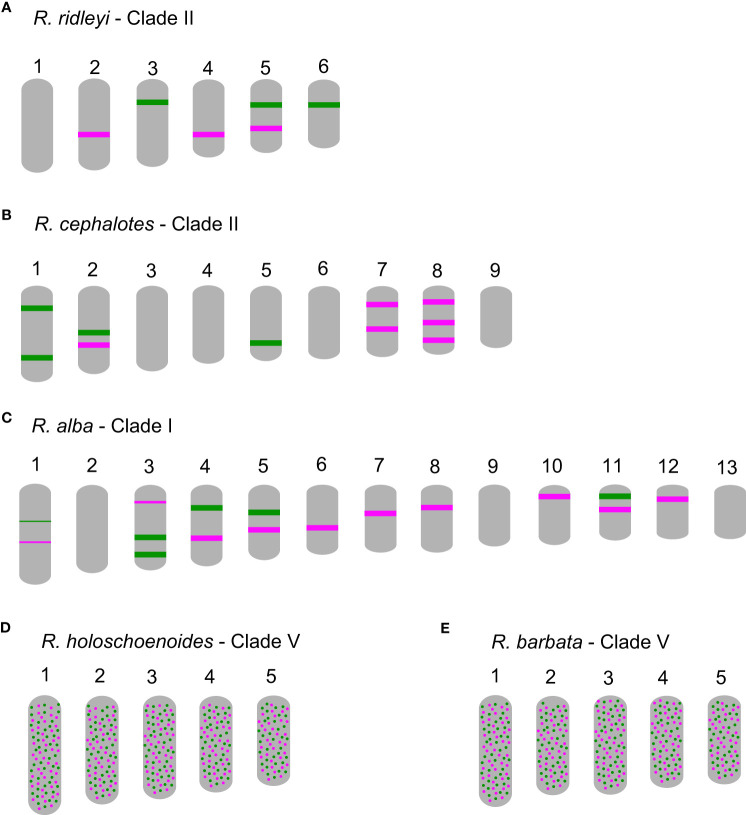
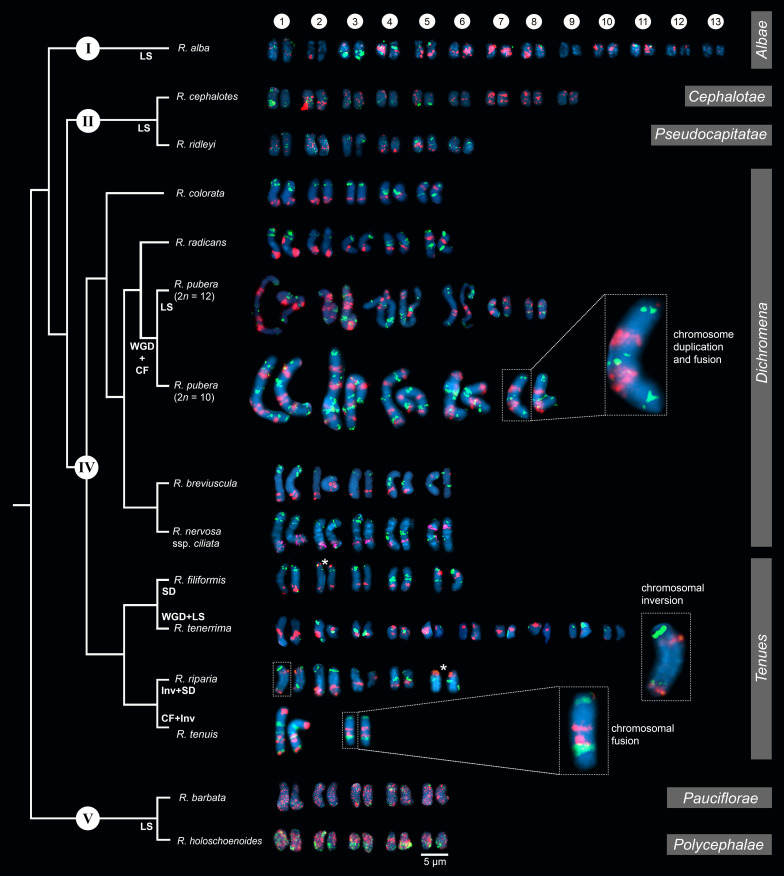
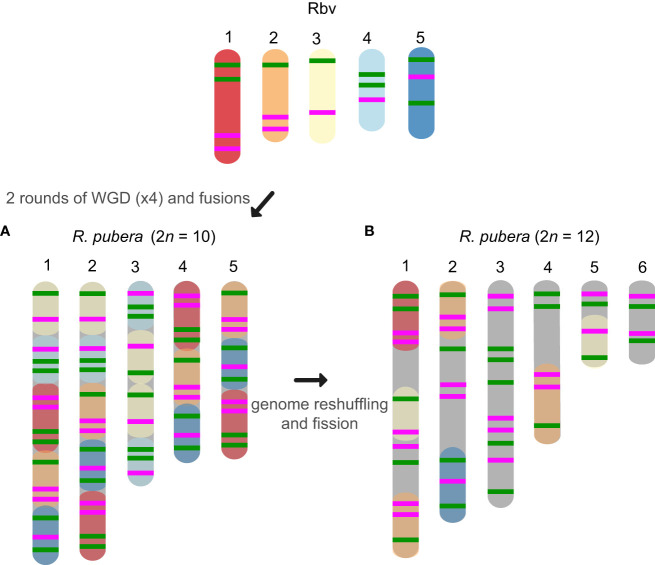
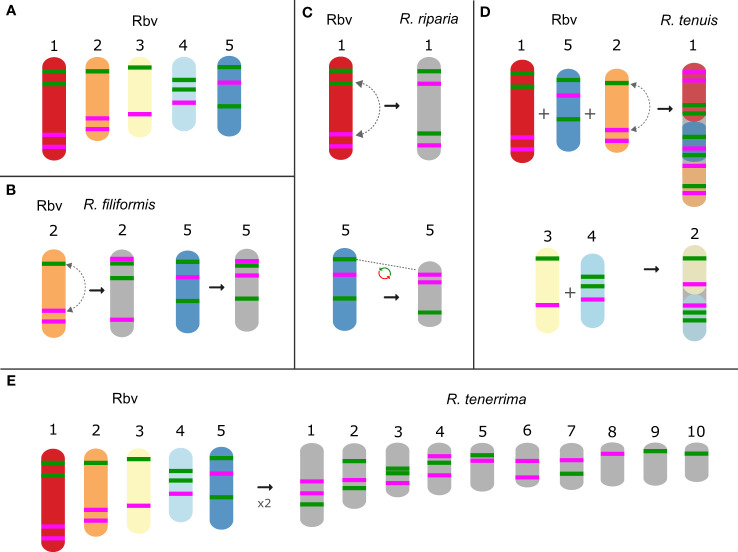
Holocentric karyotypes are assumed to rapidly evolve through chromosome fusions and fissions due to the diffuse nature of their centromeres. Here, we took advantage of the recent availability of a chromosome-scale reference genome for , a model species of this holocentric genus, and developed the first set of oligo-based barcode probes for a holocentric plant. These probes were applied to 13 additional species of the genus, aiming to investigate the evolutionary dynamics driving the karyotype evolution in . The two sets of probes were composed of 27,392 (green) and 23,968 (magenta) oligonucleotides (45-nt long), and generated 15 distinct FISH signals as a unique barcode pattern for the identification of all five chromosome pairs of the karyotype. Oligo-FISH comparative analyzes revealed different types of rearrangements, such as fusions, fissions, putative inversions and translocations, as well as genomic duplications among the analyzed species. Two rounds of whole genome duplication (WGD) were demonstrated in , but both analyzed accessions differed in the complex chain of events that gave rise to its large, structurally diploidized karyotypes with 2 = 10 or 12. Considering the phylogenetic relationships and divergence time of the species, the specificity and synteny of the probes were maintained up to species with a divergence time of ~25 My. However, karyotype divergence in more distant species hindered chromosome mapping and the inference of specific events. This barcoding system is a powerful tool to study chromosomal variations and genomic evolution in holocentric chromosomes of species.
由于全着丝粒染色体的着丝粒具有弥散性,因此推测其通过染色体融合和裂变快速进化。在此,我们利用了最近可获得的该全着丝粒属的模式物种的染色体水平参考基因组,并开发了第一套基于寡核苷酸的全着丝粒植物条形码探针。这些探针被应用于该属的另外13个物种,旨在研究驱动该属核型进化的进化动态。这两组探针由27,392个(绿色)和23,968个(品红色)寡核苷酸(45个核苷酸长)组成,并产生15个不同的荧光原位杂交信号,作为一种独特的条形码模式,用于识别该核型的所有五对染色体。寡核苷酸荧光原位杂交比较分析揭示了不同类型的重排,如融合、裂变、推定的倒位和易位,以及分析物种间的基因组重复。在该物种中证实了两轮全基因组复制(WGD),但两个分析的种质在导致其具有2n = 10或12的大型、结构二倍体化核型的复杂事件链上存在差异。考虑到物种的系统发育关系和分化时间,探针的特异性和同线性在分化时间约为2500万年的物种中仍得以保持。然而,更远缘物种的核型差异阻碍了染色体定位和特定事件的推断。这种条形码系统是研究该物种全着丝粒染色体的染色体变异和基因组进化的有力工具。